Cookware
Stainless Steel Saucepan
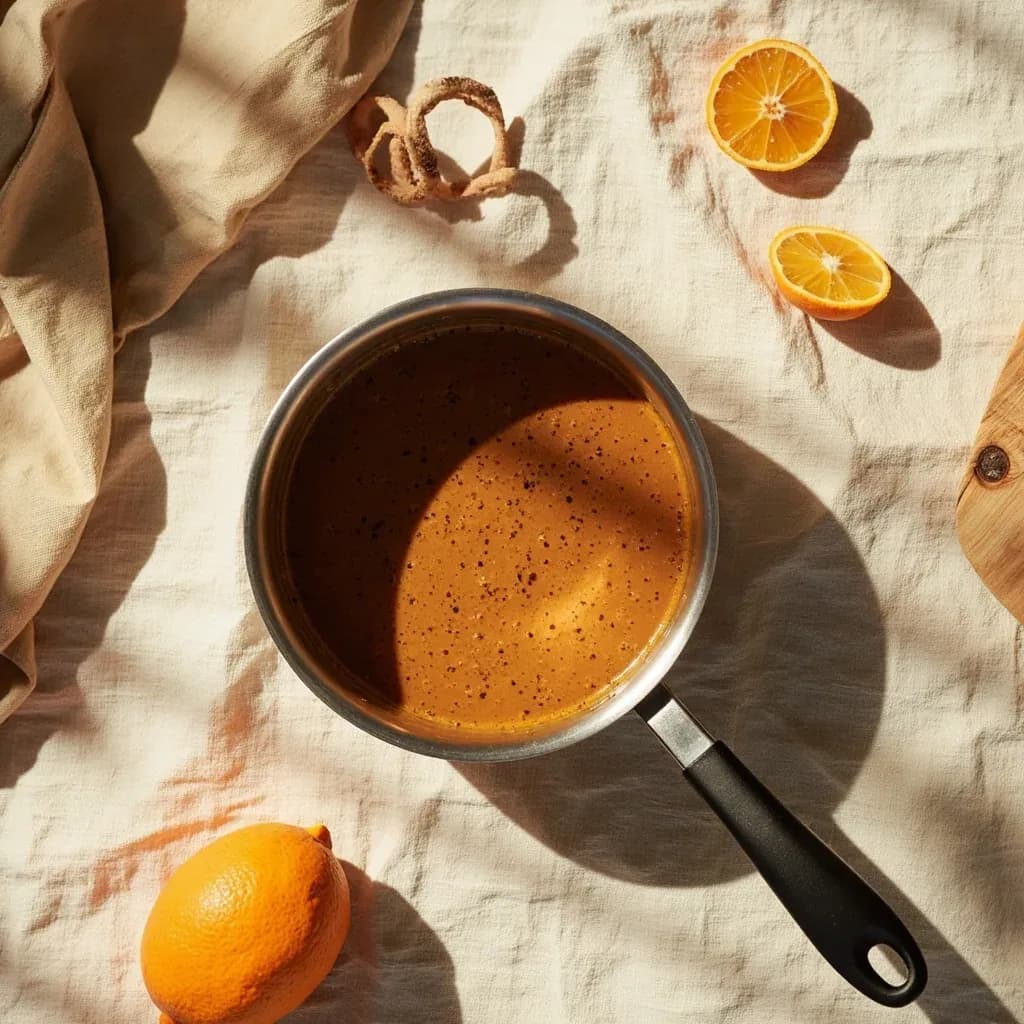
A nonreactive saucepan that browns fond for pan sauces and tolerates acidic reductions; the tri-ply base spreads heat evenly for custards, syrups, and grains.
The stainless steel saucepan is the workhorse of the home and professional kitchen — a deep, straight-sided pot with a single long handle (and often a small helper handle on 3-quart and up) designed for liquids, reductions, and small-batch cooking. What separates it from other pots is the cooking surface: austenitic 18/10 stainless is nonreactive, so it will not leach metallic flavors into acidic tomato, wine, or citrus reductions, nor will it discolor or curdle dairy the way bare aluminum or unlined copper can. In return for that chemical neutrality, you give up thermal conductivity: plain stainless conducts heat at roughly 15 W/m·K, about fifteen times less than aluminum, so nearly every quality saucepan is bonded to a more conductive metal — either as a disc sealed to the base or, in better pans, as a layer clad continuously through the base and up the sidewalls.
The geometry matters as much as the metal. A saucepan is taller than it is wide, with a height-to-diameter ratio of roughly 1.5 to 2:1, which limits evaporation and makes a tight lid do real work — moisture returns to the pot, flavors concentrate gradually, and grains like rice or farro cook in their own steam. That same height means the sidewalls contribute little during a sear; most of the heat is delivered through the base, and any browning happens in a ring the size of your burner.
The saucepan is best understood against its near neighbors. A sauté pan is wider and shallower, built for evaporation and tossing; a saucier has the saucepan's volume with curved walls that make whisking emulsions effortless; a stockpot is a scaled-up version for volumes above roughly 6 quarts. Most cooks reach for a saucepan when they need liquid held at a steady simmer or reduction, when acidity is in play, or when a pan sauce is on the horizon — because stainless browns fond more reliably than nonstick and lifts that fond more cleanly than cast iron, which is sensitive to acidic deglazes.
Alternatives
Types & varieties
Stainless body with an aluminum or copper disc bonded only to the base. Budget-friendly and durable, but heat travels up the sidewalls poorly, increasing the risk of scorching on larger sizes.
Stainless–aluminum–stainless layers extending from base to rim. The standard for even heating across the cooking surface; the construction that built All-Clad's reputation and defines most serious-cook recommendations.
Adds extra layers (e.g., Demeyere Atlantis, All-Clad D5) for greater heat retention and uniformity; heavier, slower to preheat, and noticeably more even on large burners.
Premium constructions such as Demeyere Industry that maximize thermal buffering; considerable weight and long preheat time in exchange for exceptional heat stability.
Copper instead of aluminum as the conductor for faster response to burner changes; traditional French preference, expensive, and typically heavier than aluminum-clad equivalents.
Related form with sloped, rounded walls; technically a different pan, but often chosen for the same jobs when whisking emulsions or stirring custards.
British term for a saucepan with two small loop handles and a lid; useful when both hands are needed for stirring or when the pan is heavy with stock.
Small (1–1.5 qt) with a pronounced pouring spout; practical for heating milk, preparing a single-portion reduction, or finishing a pan sauce for two.
Larger (5–8 qt) version, often still with a single long handle on home-cook lines; bridges saucepan and stockpot sizes for larger batches of grains, soups, and stocks.
Disc-Bottom vs. Fully-Clad: When the Upgrade Pays Off
Disc-bottom pans dominate the entry-level and restaurant-supply market because they are inexpensive, light, and durable. The aluminum or copper plate spreads heat across the base, but the stainless sidewalls stay relatively cool, so anything clinging to the walls — a custard, a starchy grain, a milk-based sauce — sees a temperature gradient and tends to scorch. On a 1- or 1.5-quart pan, the heat-radius issue is small enough that disc-bottom performs well. Beyond 2 quarts, the upgrade to fully-clad construction pays off quickly: heat travels up the walls as well as across the base, the pan responds to burner changes more predictably, and reductions cook evenly from edge to center.
- Choose disc-bottom for 1- and 1.5-quart sizes, tight budgets, and light-duty simmering.
- Choose fully-clad for 2-quart and up, especially if you cook custards, dairy sauces, or any reduction that clings to the walls.
- 5-ply and 7-ply are worth the weight only if you cook on a large burner and want maximum heat retention for long, steady simmers.
The Preheat Test
The single biggest mistake new stainless owners make is treating the pan like nonstick — adding food to a cold or under-heated pan, then cursing when it glues itself in. Stainless rewards a deliberate preheat: set the empty pan over medium heat for 1 to 2 minutes, flick a few drops of water onto the surface, and watch. When the drops bead up and skate across the metal in a single shimmering ball (the Leidenfrost effect), the pan is at the right temperature for fat and food. Too cold and the water spreads; too hot and it boils away instantly. Once you have the test in your hands, the pan's behavior stops being a mystery.
- Preheat over medium heat — high heat on stainless buys little speed and scorches quickly.
- Add fat only after the water-bead test passes; food should sizzle on contact, not sit in silence.
- Some sticking is normal before fond releases; scraping before the fond loosens on its own tears it into fragments rather than lifting it cleanly.
Care and Longevity
Stainless is among the most forgiving cookware to own. It is metal-utensil safe, dishwasher-safe, and indifferent to the acids and salts that destroy other metals. The rainbow patina and gray heat tint that develop with use are oxides — cosmetic, not damage — and lift with a paste of Bar Keeper's Friend or a baking-soda scrub. Pitting corrosion can occur in pans that sit with salted water for hours; the practical fix is to salt boiling water only after it has reached a rolling boil, and to empty and dry the pan promptly.
- Deglaze promptly after searing — the fond is the foundation of a pan sauce.
- Avoid thermal shock: never run cold water into a screaming-hot pan, especially on disc-bottom models, which can warp.
- Soak stuck-on residue in hot water with a splash of vinegar before scrubbing; it saves elbow grease and protects the polished surface.
Common uses
Tips & pitfalls
- Preheat the empty pan over medium heat for 1–2 minutes and use the water-bead (Leidenfrost) test before adding fat — this is the difference between fond that releases and fond that welds itself to the metal.
- Use medium heat, not high. Stainless is a poor conductor; cranking the burner scorches dairy, butter, and thickeners without appreciably speeding the cook.
- Don't crowd the pan. Too much food at once releases steam and prevents browning — work in batches when searing, then combine.
- Salt the water only after it reaches a rolling boil, not from a cold start. This minimizes pitting corrosion in hard-water conditions and avoids layering undissolved salt on the base.
- Deglaze while the pan is still hot. Add wine, stock, or citrus juice and scrape with a wooden spoon or flat-edged spatula — the fond is the entire foundation of a pan sauce.
- Match the pan diameter to the burner. A 2-quart saucepan on a 10-inch burner wastes heat around the edges and burns the center; a 4-quart on a 6-inch burner never gets hot enough to sear.
- Wet the pan walls with a wet pastry brush when making caramel or sugar syrup — the water dissolves stray crystals back into the batch and prevents a single seed from turning the whole pot grainy.
- For thick reductions and pan sauces, finish with a few tablespoons of cold butter swirled in off the heat. The butter emulsifies into the sauce, adds gloss, and rounds the flavor — a technique that depends on the nonreactive stainless surface for a clean finish.
Good to know
- Material
- Cooking surface is 18/10 austenitic stainless (18% chromium, 10% nickel); outer layer is usually 18/0 or magnetic ferritic stainless for induction compatibility.
- Common home sizes
- 1, 1.5, 2, 3, and 4 quarts; 6-quart exists for larger batches, beyond which the form transitions to a stockpot with two loop handles.
- Wall geometry
- Straight or slightly flared sides, taller than wide at roughly 1.5–2:1 height-to-diameter, which limits evaporation compared with a sauté pan.
- Conductivity gap
- Plain stainless conducts heat at about 15 W/m·K; aluminum (≈237) and copper (≈401) cores compensate.
- Reactivity
- Nonreactive with acidic ingredients (wine, tomato, citrus, vinegar) and with dairy — unlike bare aluminum or unlined copper.
- Induction compatibility
- Compatible only when the outer layer is magnetic; most modern bonded lines are induction-ready.
- Oven safety
- All-metal construction is typically oven-safe to 500–600°F; phenolic or silicone-coated handles lower the limit to about 350–400°F.
- Care
- Dishwasher-safe; heat tint and rainbow patina are cosmetic oxides, easily removed with Bar Keeper's Friend or a baking-soda paste.
Also called
stainless saucepan · steel saucepan · tri-ply saucepan
