Prep Tools
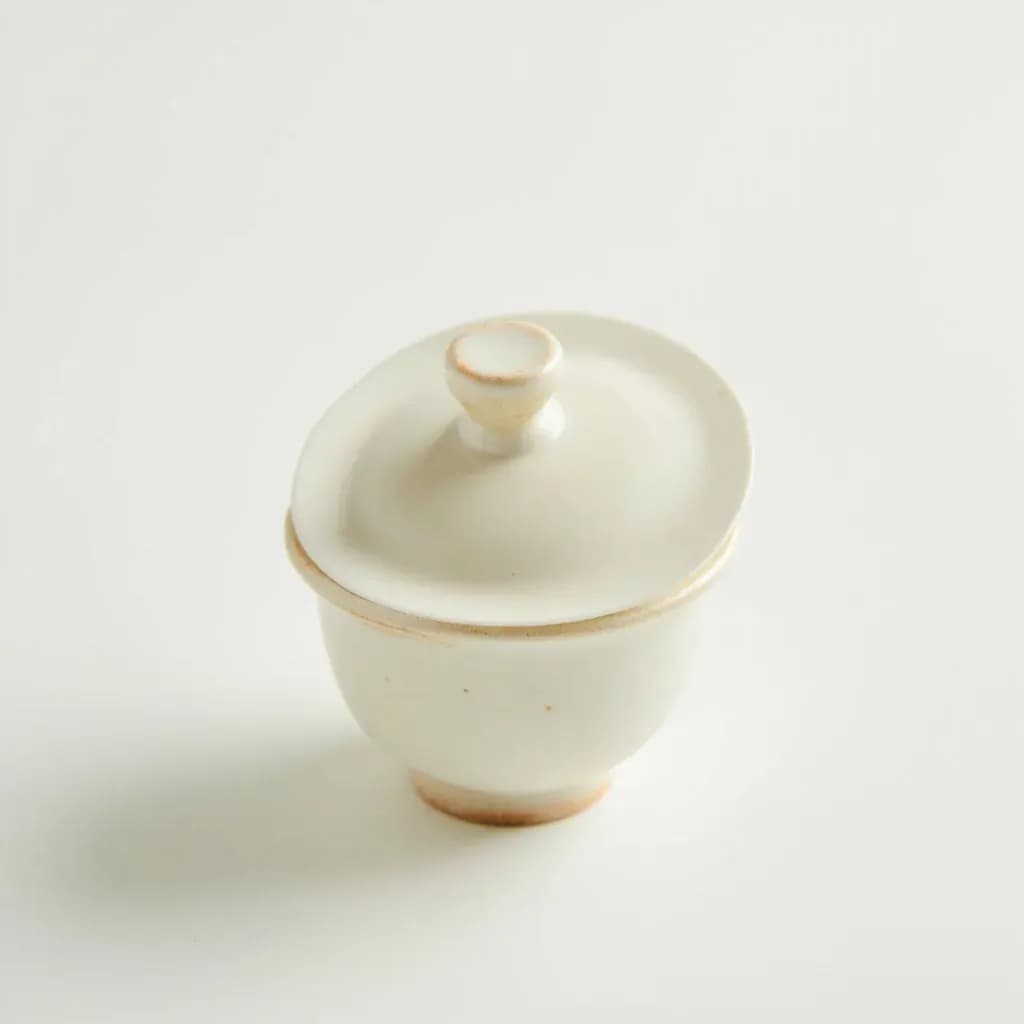
Tea Tasting Cup
A small standardized cup-and-bowl set used to brew and evaluate tea consistently.
A tea tasting set is a lidded brewing cup paired with a small bowl, used to steep a fixed dose of tea for a set time so leaves can be judged for aroma, color and flavor under repeatable conditions. Professional tasters and graders rely on it to compare lots side by side. Cobalt-blue tasting glasses are used elsewhere, as in olive oil tasting, to mask the sample's color.
The tea tasting cup is less a single piece of crockery than the centerpiece of a matched tasting set: a covered brewing pot, a wide shallow white cup on a saucer, and a separate bowl for inspecting the spent leaves. Every design choice serves the same job — letting a trained taster read the tea's color, aroma, body, and finish without the vessel getting in the way. Pure white porcelain (or bone china) on every interior surface is non-negotiable, because the eye is judging the liquor's true color against it; a tinted glaze or a transfer-printed pattern would distort that read.
The cup itself is deliberately wide and shallow, maximizing the surface area of the liquor so volatile aromatics collect in the headspace and rise to the nose. The set took its modern form in 19th-century London, alongside the formal tea auction warehouses and broking houses, and was eventually codified in ISO 3103, the international standard that defines the brewing ratio, infusion time, and water temperature used to compare teas across origins and seasons. For a buyer, blender, or serious enthusiast, the kit's real value is consistency: the same cup, the same pot, the same protocol, sample after sample, so that today's Keemun can be honestly compared to last month's.
Across traditions the kit takes several forms — a Western professional set with a separate spent-leaf bowl, the Chinese gaiwan that brews and presents in one vessel, a Japanese kyusu-and-yunomi pair, or modern crystal and glass cups that let light pass through the liquor. Each configuration shifts the emphasis of the evaluation, but all share the goal of stripping the vessel out of the taster's judgment.
Alternatives
Types & varieties
The classic Western professional set: covered brewing pot, white cup and saucer, and a spent-leaf bowl. Usually bone china, sold under names like 'International,' 'Congou,' or simply 'Tasting Set.'
The vessel configuration defined by the International Organization for Standardization for sensory analysis of tea — a roughly 310 ml white porcelain pot with a wide top, paired with a white cup and saucer.
Chinese lidded bowl (盖碗), typically 100–150 ml porcelain, with a saucer. The lid holds back leaves while pouring; the same vessel both brews and presents the tea.
Wider, deeper bowl (commonly 150–200 ml) used in North American specialty-tea cuppings, with a generous opening to read aroma and color. Often sold as a matched set on saucers.
Modern borosilicate or lead-crystal cups with wide bowls, used in contemporary tasting rooms where reading the liquor against transparent glass is preferred over porcelain.
A small kyusu (side-handle teapot) paired with small porcelain yunomi cups; the standard for appraising sencha, gyokuro, and matcha in Japanese competitions.
The Tasting Protocol (ISO 3103)
ISO 3103 was written so that a Keemun tasted in London and a Darjeeling tasted in Kolkata could be judged on equal terms. The standard is blunt by design: a single brewing ratio, a single infusion time, and freshly boiling water regardless of tea type. The point is not to make the best possible cup of any given tea, but to produce a liquor that is comparable across samples.
- Weigh 2 g of leaf per 100 ml of freshly boiling water; the pot is pre-warmed, the water is at full rolling boil.
- Infuse for 6 minutes, then pour through the spout strainer into the white cup.
- Inspect the liquor for color and clarity against the white porcelain and a neutral light source.
- Pour the spent leaves into the shallow bowl while still hot; assess tip content, leaf size, color change, and evenness of fermentation.
- Slurp a small portion (40–60 ml) briskly to aerate the liquor across the whole palate, then record aroma, body, astringency, and finish.
Why the Spent-Leaf Bowl Matters
In coffee tasting the spent grounds are discarded; in professional tea evaluation, the infused leaves are one of the most informative parts of the cup. The shallow bowl exists specifically to spread the wet leaves into a single layer for inspection.
- Size and intactness of leaf indicate grade — whole tips and unbroken leaves fetch higher prices than broken fannings.
- Color uniformity reveals evenness of withering, rolling, and (for oolong) oxidation; patchy leaves signal processing faults.
- Aroma of the hot wet leaf is often more diagnostic than aroma of the liquor, especially for origin and cultivar.
- Tip content (the pale golden buds) is a quick visual proxy for hand-plucked quality in many black and white teas.
Common uses
Tips & pitfalls
- Pre-warm every vessel with freshly boiled water and discard before brewing — a cold cup drops the liquor temperature and mutes both aroma and color.
- Insist on pure white, undecorated porcelain on every interior surface. Patterns, off-white glazes, or colored interiors distort the read of liquor color.
- When tasting several samples in a row, pour a small amount of the next tea into the cup, swirl, and discard to rinse the rim and reset the nose.
- Slurp the tea firmly to aerate it and spread it across the whole palate; this is professional cupping protocol, not impolite table manners.
- Taste blind where possible — number the cups and reveal identity afterward. Expectation bias distorts aroma and body perception more than most tasters realize.
- Limit a serious session to 6–8 samples; palate fatigue sets in fast. The only acceptable cleansers are hot water and plain, unsalted water crackers or bread.
- Hold the cup against a white saucer, a piece of white paper, or a color reference card to judge 'brisk,' 'bright,' 'colory,' or 'dull' liquor accurately.
- Inspect the spent leaves while they are still hot — the aroma released as they cool is one of the most useful indicators of origin, leaf grade, and processing faults.
- Keep the room neutral: no perfume, no cooking smells, no coffee, and a consistent daylight or daylight-equivalent light source for color assessment.
- Never wash tasting vessels with scented detergent; rinse in plain hot water and air-dry upside down to avoid residue or lint tainting the next sample.
Good to know
- Cup capacity
- Approximately 150 ml (5 fl oz), though sets range from 100 to 180 ml
- Material
- Pure white porcelain or bone china, undecorated on the interior
- Cup shape
- Wide, shallow bowl on a low foot, with a matching saucer — the wide opening maximizes aroma release and color reading
- Set components
- Covered brewing pot, cup and saucer, and a separate shallow spent-leaf bowl
- Brewing pot
- Porcelain, roughly 250–310 ml, with a perforated strainer set into the spout to filter leaves as the liquor is poured
- Standard reference
- ISO 3103, the international standard for preparing tea for sensory evaluation
- ISO 3103 brew ratio
- 2 g of tea per 100 ml of water, infused for 6 minutes in freshly boiling water
- Cleaning
- Hot water only — no scented detergent; residue taints subsequent samples
Also called
Cobalt-Blue Tasting Glass · Tea Tasting Set · Cupping Cup
Related

Peeler
Swift blade for stripping skin off fruit and vegetables

Grater
Sharp-toothed surface for shredding cheese and vegetables

Microplane
Ultra-fine rasp for citrus zest, garlic, and hard cheese

Mixing Bowl
All-purpose bowl for combining, whisking, and tossing

Whisk
Looped wires that beat air into eggs, cream, and sauces

Spatula
Flat blade for flipping, lifting, and scraping

Slotted Spoon
Pierced spoon that lifts solids and drains the liquid behind

Wooden Spoon
Gentle, heat-friendly spoon for stirring anything