Prep Tools
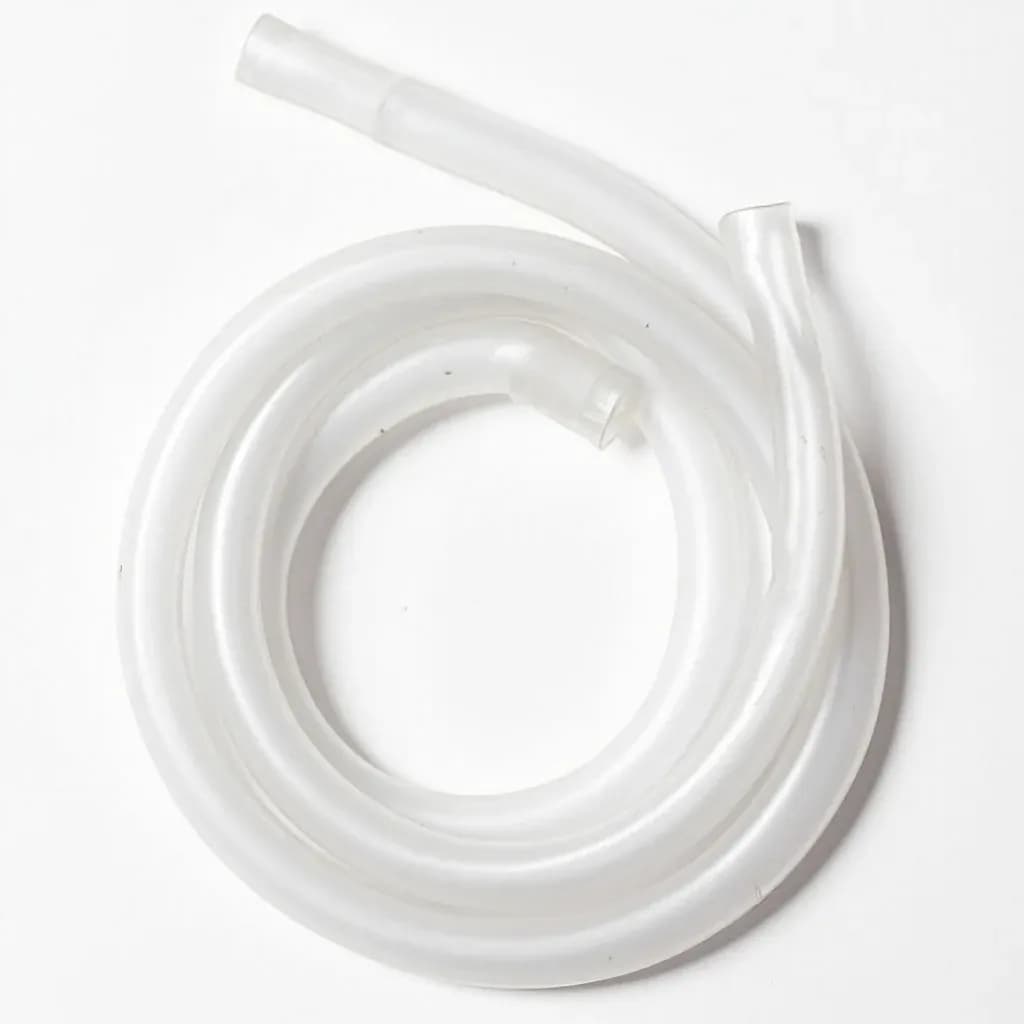
Transfer Hose / Tubing
Food-grade flexible tubing for siphoning and moving liquids between vessels without splashing.
Transfer hose is flexible food-grade tubing, usually clear silicone or vinyl, used to siphon and move liquids cleanly from one vessel to another. Brewers and winemakers attach it to a racking cane or pump to draw beer, wine, or must off its sediment with minimal oxygen pickup. Being clear lets the operator watch the flow and stop before sediment is sucked up.
A transfer hose is food-grade flexible tubing used to move liquids between vessels by gravity siphon or pump without pouring, splashing, or aerating. It sounds unglamorous, but it is the quiet workhorse of any kitchen, brewery, or winery that handles more than a few liters of liquid at a time — the difference between ladling stock pot by pot and cleanly racking five gallons of wine off its lees in ten minutes. The category spans everything from a short 1/4 in silicone line on a sous-vide circulator to a 25 ft, 3/4 in braided hose running from a boil kettle to a chiller in a microbrewery.
The right pick is dictated by four intersecting constraints: temperature, chemical exposure, transparency, and pressure. Clear PVC is cheap and lets you watch flow but degrades in hot liquids — softening, clouding, and leaching plasticizers; silicone tolerates heat but costs more and is usually translucent; braided PTFE is nearly indestructible but priced for professional use. Match the tubing to the job, and it will last for years; mismatch it, and you will see clouding, cracking, or leaching long before you expect to.
Alternatives
Types & varieties
Flexible, heat-resistant, usually translucent; the standard for hot liquids, sous-vide circulator returns, and steam-side lines. Tolerates boiling and dishwasher cleaning.
Inexpensive and very transparent so you can watch flow, but limited to cold or cool liquids — heat clouds it and can leach plasticizers.
Saint-Gobain brand, NSF 51/61 listed, crystal-clear with longer service life than generic PVC; common in breweries and coffee bars.
Resists oils, solvents, and higher temperatures; used for flavoring oils, alcohol concentrates, and cleaning chemistry where standard PVC would swell.
Rigid, low-cost, sold by the coil; suits simple gravity drains, aquarium-style applications, and RO water lines.
Most chemically inert and heat-tolerant option; the stainless-braided version handles pump pressure and high heat in distilleries and commercial kitchens.
Multi-layer construction with polyester or stainless braid; required for pump-out applications such as espresso drains or commercial sous-vide baths.
Quick-disconnect transfer lines sized 1/2 in–2 in for bulk dairy, oil, and syrup handling in production environments.
Short rigid wand with a spring-loaded bottom valve that shuts off flow on contact with the bottle floor; built for carbonated beverage bottling.
Rigid tube with attached transfer hose that creates a self-priming siphon after a few plunger pumps; the standard racking tool in home winemaking and brewing.
Choosing the right tubing
Start with three questions: How hot is the liquid? How far does it have to travel? Does it need to be visible? Cold racking of a carboy calls for clear 3/8 in PVC on an auto-siphon; the same task with hot stock from a kettle calls for silicone. Diameter matters more than people expect — 1/4 in lines dribble, 1/2 in lines lose prime easily, and 3/8 in is the sweet spot for most 5–6 gallon transfers.
- Cold liquids, short runs, visual monitoring: clear PVC or Tygon B-44-3.
- Hot liquids (stock, syrup, glaze, sous-vide return): food-grade silicone.
- Oils, solvents, alcohol concentrates, cleaning chemistry: Tygon FKM or PTFE.
- Pump pressure or commercial hot-syrup lines: stainless-overbraided PTFE.
- Bulk dairy or production transfer: CAMLOCK-coupled reinforced hose, 1/2 in–2 in.
Hardware at the ends
Tubing is only half the system — the racking cane, bottling wand, hose clamp, or quick-disconnect at each end determines how cleanly the transfer actually runs. A plain barbed fitting without a clamp is fine for gravity siphons under a few psi; anything from a pump needs a worm-gear or Oetiker clamp, and recurring connections are worth a push-to-connect fitting or a CAMLOCK coupling. Spec the connectors and the sanitizer in the same step as the hose itself.
- Racking cane / auto-siphon: the rigid inlet that lets you draw clear liquid off the top of sediment.
- Bottling wand: spring-loaded valve that shuts off at the bottle floor to limit foam and oxygen pickup.
- Hose clamp: worm-gear or Oetiker on any plain barbed fitting under pump pressure; push-fit alone is not reliable above a few psi.
- Quick-disconnect / CAMLOCK: for repeated hookups in production kitchens and dairies.
- Sanitizer soak: dedicated bucket and lid — never the same one you use for cleaning the floor.
Common uses
Tips & pitfalls
- Confirm the tubing is rated FDA 21 CFR food-contact or NSF 51/61 — aquarium hose and hardware-store vinyl look identical but are not food-grade.
- Match inner diameter to the job: too narrow and you wait forever; too wide and a gravity siphon loses prime. 3/8 in is the sweet spot for racking 5–6 gallon carboys.
- Prime the line before you start — fill it with liquid or submerge the inlet — to avoid pushing air through hot stock or carbonated beverage.
- Keep the receiving vessel lower than the source. Once primed, a gravity siphon is self-sustaining only as long as that height difference holds.
- Sanitize PVC and most Tygon cold; keep soak temperatures under about 140 °F (60 °C) or the tubing clouds and can leach plasticizers. Silicone and PTFE can be boiled or run through a dishwasher.
- Use a hose clamp on any plain barbed fitting under pump pressure; push-fit alone is not reliable above a few psi.
- For carbonated transfers, seat the bottling wand on the bottle floor and release as it fills to minimize foam — the spring-loaded valve is worth the few extra dollars.
- Replace tubing that has gone cloudy, sticky, cracked, or developed off-odors; clear PVC in particular degrades over months of repeated use, and a degraded line is a flavor and food-safety risk.
- Label each hose by use (oil, dairy, sanitizer, beverage) and dedicate it — cross-use is the fastest way to transfer flavors or contaminants between batches.
Good to know
- Category
- Prep tool / liquid-handling accessory
- Primary materials
- Food-grade silicone, clear food-grade PVC (vinyl), Tygon-brand specialty tubing (B-44 PVC, FKM fluoroelastomer), food-grade polyethylene, PTFE (Teflon) with stainless overbraid
- Typical inner diameter
- 1/4 in (6 mm) for bottling wands; 3/8 in (10 mm) and 1/2 in (13 mm) for racking; 3/4 in–1 in (19–25 mm) for bulk transfer
- Length range
- 3 ft (0.9 m) for bottling wands to 10–25 ft (3–7.6 m) for carboy-to-keg transfer
- Temperature limits
- Silicone roughly -60 °F to +500 °F (-51 °C to +260 °C); clear food PVC about 25 °F to 150 °F (-4 °C to +65 °C); braided PTFE handles boiling and steam
- Pressure rating
- Light-wall silicone/PVC is gravity/siphon rated only; reinforced or braided hose handles pump-side pressure (commonly 50–150 psi)
- Certifications to look for
- FDA 21 CFR food-contact compliance; NSF/ANSI 51 (food equipment) or NSF/ANSI 61 (drinking water); 3-A Sanitary for dairy
- Sterilization
- Silicone and PTFE tolerate boiling and dilute bleach/Star-San; PVC is cold-sanitize only (under ~140 °F / 60 °C) to avoid clouding and plasticizer leaching
Also called
Food-Grade Siphon Tubing · Food-Grade Transfer Tubing · Siphon Tubing · racking tube
Related

Peeler
Swift blade for stripping skin off fruit and vegetables

Grater
Sharp-toothed surface for shredding cheese and vegetables

Microplane
Ultra-fine rasp for citrus zest, garlic, and hard cheese

Mixing Bowl
All-purpose bowl for combining, whisking, and tossing

Whisk
Looped wires that beat air into eggs, cream, and sauces

Spatula
Flat blade for flipping, lifting, and scraping

Slotted Spoon
Pierced spoon that lifts solids and drains the liquid behind

Wooden Spoon
Gentle, heat-friendly spoon for stirring anything