Prep Tools
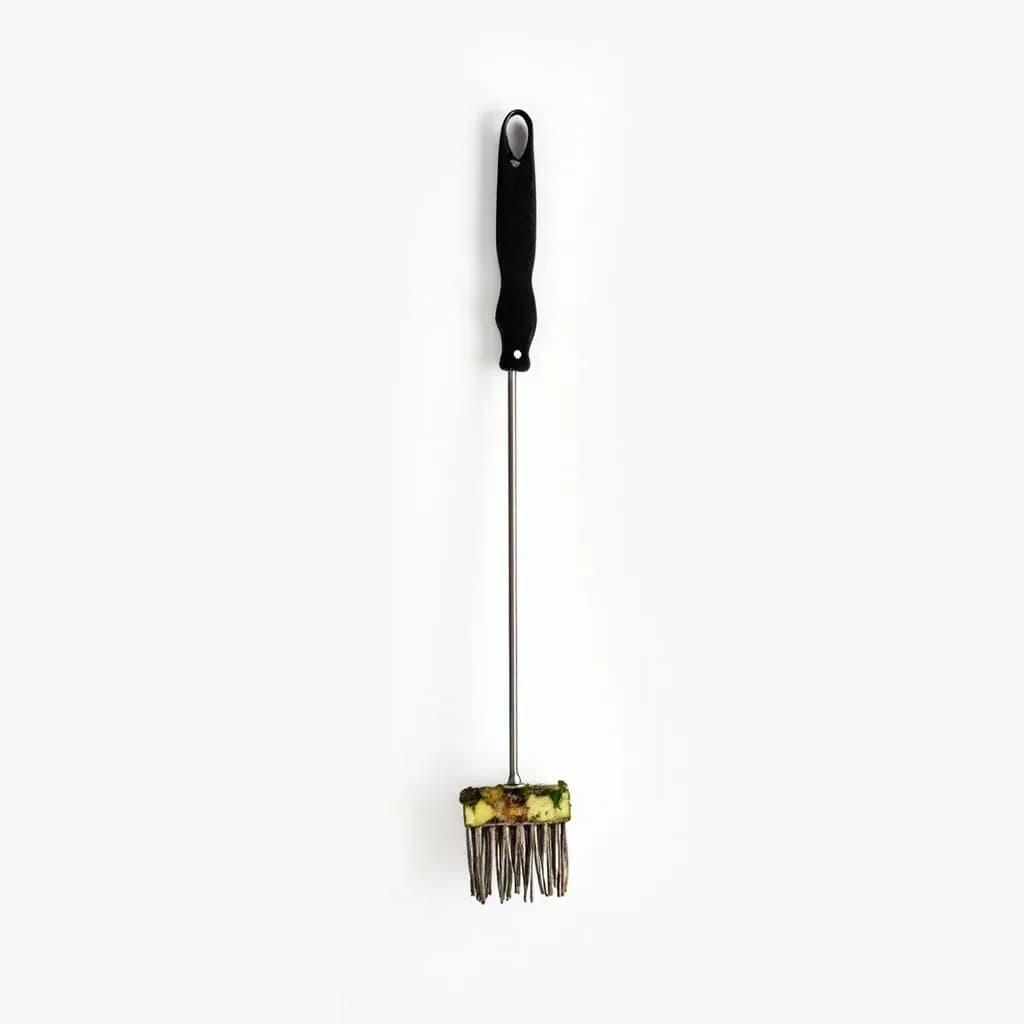
Grill Grate Brush
A stiff-bristle brush for scraping burnt residue off hot grill grates before and after cooking.
A grill grate brush has stiff wire or coiled-steel bristles set on a long handle for scrubbing charred food and grease from grill bars. It is used while the grate is still warm so residue lifts off easily, keeping food from sticking and reducing flare-ups. Bristle-free coil or wood-scraper versions are popular to avoid loose wire bristles ending up in food.
A grill grate brush is a handheld abrasive tool designed to mechanically dislodge polymerized fat and carbonized food from metal cooking grates. The basic design—a cluster of stiff bristles mounted to a long handle—dates from the mid-twentieth century, when backyard grilling became routine domestic cooking in America, and the tool has remained largely unchanged because the principle behind it is sound: heat softens cooked-on residue, and a stiff metal bristle shears it off the metal surface. The long handle (usually 16 to 20 inches) keeps the cook's hand well back from radiant heat, while the bristle block is sized to cover common consumer grate dimensions in a few passes.
What separates a serviceable brush from a poor one is bristle integrity and handle balance. Stainless steel wire is the standard because it is hard enough to cut through heavy carbon yet corrosion-resistant enough to survive repeated exposure to heat, grease, and outdoor storage. Brass and nylon fill softer niches—porcelain-enamel grates, nonstick coatings, and the like—where steel would scratch or chip the finish. Choosing a brush is therefore as much a question about the surface you are cleaning as the residue you are removing.
A real safety concern accompanies wire brushes. Bristles fatigue, fracture, and shed over time; when that happens, a tiny steel sliver can transfer to food and, in rare but documented cases, be ingested. Both the U.S. FDA and Health Canada have published consumer advisories on the issue, which is why many serious grillers now keep a bristle-free alternative on hand—a chain-mail scrubber, a pumice grill brick, or even a halved onion rubbed across a hot grate with tongs—as a backup for high-traffic cooks or when serving children.
Alternatives
Types & varieties
The standard heavy-duty brush for cast iron and stainless steel grates; the most common style sold
Softer than steel; the correct choice for porcelain-enamel grates where steel would scratch or chip the coating
Non-abrasive option for nonstick or delicate coatings; weaker against heavy carbon buildup
Larger contact area that covers broad grates in fewer passes; useful on gas grills with wide cooking surfaces
Pairs wire bristles with a flat stamped-steel scraper edge for tackling caked-on residue in one tool
Interlocking stainless steel rings forming a flexible pad; a bristle-free alternative favored in competition barbecue circles
Dense compressed-pumice block rubbed across the grate; no wire involved and very effective on hot grates
Stamped-steel or wood-handled scraper with no bristles, used cold or warm for heavy carbon
Extended or angled handles for leverage and reach on large kamado or barrel smokers
The case for heating the grill first
The most common error cooks make with a grill brush is using it cold. Polymerized fat—the sticky, varnish-like film that builds up on a well-used grate—softens dramatically once the grate climbs above roughly 400°F. Brushing a cold or barely warm grate is hard work and rarely gets the surface truly clean; brushing a properly preheated grate turns the same job into a few quick passes. The traditional pitmaster approach is to fire the grill, close the lid, let it come up to temperature, then brush before laying down the first round of food. Residue that does not lift on the first pass will carbonize further as the cook proceeds and can be addressed afterward.
- Preheat to 400–500°F (200–260°C) before brushing; the residue will release in a fine gray dust
- Brush in the direction of the grate bars, not across them, to reduce bristle fatigue
- Follow brushing with a light wipe of high-smoke-point oil on a paper towel held with tongs, which seasons the grate and helps prevent rust on cast iron
Bristle-free alternatives worth knowing
Because of the documented risk of bristle ingestion, several alternatives have moved from fringe to mainstream. None require a wire brush, and several work as well or better on heavy buildup.
- Chain-mail scrubber: a square of welded stainless rings, used with a glove or tongs; extremely effective and sheds no bristles
- Grill brick: a block of compressed pumice rubbed across a hot grate; cheap, effective, and consumed slowly over many cooks
- Half-onion method: skewer or tong a halved raw onion, cut side down, and rub it across a hot grate; the moisture helps lift residue while imparting a faint sweet note
- Aluminum foil ball: crumple heavy-duty foil into a tight ball, grip it with tongs, and scrub the hot grate; the field-expedient option when nothing else is available
Bristle inspection and replacement
A wire brush should be inspected before every cook. The test is simple: draw the brush firmly across a white cloth or the palm of your hand. If even one bristle detaches, retire the brush immediately. Frayed, splayed, or shortened bristles are a sign of impending failure, not a sign that the brush is 'well broken in.' Most brushes last one to two grilling seasons of regular use; heavy users, or those who brush at very high temperatures, will replace more often.
Common uses
Tips & pitfalls
- Heat the grill to 400–500°F (200–260°C) before brushing; residue carbonizes and releases far more easily than when the grate is cold
- Inspect bristles by drawing the brush across a white cloth or your palm before every cook; retire the brush the moment any wire loosens
- Never use stainless steel brushes on porcelain-enamel or ceramic-coated grates; use brass or nylon instead to avoid chipping the finish
- Brush along the length of the grate bars rather than across them; cross-grain brushing accelerates bristle breakage
- Follow brushing with a thin coat of high-smoke-point oil on the warm grate to season it and inhibit rust on cast iron
- Do not soak a brush with a wooden handle; towel-dry the head and store the tool indoors so the bristles do not corrode
- If bristles are bent, splayed, or visibly shorter than when new, replace the brush without delay
- Keep a bristle-free alternative (chain-mail, grill brick, or foil ball) on hand for cooks where children are being served
- Never brush a grill that is still actively flaming; let the flames die down and the coals ash over before scraping
Good to know
- Primary function
- Scraping carbonized food residue and polymerized grease from metal grill grates before and after cooking
- Typical handle length
- Approximately 16–20 inches (40–50 cm) to keep the hand well back from radiant heat
- Standard bristle material
- Stainless steel wire, with brass used for softer applications
- Brush head width
- Generally 3–8 inches (8–20 cm) to match common grate bar spacing
- Compatible surfaces
- Stainless steel, cast iron, and porcelain-coated grates (with appropriate bristle choice)
- Best used on
- Warm grates at roughly 400–500°F (200–260°C), after flames have subsided
- Lifespan
- Typically one to two grilling seasons of regular use before bristles fatigue
- Safety note
- Bristle ingestion is a documented hazard; the U.S. FDA and Health Canada have issued consumer advisories
Also called
Grill Brush · BBQ Brush · Barbecue Grill Brush
Related

Peeler
Swift blade for stripping skin off fruit and vegetables

Grater
Sharp-toothed surface for shredding cheese and vegetables

Microplane
Ultra-fine rasp for citrus zest, garlic, and hard cheese

Mixing Bowl
All-purpose bowl for combining, whisking, and tossing

Whisk
Looped wires that beat air into eggs, cream, and sauces

Spatula
Flat blade for flipping, lifting, and scraping

Slotted Spoon
Pierced spoon that lifts solids and drains the liquid behind

Wooden Spoon
Gentle, heat-friendly spoon for stirring anything