Prep Tools
Woven Basket
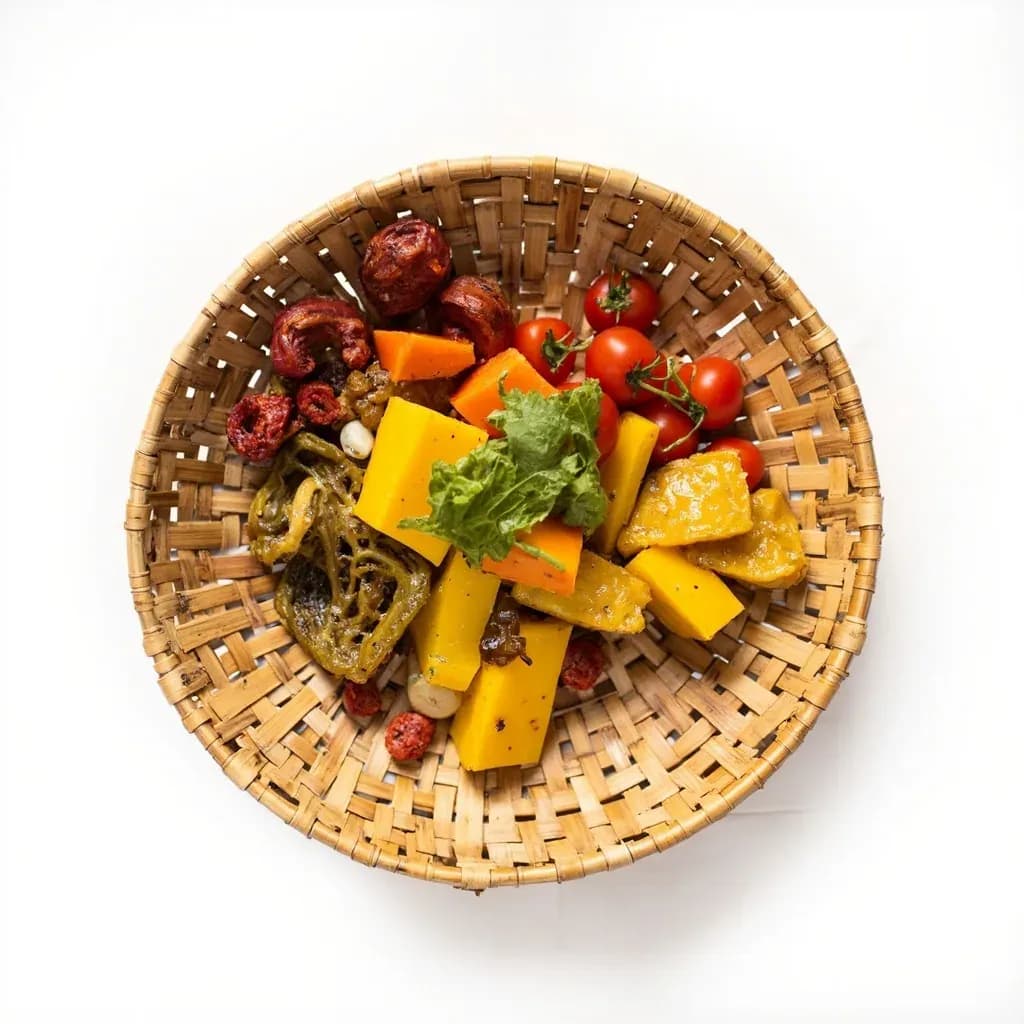
A handwoven basket used to store, serve, steam, or cover food in many traditional kitchens.
A woven basket is a multipurpose container of plaited bamboo, grass, or palm used to hold produce, carry market goods, and present communal dishes. In Ethiopian kitchens a tall mesob serves injera and stews, while bamboo cones steam sticky rice and mesh domes cover food to keep insects off. Breathable weave lets air circulate, which helps keep vegetables and bread from sweating compared with sealed plastic.
A woven basket is a container made by interlacing strips of plant fiber — bamboo, rattan, willow, palm, seagrass, straw, reed, or split cane — into a rigid, breathable vessel. Among the oldest tools in any kitchen, baskets predate fired pottery in many cultures and survive today because they solve three problems at once: they hold their shape under load, they let air and moisture pass through the walls, and they are food-safe as long as they stay dry. That combination is hard to replicate with metal or plastic, which is why woven forms persist in cuisines as different as Chinese dim sum, French country baking, and Ethiopian home cooking.
In the modern kitchen the basket shows up in three main jobs. It steams food over boiling water, where the lid traps steam and the slatted base lets the food sit above the liquid rather than in it. It proofs bread dough, where the coiled or ribbed interior shapes the loaf, wicks surface moisture, and leaves a signature pattern on the crust. And it stores produce such as onions, potatoes, and garlic in a cool pantry, where constant airflow extends shelf life and prevents the condensation that rots roots in sealed bins.
The single principle that governs every use is dryness. Baskets are not waterproof, not dishwasher-safe, and not improved by long soaks. Treat them like wooden tools: wipe, air-dry thoroughly, and store in moving air. Do that, and a good bamboo steamer will run for years of weekly service; a willow storage basket can last a generation.
Alternatives
Types & varieties
Stackable Asian steamer (dim sum style, Korean jogi/jjok) with two tiers and a domed lid, set over a wok or pot of simmering water.
Spiral-coiled cane proofing basket for bread dough, often lined with linen; comes round, oval, or long, sometimes ridged to imprint the loaf.
Open-weave European basket for onions, potatoes, garlic, and shallots; the airflow it provides is the reason it works.
Southeast Asian flat or basket-shaped steamer (Thai, Indonesian) for sticky rice, fish, and small cakes like puto and kuih.
Ethiopian lidded bowl-basket of dyed and natural fibers, used to serve and store injera and shared meals.
Round, shallow Chinese basket with a handle, used to assemble and hold bamboo-leaf-wrapped sticky rice dumplings.
Lined Mexican palm or willow basket that keeps fresh tortillas warm at the table.
Small open basket with a flat back and wrist loop, designed to hang free while harvesting berries, mushrooms, or herbs.
Very open flat weave for rinsing greens, draining mushrooms, or sifting; the Japanese mi-zaru is a familiar modern example.
Lidded wicker basket with a handle, lined with fabric, used to transport and serve bread, cheese, and cold foods.
Matching weave to job
The right basket for the task is mostly a question of weave density, not aesthetics.
- Open weave (willow, rattan, slotted bamboo): choose for produce storage and for steaming, where steam must rise freely and air must reach stored roots.
- Tight weave (split-bamboo strainers, coiled bannetons): choose for holding wet dough, draining small berries or herbs, and sifting.
- Ridged or corrugated weave (long bannetons, some bamboo steamers): choose when you want the basket itself to mark the food — a fluted baguette, a striped steamed bun.
Baskets for bread baking
A banneton does two things at once during the final proof: it holds the dough's shape as it relaxes, and it pulls a thin layer of moisture out of the surface so the crust sets. That wicking action is what gives a country loaf its taut, lightly patterned skin and helps it release cleanly from the basket onto a peel or Dutch oven.
- Dust the basket generously with rice flour, or use a well-floured linen couche, for high-hydration or sticky doughs — wheat flour alone will glue the dough in.
- Spritz the basket with water rather than soaking it; bannetons like moderate humidity, not saturation.
- Set the seam of shaped dough facing up in the basket so the surface tension pulls taut against the coil pattern.
- Cold-retard the proofed loaf in the basket, then turn it straight onto a preheated stone or Dutch oven to bake.
Baskets for steaming
Steam cooking in a bamboo basket is gentler than boiling because the food never touches the liquid, and the bamboo lid absorbs condensation and sheds it back down the sides rather than dripping onto the food. The basket itself takes on a little moisture and flavor over time, which seasoned cooks regard as an asset rather than a flaw.
- Line the basket with cabbage or lettuce leaves, perforated parchment, or cheesecloth to prevent sticking and to keep the weave clean.
- Stack two tiers at once when cooking for a crowd; rotate the top tier halfway through so everything cooks evenly.
- Add aromatics — ginger, scallion, citrus peel — directly to the water below for a scented steam.
- Wipe the basket dry between uses and stand it on its side so air moves through both tiers; a closed, damp basket will sour.
Common uses
Tips & pitfalls
- Keep baskets dry between uses — trapped moisture is the single biggest cause of mold, mustiness, splitting, and warped weave.
- Never put a woven basket in the dishwasher; the prolonged heat and water will delaminate the fibers and undo the joinery.
- Line a banneton with a well-floured linen couche or rice-flour-dusted cloth to release sticky, high-hydration doughs cleanly.
- For steaming, line baskets with cabbage leaves, perforated parchment, or cheesecloth to prevent sticking and extend the basket's life.
- Choose open weave for produce storage (airflow matters) and tighter weave for dough, draining, and fine herbs.
- Sun-dry baskets occasionally and brush off loose debris; this also discourages pantry moths and mildew.
- If using an antique or market-found basket for food, line it — older materials may have been treated with arsenic, lead paint, or harsh dyes.
- Oil a banneton's interior very lightly with food-grade rice bran or coconut oil from time to time to keep the cane supple and prevent cracking.
Good to know
- Materials
- Bamboo, rattan, willow, palm leaf, seagrass, straw, reed, and split wood — all natural, renewable plant fibers.
- Origin
- Woven vessels date back over 10,000 years and appear independently in nearly every traditional cuisine.
- Typical sizes
- Picking baskets 4–6 in (10–15 cm); bamboo steamers 10–12 in (25–30 cm); root-vegetable storage baskets 14–20 in (35–50 cm).
- Steaming capacity
- A 10 in (25 cm) bamboo steamer holds 8–12 standard dumplings or one whole small fish.
- Banneton sizing
- Round (boule) baskets 8–10 in (20–25 cm); oval (batard) 10–14 in (25–35 cm); long baguette forms 26–30 in (66–76 cm) with corrugations.
- Weave density
- Open weaves favor airflow for produce storage; tight weaves suit sifting, draining, and retaining wet dough.
- Care
- Never soak; never machine wash. Wipe with a dry or barely damp cloth and air-dry thoroughly to prevent mold and warping.
- Food safety
- Vintage green baskets were sometimes preserved with arsenic-based pesticides; older painted baskets may carry lead. Line with cloth if provenance is uncertain.
- Lifespan
- A quality bamboo steamer lasts 3–5 years of regular use; willow storage baskets can last decades.
Also called
Mesob (Woven Serving Basket) · Mesob · Sefed · Bamboo Steaming Cone (Kukusan Bambu) · Mesh Food Cover · Food Cover
Related

Peeler
Swift blade for stripping skin off fruit and vegetables

Grater
Sharp-toothed surface for shredding cheese and vegetables

Microplane
Ultra-fine rasp for citrus zest, garlic, and hard cheese

Mixing Bowl
All-purpose bowl for combining, whisking, and tossing

Whisk
Looped wires that beat air into eggs, cream, and sauces

Spatula
Flat blade for flipping, lifting, and scraping

Slotted Spoon
Pierced spoon that lifts solids and drains the liquid behind

Wooden Spoon
Gentle, heat-friendly spoon for stirring anything