Transform & Preserve
Ash Coating
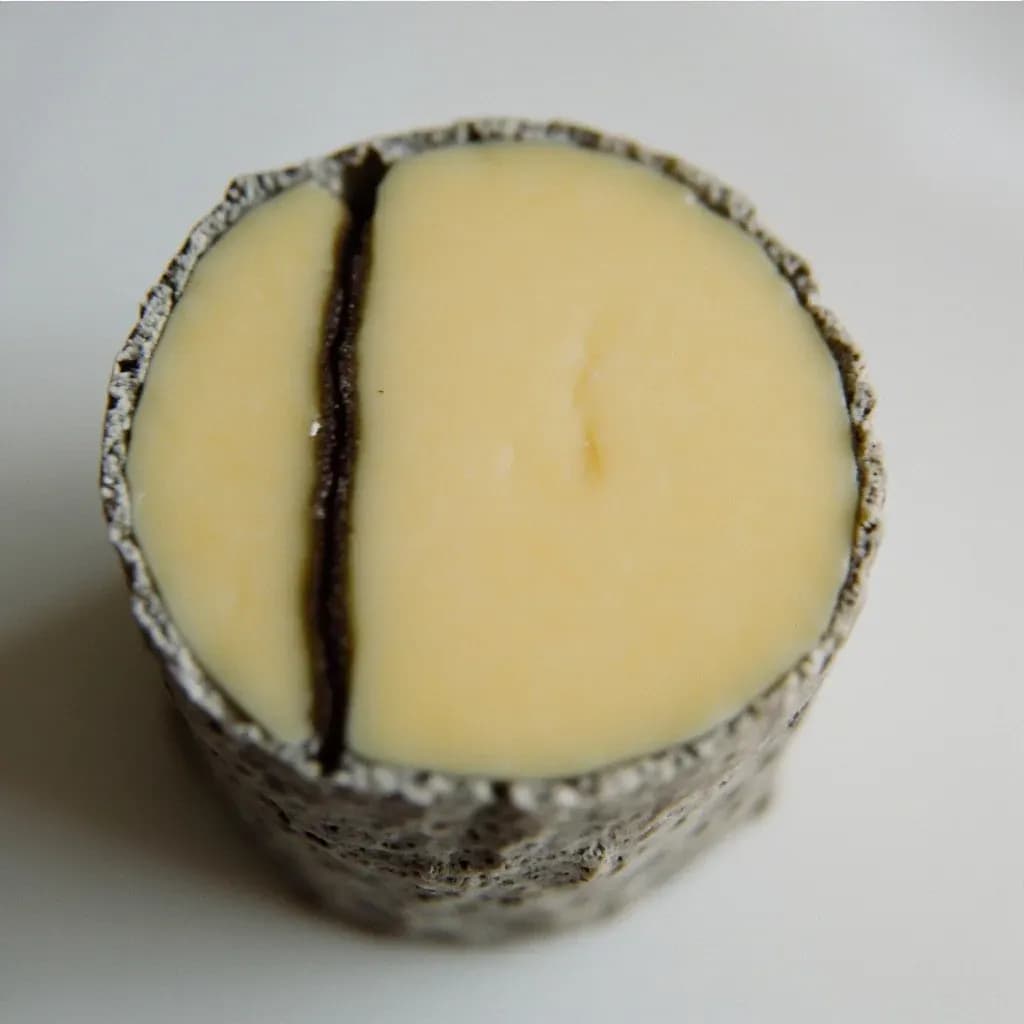
Dusting cheese or vegetables with edible vegetable ash to flavor, dry, and stripe them.
Ash coating dusts food, most famously goat cheese, with fine food-grade vegetable ash. The ash slightly neutralizes the surface, helps draw out moisture, and supports rind development while adding a smoky note and a dramatic dark line or layer. It is also used on roasted vegetables for color and earthy flavor.
Ash coating is the practice of finishing a dish with a thin layer of edible carbon — vegetable ash made from charred plant matter, or food-grade activated charcoal — to create a streak of pale grey or matte black against pale ingredients. In its modern restaurant form, popularized by René Redzepi and the cooks at Noma in Copenhagen, ash is treated as a finishing powder rather than a seasoning: a few grains dragged across a goat cheese log or dusted beneath a single scallop can do the visual work of an entire garnish. Its flavor contribution is modest — a faint smokiness, a touch of mineral bitterness, sometimes a whisper of the parent vegetable — which is precisely why cooks reach for it. The powder reads first with the eyes, then disappears into the dish, leaving behind a small lift of savoriness and a graphic line that no sauce or microgreen can match.
How ash behaves depends almost entirely on what is underneath it. On a dry, oil-free surface it falls off in patches; on a damp or lightly oiled surface it grips and stays put for the few minutes between plating and the first bite. Because the material is largely carbon, it has almost no water activity and will not dissolve into sauces or weep onto the plate the way a spice dust might. That stability is what makes it useful for stripes, half-dipped presentations, and stenciled patterns on everything from compound butter to clear consommés. The same property also means it lasts: kept dry and sealed, a jar of leek ash will keep its color and aroma for many months without losing potency.
Practically, the technique splits into two camps. Most cooks buy food-grade activated charcoal, which is neutral, reliably black, and consistent batch to batch. A smaller number char their own from leek tops, onion skins, or herb stems to capture a faint, plant-specific aroma in the powder itself. Either way the rule is the same: use only material known to be safe for ingestion, sieve it fine, apply it sparingly, and put it on at the very last moment so the contrast and the smoky note survive the journey from pass to table.
- Difficulty
- Medium
Types & varieties
Made from burned leek tops; the workhorse of modernist pantries, with a clean, faintly sweet smoke.
Burned onion skins or trimmings; sharper aroma, deeper black color.
Burned spinach or other leafy greens; pure matte black, mineral finish.
From parsley stems, chard ribs, or other herb stalks; lighter grey, subtle vegetal note.
Commercially produced, food-grade; not a true ash but the most consistent and accessible choice for visual finishing.
How to do it
- 1
Choose the ash source
Decide between food-grade activated charcoal (easiest, most consistent) and a homemade vegetable ash. Leek tops and onion skins are the standard starting points for DIY.
- 2
Make black vegetable ash from scratch (optional)
Spread clean, dry vegetable matter on a foil-lined sheet pan in a single layer. Tent loosely with foil and char at about 200°C (400°F) for 1–2 hours, until the material is reduced to a black, carbon-rich powder rather than a pale mineral ash. Ventilate the kitchen and let it cool fully before opening the foil.
- 3
Grind to a uniform powder
Pulse the cooled ash in a clean, dry spice grinder or mortar until it looks like fine flour. Any coarse fragments will read as grit on the palate.
- 4
Sift
Pass the powder through a fine-mesh sieve. Discard the coarse residue. Sifting is the step most home cooks skip, and it is the difference between a clean coating and a sandy one.
- 5
Prepare the surface to be coated
Pat the food dry with a paper towel. For very smooth items — a goat cheese log, a scallop, a cylinder of compound butter — brush lightly with neutral oil, melted butter, or a thin film of water so the ash has something to grip.
- 6
Apply the ash
Dust through a small sieve for an even coat, roll the item in a shallow dish of ash, or use a soft brush and a fingertip to drag stripes across a moistened surface. A stencil cut from parchment works for graphic shapes.
- 7
Plate at the last moment
Coat and plate immediately before service. On warm, oily, or wet foods, the visual punch fades within minutes, and a faint aroma of smoke is lost entirely.
Ash in cheese versus ash on the plate
The word 'ash' in cooking covers two unrelated practices, and confusing them is the most common mistake newcomers make. In European and European-style cheesemaking — Morbier (France), Humboldt Fog (California, inspired by Morbier), Coolea (Ireland), and many small-farm chèvres — vegetable ash is layered through the curd or dusted onto the rind while the cheese is still young. There it does real work: it raises surface pH, encourages the growth of specific molds, and contributes a faint bitterness that defines the cheese's flavor over months of aging. The ash used in cheesemaking is also typically a paler, mineral-rich product rather than the deep black carbon sought for plating. Ash coating on the finished plate is the opposite: a finishing cosmetic, applied seconds before service, valued almost entirely for the line it draws. The same name, very different intent.
- Cheese ash is a process ingredient integrated into the curd; plating ash is a finishing cosmetic.
- Cheese ash is often pale grey and mineral; plating ash is ideally a deep, matte black carbon.
- Lye-rich wood ash (used for pretzels, bagels, hominy, and lutefisk) is a third tradition and is not interchangeable with either.
Sourcing and safety
Because ash and charcoal look identical regardless of origin, the sourcing rule is absolute: only use material labeled food-grade. Activated charcoal sold for culinary use is purified and tested; vegetable ash you make yourself must come from clean, unsprayed plant matter charred in a controlled kitchen environment. Never use fireplace ash, barbecue ash, or ash from a bonfire — these carry heavy metals, combustion byproducts, and chemical residues from fuels and treated woods that have no place on food. If you are unsure, buy the jar.
Common uses
Tips & pitfalls
- Use only food-grade vegetable ash or food-grade activated charcoal; fireplace, woodstove, and barbecue ash are not safe to eat.
- Pat the food dry before dusting so the ash adheres in an even layer rather than beading up on moisture.
- Sieve through a fine mesh every time — even store-bought charcoal benefits from a quick pass to remove the occasional gritty fragment.
- Apply sparingly. A heavy coating turns bitter and dusty on the palate and visually overwhelms the food beneath it.
- When making ash from scratch, char under restricted oxygen (a foil tent, low oven) to push past white mineral ash into deep black carbon.
- Balance the slight bitterness with bright acidity — lemon, sherry vinegar, or a pickled garnish — so the dish tastes lifted rather than ashy.
- Apply at the very last step, just before the plate leaves the pass. Ash sitting on warm or oily food loses its contrast and smoky aroma within minutes.
- Store in an airtight container away from strong spices; the powder is highly porous and will pick up neighboring aromas quickly.
Good to know
- Category
- Modernist finishing technique, with a parallel tradition in European cheesemaking
- Origin in plating
- Contemporary fine dining; widely associated with René Redzepi and Noma, Copenhagen
- Common ash sources
- Burned leek tops, onion skins, spinach, herb stems, or food-grade activated charcoal
- Flavor profile
- Mild, smoky, slightly bitter, mineral; primarily valued for visual effect
- Color range
- Pale grey through deep matte black, depending on source vegetable and char conditions
- Application methods
- Dusting, rolling, dipping, stenciling, or dragging with a brush
- Best contrast
- White or pale foods — fresh goat cheese, white fish, scallops, butter, root vegetables
- Storage
- Airtight, dry, cool, dark; keeps for several months; absorbs ambient aromas easily
Also called
Vegetable Ash Coating · Ashing
Related

Confit
Cook slowly submerged in fat for silky tenderness and keeping

Cure
Draw out moisture with salt and time to preserve and concentrate

Pickle
Steep in acidic brine for bright, tangy, crunchy preservation

Ferment
Let friendly microbes transform food into tangy, complex flavor

Marinate
Soak in a seasoned mix to flavor and tenderize before cooking

Brine
Soak in salt water so meat stays juicy and seasoned throughout

Dehydrate
Slowly dry out moisture to concentrate flavor and extend shelf life

Cold-Smoke
Perfume cured food with smoke without cooking it through