Prep & Assembly
Board Building
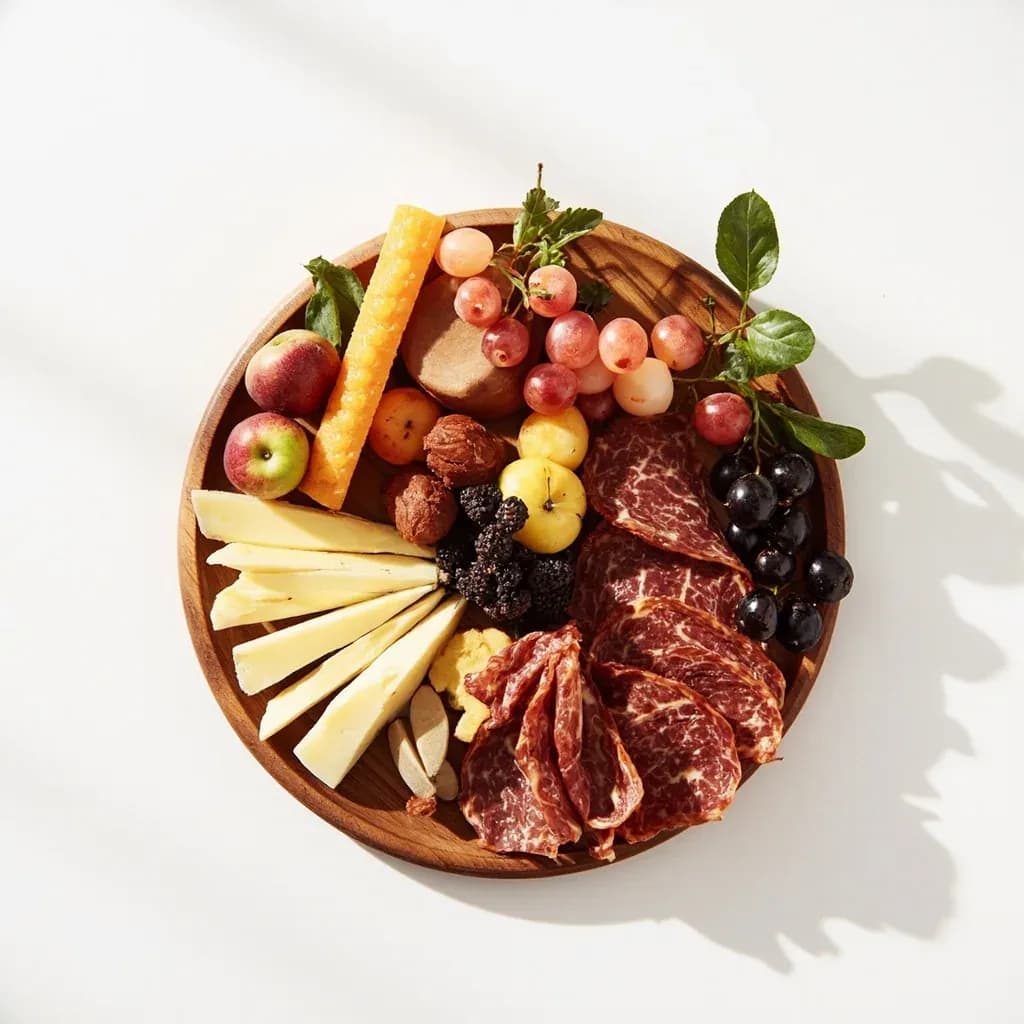
Arranging cheeses, charcuterie, and accompaniments on a board for an inviting spread.
Board building composes a cheese or charcuterie board, arranging cheeses, cured meats, fruits, nuts, and condiments for visual appeal and flavor variety. It balances textures, colors, and tastes while keeping items easy to reach and serve. Spacing anchor items first, then filling gaps, creates an abundant, organized look. The aim is both beauty and a self-serve grazing experience.
Board building is the deliberate composition of cheeses, cured meats, fruits, and accompaniments on a single serving surface so the spread is balanced in flavor, varied in texture, and visually generous. It looks casual, but it follows real rules of thumb — milk type, texture, flavor intensity, and color must all be balanced at once so a guest can move from a creamy bloomy-rind to a hard aged cheese, from sweet to salty to acidic, without hitting a dead patch.
A good board is also a logistics exercise. Cheeses need tempering time, wet ingredients need bowls, every cheese wants its own utensil, and roughly 30% of the surface should stay visible so the spread reads as abundant rather than chaotic. The format scales gracefully from a 9×13 in board for four to a full grazing table on kraft paper for a crowd, which is why it has become the default opener for casual entertaining and the standard for wine and cocktail pairings.
- Difficulty
- Easy
Types & varieties
Cheese-focused spread of 4–6 cheeses with minimal meat; the classic format for wine pairing.
Balanced mix of cured meats and cheeses with accompaniments; the everyday standard.
Large-format, abundant, informal; multiple boards or a full table covered in butcher paper.
Raw vegetables as the centerpiece, with dips and spreads; popular in spring and summer.
Softened butter spread directly on the board, finished with flaky salt, herbs, honey, or chili; popularized by Justine Snacks (Justine Doiron) on TikTok in 2022.
Pastries, jams, smoked fish, soft cheeses, fresh fruit, and cured meats.
Chocolate, cookies, macarons, candied nuts, fresh berries, and sweet dips.
Hummus, tzatziki, marinated feta, olives, dolmas, grilled flatbread, and cured meats like sujuk.
Smoked salmon, gravlax, shrimp, lemon, capers, crème fraîche, and baguette.
Italian-leaning: prosciutto, salami, marinated artichokes, roasted peppers, provolone, and olives.
How to do it
- 1
Choose the board and plan the scope
Select a clean, food-safe board sized to the guest count — roughly 9×13 in for four, 12×18 in for eight, multiple boards or a table for more. Decide on 3–5 cheeses covering different milks and textures, 2–4 cured meats of contrasting styles, 2–3 spreads, 2–3 fruits (fresh and dried), 2–3 crunchy or briny items, and one or two sweet accents.
- 2
Prep all components
Pull cheeses out 30–60 minutes ahead so they reach cool room temperature. Slice cured meats and prep folds, ribbons, or rosettes. Pit and drain olives, pour honey and jam into small bowls, rinse grapes and berries, portion crackers, and toast any nuts or bread slices.
- 3
Place bowls and structural anchors first
Set small bowls, ramekins, or hollowed cheese rinds for wet ingredients — olives, cornichons, honey, mustard, jam — at roughly even intervals on the board. These fix the geometry, create natural zones, and prevent runny items from pooling on the wood.
- 4
Arrange the cheeses
Space cheeses around the board, leaving breathing room between each. Pre-slice one piece of each firm or semi-firm cheese so guests don't have to wrestle a whole wedge. Vary shape, color, and milk type: a bloomy-rind Brie, a hard aged Manchego, a blue, and a fresh goat log together hit all four major categories.
- 5
Add the cured meats
Fan, fold, drape, or roll each meat into a distinct shape. Prosciutto ribbons, a salami rose or river, soppressata folds, and coppa ribbons all read differently; use 2–3 techniques to add height and texture. Keep meat clusters slightly separated from the strongest cheeses to avoid flavor overlap.
- 6
Fill in produce and crunchy items
Tuck grape clusters, fig halves, apple or pear slices, berries, and dried fruit into negative space. Add small piles of Marcona almonds, walnuts, or pistachios near complementary cheeses — walnuts beside a blue, almonds near a hard sheep's-milk cheese.
- 7
Add crackers, bread, and spreads
Place crackers and sliced baguette in clusters between cheeses, with a butter, jam, or mustard bowl nearby. Don't bury them at the bottom; they should be reachable without dismantling the composition. Fan crackers slightly so guests can grab one without dislodging the rest.
- 8
Garnish and finish
Sprinkle fresh rosemary, thyme sprigs, sage leaves, pomegranate arils, or edible flowers into remaining gaps to add color and hide small voids. Add flaky salt to cheeses that need it and a final drizzle of olive oil or honey over hard cheeses if the flavor profile calls for it.
- 9
Set out utensils and serve
Place a dedicated cheese knife, spreader, or fork at each cheese and meat. Set out small plates, napkins, and a discard bowl for pits and rinds. Keep a side plate of extra crackers and fruit off-board and refill as the spread is picked through.
The Five Dimensions of Balance
A board that works is balanced across five overlapping dimensions. Hitting all five is what separates a thoughtful spread from a haphazard one, and missing any one of them is what makes a board feel flat or predictable.
- Milk type: combine cow, sheep, goat, and (occasionally) buffalo cheeses so the spread isn't all one flavor family.
- Texture: aim for range — fresh, soft, semi-soft, semi-hard, hard, and blue-veined — though 3–5 cheeses will necessarily emphasize some textures over others.
- Flavor intensity: progress from mild to pungent across the board so guests can self-select intensity.
- Color: mix whites, ivories, golds, ambers, blue-veined, and red-waxed rinds for visual rhythm.
- Accompaniment function: offer something sweet (jam, honey, dried fruit), salty (cured meat, olives), acidic (cornichons, pickled onion), crunchy (nuts, crackers), and fatty (butter, soft cheese).
Choosing the Board
Surface matters as much as contents. Wood is the traditional choice — gentle on knives, warm in appearance, and forgiving of small drips. Marble and slate stay cooler in warm rooms and suit a more graphic, modern look. Bamboo and composite boards are durable and easy to sanitize; ceramic and recycled glass are striking but unforgiving on knives.
- Hardwoods: acacia, maple, walnut, olive, and cherry are all good; avoid soft pine and strongly aromatic woods that can transfer flavor.
- Marble or slate: best for hot rooms and for showcasing soft cheeses that benefit from a cool surface.
- Bamboo: budget-friendly and easy to sanitize; harder than walnut, so it will dull knives faster.
- Ceramic or recycled glass: striking presentation, but hard on edges and prone to chipping.
- Size: a 12×18 in board fits an 8-person spread comfortably; scale up or add boards for larger groups.
- Keep strongly aromatic ingredients (raw onion, ripe blue, kimchi) at the board's edge or in their own bowl rather than spreading their flavor across delicate cheeses.
Scaling Up: Grazing Tables
For more than a dozen guests, a single board is the wrong tool. Build a grazing table on kraft paper over a long table, working in sections rather than treating the whole surface as one composition.
- Lay brown kraft paper or butcher paper flat over the table; the matte surface hides drips and reads as rustic.
- Build in zones — cheese cluster, meat cluster, produce cluster, sweet cluster — separated by greenery or bread.
- Use wooden boards, slate tiles, and baskets to vary height and break up the visual plane.
- Refill continuously from the kitchen; grazing tables look best when they never quite empty.
- Stick with the standard 2 oz cheese and 2 oz meat per guest as a planning baseline; build abundantly and let guests graze at their own pace.
Common uses
Tips & pitfalls
- Temper cheese 30–60 minutes out of the fridge; cold mutes flavor and makes firm cheeses crack when cut.
- Place cheeses on the board first as anchors, then build meat, then accompaniments, then fill gaps last.
- Use small bowls or ramekins for wet items — olives, cornichons, honey, jam — so they don't run across the board.
- Fold or drape thinly sliced cured meats rather than laying them flat; ribbons, roses, and nests add visual height.
- Vary three axes at once: flavor (mild to strong), texture (soft to hard), and color (white to amber to blue) to keep the palate and the eye engaged.
- Group items in odd-numbered clusters of three or five; odd numbers read as more abundant and intentional.
- Label cheeses with small chalkboard or kraft tags; helpful with washed-rind or blue cheeses guests may not recognize.
- Stock small backup bowls of crackers and fruit off-board; refill as the board is picked through.
- Common mistake: overcrowding, which collapses visual height and makes it hard for guests to remove items cleanly.
- Common mistake: serving too much meat and not enough cheese; cheese should occupy roughly 40–50% of the surface area of a balanced board.
Good to know
- Also called
- Charcuterie board, cheese board, grazing board, plank
- Typical board size
- 9×13 in for 4 guests; 12×18 in for 8; multiple boards or a table for larger groups
- Common materials
- Hardwoods (acacia, maple, walnut, olive, cherry), bamboo, marble, slate, ceramic, recycled glass
- Difficulty
- Beginner to intermediate; scales with ambition
- Planning ratio (cheese)
- 2 oz (55 g) per guest as a main course; 1–2 oz as an appetizer
- Planning ratio (meat)
- 2 oz (55 g) per guest
- Cheese guideline
- 3–5 cheeses covering different milk types, textures, and flavor intensities
- Meat guideline
- 2–4 cured meats, contrasting fat levels and curing styles
- Serving temperature
- Cheese at cool room temperature (~65°F / 18°C) for 30–60 minutes before service
- Build time
- 20–45 minutes for a standard 12–14 in board, plus tempering time
- Pairing rule of thumb
- Offer a mix of sweet, salty, acidic, fatty, crunchy, and creamy elements
- Utensil rule
- One dedicated knife, spreader, or fork per cheese to prevent flavor cross-over
Also called
Board Building (Plating a Cheese Board)
Related

Whisk
Beat ingredients smooth and aerated with a looping wire motion

Sift
Pass dry ingredients through mesh to aerate and remove lumps

Strain
Pour through mesh to separate solids from liquid for a smooth result

Filter
Pass liquid through fine material to clarify out the smallest particles

Rice
Press cooked potatoes through small holes for fluffy, lump-free texture

Mash
Crush soft cooked food into a rustic, creamy purée

Grind
Crush food into a coarse to fine texture, from spices to meat

Grate
Shred food into fine bits against a sharp-toothed surface