Water & Steam
Caramel Braising (Kho)
Vietnamese braising of meat or fish in caramelized sugar, fish sauce, and water.
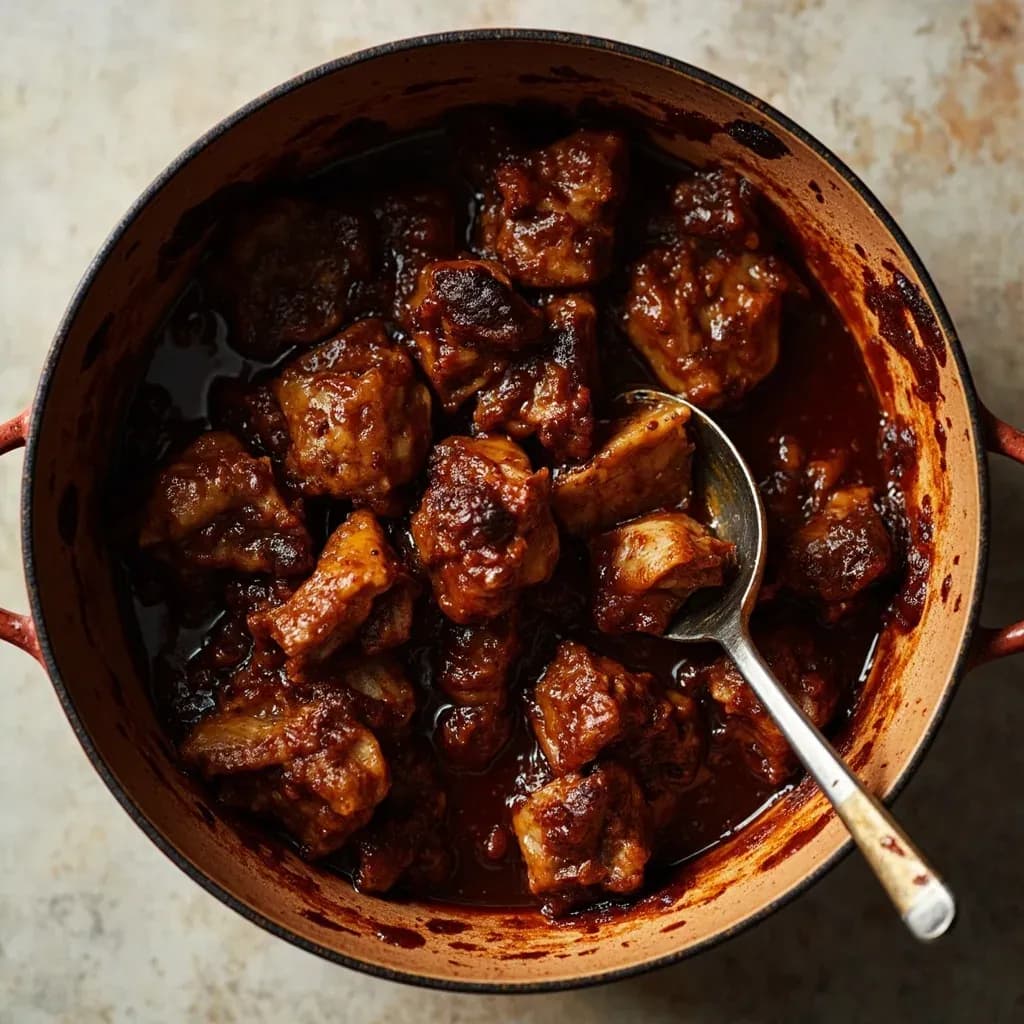
Kho braises protein in a base of cooked-down caramel (nuoc mau) with fish sauce, building a savory-sweet, mahogany glaze. The caramel adds color, bitterness, and depth while the long simmer tenderizes the meat or fish. Common versions include thit kho (pork) and ca kho (catfish), often finished until the liquid is syrupy.
Kho is the everyday Vietnamese braise built on a three-part foundation: caramelized sugar (nước màu), fish sauce (nước mắm), and a modest amount of water or coconut water. The sugar cooks with just a film of water until it foams and turns a deep amber, then fish sauce is added — hissing and spattering — before the protein goes in. Unlike Western braises that lean on stock and aromatics for depth, kho draws most of its savory-sweet backbone from that one pan of caramel.
Kho is a foundational technique of Vietnamese home cooking, with particular weight in the South. Pork belly braised with duck eggs (thịt kho trứng) is the iconic Tết (Lunar New Year) dish of the Southern table; catfish cooked in a clay pot (cá kho tộ) is what Mekong families eat with rice all year. Done well, the cooking liquid reduces to a syrupy, mahogany glaze that clings to the meat and soaks into the rice beneath — never a soup, never a thin sauce. Done badly, the caramel scorches to bitterness, the sauce stays watery, or the fish sauce steamrolls the sweetness.
The hallmark of a good kho is restraint and timing: the caramel must stop at deep amber (it keeps cooking off-heat), the liquid should barely reach two-thirds up the protein, and the final reduction happens uncovered so the sauce turns glossy. A clay pot (nồi đất) is traditional because its thick walls hold low, even heat and let the sauce concentrate without scorching, but a Dutch oven gets you most of the way there with a little more vigilance.
- Difficulty
- Medium
Types & varieties
Pork belly braised with duck or chicken eggs; iconic Tết (Lunar New Year) dish in the South, the eggs stained mahogany from the sauce
Catfish or snakehead braised in a clay pot with pork belly fat for richness; served sizzling directly in the pot
Central Vietnamese version that swaps fish sauce for fermented shrimp paste (mắm ruốc), giving a deeper, funkier profile
Chicken braised with ginger, fish sauce, and caramel; homestyle, quick-cooking weeknight version
Small whole shrimp simmered with caramel, fish sauce, garlic, and black pepper until chewy and glazed
Beef braise on the same caramel base but enriched with lemongrass, star anise, and five-spice; closer to a stew, often served with bánh mì or rice noodles
How to do it
- 1
Make the nước màu
In a clay pot or heavy Dutch oven over medium heat, combine 2–3 tablespoons of sugar (palm sugar or white) with just a thin film of water (about 1–2 teaspoons). Swirl the pot — don't stir — and cook 4–6 minutes until the sugar melts, foams, and darkens to a deep amber that smells toasted. Pull the pot off the heat; residual heat will carry it one shade darker.
- 2
Add fish sauce
From a low angle, pour in 3–4 tablespoons of fish sauce. It will hiss and spatter aggressively, so keep the lid nearby. Stir briefly to combine; the mixture should smell sharp and savory, not acrid or burnt.
- 3
Bloom the aromatics
Add 2–3 minced garlic cloves, 1 minced shallot, and a few grinds of white or black pepper. Optional: a bruised lemongrass stalk, a sliced chili, or a smashed whole shallot. Stir for 20–30 seconds until fragrant — never let them brown in the caramel.
- 4
Sear the protein
Add 600–800 g of pork belly, ribs, chicken, or fish. Toss gently for 1–2 minutes so every piece takes on color and the fat starts to render. For pork belly, lay the pieces skin-side down first for a chewier crust. Handle fish carefully so the pieces stay whole.
- 5
Add liquid and simmer covered
Pour in enough water, stock, or coconut water to come about two-thirds up the protein — roughly 1 to 1.5 cups. Bring to a gentle boil, skim any gray foam, then drop to a low simmer. Cover and cook: 45–60 minutes for fish, 60–90 minutes for pork belly, 90–120 minutes for ribs or beef.
- 6
Reduce to a glaze
Uncover and simmer another 5–10 minutes until the sauce turns glossy and coats the back of a spoon. If you're adding hard-boiled eggs (traditional with pork belly), drop them in 20–30 minutes before the end so they absorb color and flavor. Adjust with a splash of fish sauce for salt, a pinch of sugar for sweetness, or a few drops of hot water to thin.
- 7
Rest and serve
Off the heat, let the kho rest 10–15 minutes so the sauce stops running and clings to the meat. Serve directly from the pot, or over steamed white rice with quick-pickled mustard greens (dưa cải chua) or pickled small shallots (củ kiệu). Spoon the mahogany sauce generously over the rice.
The caramel stage is everything
Every kho lives or dies in the first five minutes. The sugar must cook past sugar-stage into a true caramel — through foam, into a thin syrup, then into a deep amber that smells toasted, not burned. Pull the pot off the heat before it looks finished; the residual heat from the pot walls will carry the color another full shade. Once you add the fish sauce, the clock resets: you cannot rescue a scorched caramel with more liquid.
- Caramelize the sugar with just a film of water — swirling the pot, never stirring with a spoon, which can seed crystals.
- Watch for the smell more than the color. The moment it smells like toasted marshmallow or roasted nuts, it's done.
- Pour fish sauce in from a low angle and have a lid ready; it spatters hard and can burn your hand.
- If the caramel seizes into a hard lump when liquid hits, return to low heat and stir until it dissolves before adding protein.
Regional differences
Kho changes character as you move down the country. Northern versions use more nước mắm and less sugar, so the braise tastes saltier and the sauce stays a light caramel. Central versions often substitute mắm ruốc for a funkier, more pungent result. Southern versions — the style most familiar abroad — skew sweeter and darker, frequently built on coconut water rather than plain water, with pork belly as the dominant protein.
- North: less sugar, more fish sauce, lighter amber sauce, served with steamed rice.
- Center: fermented shrimp paste (mắm ruốc) replaces fish sauce; stronger, more pungent aromatics.
- South: palm sugar, coconut water, pork belly and eggs; the canonical Tết plate.
Common uses
Tips & pitfalls
- Stop the caramel at deep amber — it keeps darkening from the pot's residual heat. Burnt caramel tastes bitter and ruins the whole braise.
- Pour fish sauce into the hot caramel from a low angle with the lid ready; it spatters hard and the steam stings.
- Use nước mắm, not salt. The amines in fish sauce are part of kho's signature flavor — table salt gives a flat, one-dimensional result.
- Add only enough liquid to reach two-thirds up the protein. Kho is a braise that finishes as a glaze, not a soup — too much liquid and you'll never get the sauce to coat.
- Bloom aromatics after the caramel stage, not before. Garlic and shallots scorched in dry sugar turn acrid in seconds.
- Taste before reaching for additional salt. Fish sauce and any stock already carry salt; many home versions are over-salted by doubling up with soy or table salt.
- Let it rest 10–15 minutes off the heat before serving so the sauce clings to the meat instead of pooling on the plate.
Good to know
- Origin
- Vietnamese; a foundational everyday braise found across the country
- Vietnamese name
- Kho (kho thịt for meat, kho cá for fish); the caramel base is called nước màu
- Core flavor balance
- Sweet caramel + salty umami from fish sauce, with a long simmer to meld
- Traditional sugar
- Thốt nốt (palm sugar) or đường vàng (yellow sugar); granulated white sugar works in a pinch
- Salt element
- Nước mắm (fish sauce), added into the hot caramel — not later, and never replaced by salt
- Liquid
- Water, coconut water (nước dừa) for a sweeter Southern style, or a splash of beer or stock
- Traditional cookware
- Nồi đất (unglazed clay pot); a heavy Dutch oven is the closest modern substitute
- Typical time
- 45–60 minutes for fish, 60–90 minutes for pork belly, 90–120 minutes for ribs or beef — all at a gentle simmer
- Color range
- Light amber (mild sweetness) to deep mahogany (more intense, slightly bitter caramel)
- Sauce consistency
- Reduced to a glossy, syrupy glaze that lightly coats the meat — never soupy
- Difficulty
- Beginner-friendly, but the caramel stage is the make-or-break step
- Serving tradition
- Steamed white rice with quick-pickled mustard greens (dưa cải chua) or pickled shallots (củ kiệu)
- Storage
- Refrigerates 3–4 days; flavor deepens by day 2; freezes well for 1–2 months
Also called
kho · nuoc mau braising
Related

Boil
Cook in vigorously bubbling liquid at full rolling heat

Simmer
Hold liquid at a gentle shimmer for tender, unhurried cooking

Poach
Cook gently in barely-trembling liquid for silky, tender results

Steam
Cook in rising vapor to keep color, nutrients, and shape intact

Blanch
Plunge briefly in boiling water, then shock cold to lock color

Braise
Sear, then cook slow in a little liquid until fall-apart tender

Stew
Simmer bite-sized pieces fully submerged into a rich, unified pot

Sous-Vide
Seal and cook in precise warm water for edge-to-edge doneness