Heat & Fire
Mixed-Vegetable Dry Stir (Chorchori)
Bengali method of slow dry-stirring mixed vegetables with spices until tender and lightly browned.
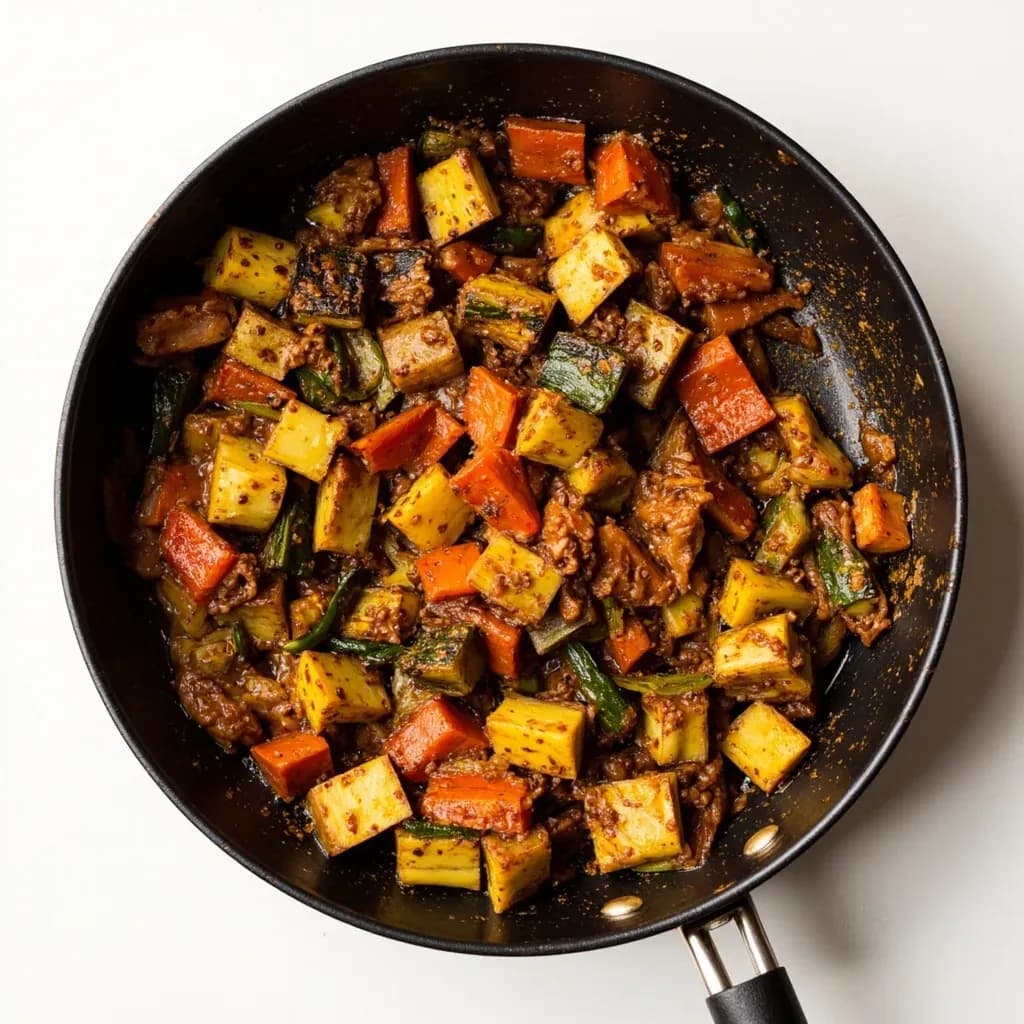
Chorchori is a Bengali dry curry where assorted vegetables are stir-cooked over moderate heat with a tempering of spices like panch phoron and mustard, with little or no added water. The vegetables release their own moisture and cook down until soft and lightly caramelized, concentrating flavor. It is a frugal, home-style dish often built from whatever vegetables and peels are on hand.
Chorchori is a Bengali method of slow-stirring two or more vegetables together in spiced oil until they soften, lightly caramelize, and finish almost dry — no added water, no gravy, no onion-garlic masala. The dish is built on contrast: a starchy vegetable (potato, sweet potato) anchors the pan, a sweet one (pumpkin, carrot, cauliflower) rounds it out, and often a bitter or vegetal one (eggplant, bitter gourd, ridge gourd) keeps the flavor honest. What defines a true chorchori is the moisture discipline — vegetables are expected to release their own water, cook in that steam, and then reabsorb it as the pan is uncovered, so the finished dish arrives in the serving bowl glossy with oil, never pooling liquid.
The flavor frame is unusually spare for Indian cooking: mustard oil heated to smoking, a tempering of panch phoron, a little turmeric, salt, and green chili. There is no garam masala, no ground coriander, no tomato. That austerity is the point — chorchori is meant to taste like the vegetables themselves, with the spice mix acting as a magnifying glass rather than a costume. Done right, each piece is tender at the core, browned at the edges, and distinctly itself rather than melting into a uniform stew.
Chorchori is best understood as a household technique rather than a fixed recipe. The vegetable list changes with the season, the market, and whatever is left in the fridge, which is why it has become the workhorse of Bengali vegetarian cooking and a reliable lunchbox dish. It is the dry sibling of labra and the everyday cousin of sukto, and learning the method opens the door to all three.
- Difficulty
- Easy
Types & varieties
The everyday kitchen-sink version, made with whatever seasonal or leftover vegetables are at hand
Generic mixed-vegetable chorchori; 'shobji' simply means vegetables, and the rest is up to the cook
Fish-included version, traditionally made with small fish or fish roe cooked alongside the vegetables
The most common two-vegetable form: potato and eggplant, classic for its starchy-bitter balance
Cauliflower and potato version, extremely common in Bengali homes and one of the easiest for beginners
How to do it
- 1
Prepare the vegetables
Wash, peel where needed, and cut 2 to 5 vegetables — potato, cauliflower, eggplant, pumpkin, beans, radish, ridge gourd, pointed gourd — into uniform batons or 1.5 cm cubes. Keep them in separate piles so they can enter the pan in the right order. Slice a 1-inch piece of ginger into fine julienne and slit 1 to 2 green chilies lengthwise.
- 2
Smoke the mustard oil
Pour 3 to 4 tablespoons of mustard oil into a kadai or wide shallow pan and heat over medium until it just begins to smoke. Reduce the heat to low. This step is the authentic Bengali starting point: it drops the raw, almost horseradish-like pungency of cold-pressed mustard oil and leaves a rounder, nuttier base. Do not skip it if you want the true flavor.
- 3
Bloom the panch phoron
Add 1 teaspoon of panch phoron and let it splutter in the hot oil for 10 to 15 seconds, until the mustard seeds pop and the fenugreek darkens slightly. If you like, add 1 broken dried red chili at the same moment for a gentle background heat.
- 4
Build the base aromatics
Add the ginger julienne and slit green chilies and stir for about 30 seconds. Sprinkle in 1/4 teaspoon turmeric and stir so the oil turns a deep, even yellow and the aromatics are coated.
- 5
Add the hard vegetables first
Tip in the vegetables that take longest to cook: potato, cauliflower, pumpkin, radish, winter squash. Toss to coat in the spiced oil. Cook uncovered over medium heat, stirring every minute or two, for 4 to 5 minutes until the edges start to look translucent and you can see the first signs of fond forming on the pan.
- 6
Add the medium and soft vegetables
Add the quicker-cooking vegetables — eggplant, beans, ridge gourd, pointed gourd, or any greens you are using. Season with salt to taste and toss well so every piece is glossed with oil. From this point, salt will start drawing moisture out of the vegetables.
- 7
Cover and slow-stir
Lower the heat to medium-low, cover, and cook for 8 to 12 minutes, lifting the lid to stir every 2 to 3 minutes. The vegetables should soften in their own steam; do not add water unless the fond on the bottom is about to burn. If you do add water, a teaspoon or two at a time is the maximum — chorchori is defined by the absence of pooled liquid.
- 8
Uncover and dry-stir to finish
Remove the lid, raise the heat back to medium, and stir continuously for 3 to 4 minutes. Any released moisture should evaporate, the fond on the pan should dissolve back into the vegetables, and the pieces should pick up a light brown caramelization on the edges. The dish is done when it looks dry, glossy with oil, and the vegetables yield to a fork while keeping their shape.
- 9
Rest and serve
Take the pan off the heat, cover, and rest for 5 minutes. This lets any residual moisture redistribute and reabsorb. Optionally finish with a torn green chili or 1 teaspoon of ghee for aroma. Serve warm with steamed white rice and dal, or alongside maach bhapa and begun bhaja.
The Chorchori Principle
The method rests on three rules that govern everything else: combine vegetables of contrasting character, cook them in their own moisture, and let a very small spice frame carry the flavor. The classic contrast is one starchy (potato), one sweet (pumpkin, carrot, or cauliflower), and one bitter or green (eggplant, bitter gourd, ridge gourd, or pointed gourd). When that triangle is in the pan, the dish almost seasons itself — the starch thickens the released liquid, the sweetness softens the bitterness, and the green vegetable keeps the whole thing from going heavy. Once you internalize the principle, the vegetable list becomes a variable rather than a constraint, and chorchori turns into a year-round technique for using up odds and ends without losing flavor.
Vegetables That Work Best
Chorchori forgives almost any firm vegetable, but the following are the traditional workhorses and the easiest to learn on:
- Potato — the most common anchor; cubes hold shape and absorb flavor well
- Cauliflower — florets brown beautifully and add a nutty sweetness
- Eggplant — provides the signature slightly bitter, creamy note; salt-and-squeeze if it seems watery
- Pumpkin or winter squash — adds natural sweetness and helps the dish finish glossy
- Ridge gourd (jhinga) and pointed gourd (parwal) — quick-cooking, mild, and very Bengali
- French beans and flat beans — add snap and a fresh green flavor
- Radish (mulo) — brings a sharp, peppery note that works in winter versions
- Bitter gourd (karela) — use sparingly, pre-fry or salt-squeeze to tame the bitterness
How Chorchori Differs From Labra and Sukto
These three Bengali vegetable dishes share ingredients and even cooks, and the borders blur in home kitchens. The useful distinction is moisture and spice load: chorchori is the driest of the three, with the fewest spices and no binding agent. Labra is wetter — closer to a thick stir-fry than a dry one — and tends to pack in more vegetables, often with a paste element such as coconut or mustard paste. Sukto is the most distinctive: built around bitter vegetables like bitter gourd, eggplant, and drumstick, frequently bound with milk or a little besan to mellow the sharpness. If you learn chorchori well, labra is a half-step away and sukto is a different branch off the same trunk.
Common uses
Tips & pitfalls
- Smoke the mustard oil until it just stops smoking before adding anything else; this mellows the pungency and is the authentic Bengali move — skipping it leaves a raw, harsh base.
- Cut all vegetables to a similar size (about 1.5 cm cubes or batons) so they finish cooking together; mismatched cuts are the most common reason some pieces turn to mush while others stay raw.
- Add vegetables in stages by hardness: potato, cauliflower, pumpkin, and radish go in first; eggplant, beans, ridge gourd, and pointed gourd follow a few minutes later.
- Resist adding water. If the pan looks dry, sprinkle a teaspoon at a time only when the fond threatens to scorch — too much liquid turns chorchori into labra.
- Do not crowd the pan. If you double the recipe, split it into two batches or use a wider kadai; overcrowding traps steam and prevents browning.
- Keep the heat at medium to medium-low once the vegetables are in. High heat browns the outside before the inside cooks through and leaves a scorched, underdone center.
- For bitter gourd or eggplant-heavy versions, lightly salt the eggplant, let it sit 10 minutes, then squeeze; this prevents sogginess and tames bitterness.
- Finish with a torn green chili or a small spoon of ghee for aroma — never with garam masala, which would mask the vegetable flavor the technique is built around.
Good to know
- Origin
- Bengal (West Bengal, India and Bangladesh); a foundational everyday technique in Bengali home cooking
- Course role
- Side dish, traditionally served with steamed rice and dal, or with maach (fish) preparations
- Moisture profile
- Dry stir-fry; no added water — vegetables cook in and reabsorb their own released liquid
- Canonical tempering
- Panch phoron (fenugreek, nigella, cumin, black mustard, fennel seeds) bloomed in mustard oil
- Spice philosophy
- Minimalist — turmeric, salt, ginger, green chili; no garam masala, no onion, no garlic
- Fat
- Mustard oil, traditionally heated to its smoking point before tempering to drop the raw pungency
- Vegetable count
- Typically 2 to 5+ different vegetables in one pan, balanced by texture and sweetness
- Prep time
- About 15 minutes (washing, peeling, uniform cutting)
- Cook time
- 20 to 30 minutes on low to medium heat
- Difficulty
- Easy; forgiving, home-style technique suitable for beginners
- Texture goal
- Tender enough to yield to a fork, but holding shape, with light browning at the edges
- Dietary notes
- Naturally vegetarian and gluten-free; vegan if finished without ghee
Also called
chorchori · Bengali dry curry
Related

Sear
Blast the surface hot for a deep-browned, savory crust

Sauté
Cook quickly in a little fat over lively heat, tossing as you go

Stir-Fry
Toss bite-sized pieces over roaring heat for fast, smoky cooking

Pan-Fry
Crisp food in a shallow layer of hot fat, turning once or twice

Deep-Fry
Submerge in hot oil for an all-over crackling crust

Roast
Cook uncovered in dry oven heat for browned edges and tender centers

Bake
Cook with steady, surrounding oven heat — the soul of bread and pastry

Broil
Hit food from directly above with fierce overhead heat