Prep & Assembly
Hand-Rolling Couscous
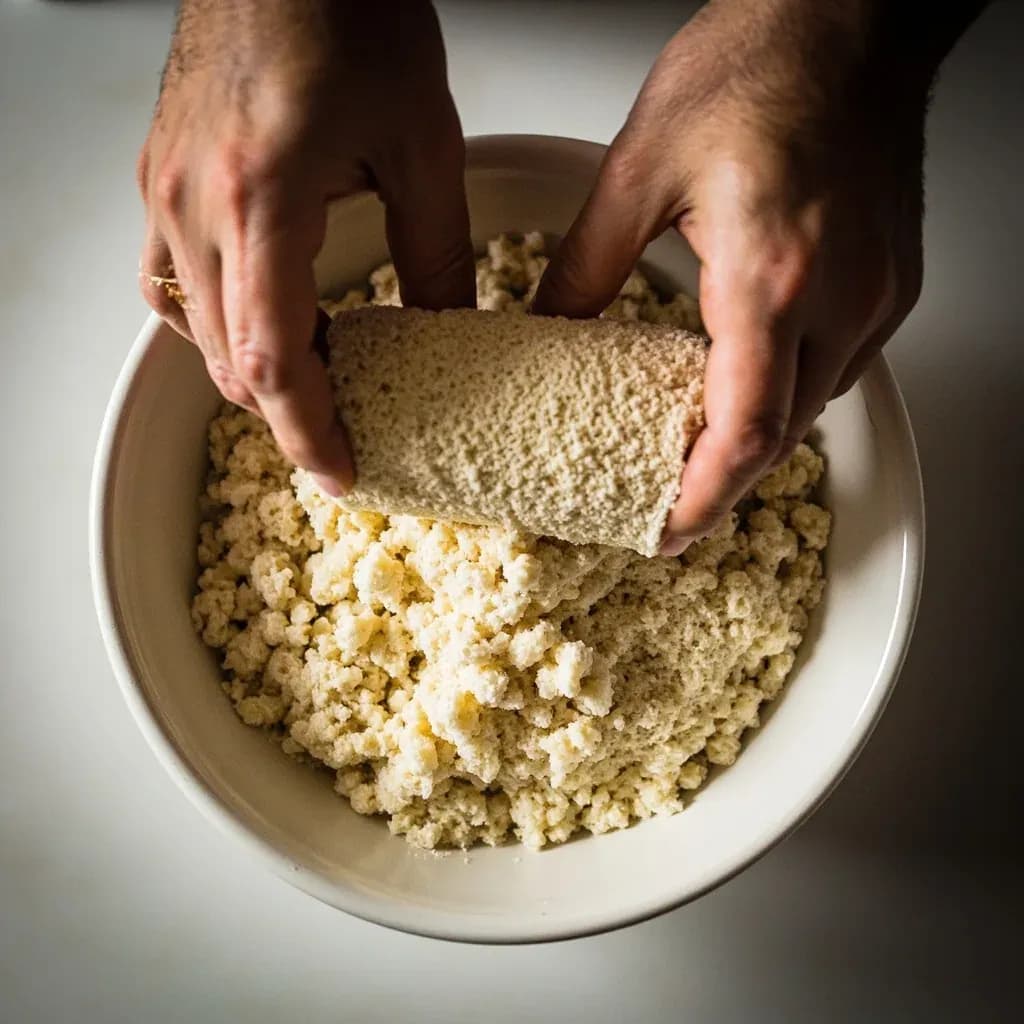
Rubbing moistened semolina by hand into tiny grains, then steaming in repeated cycles.
Hand-rolling couscous works moistened semolina between the palms and against a wide bowl so the flour clumps into tiny, even pellets, which are then steamed, fluffed, and re-steamed in repeated cycles. Each steam-and-rub cycle separates the grains and cooks them to a light, fluffy texture. This traditional North African method, done by hand over a couscoussier, yields a far more delicate grain than instant boxed versions.
Hand-rolling couscous is the foundational Maghrebi technique of converting coarse durum semolina into separate, steam-cooked grains through a rhythm of hand-rubbing, sifting, and repeated steaming. Each granule is built up by friction: a thin film of water on the palm, a quick circular rub against the side of the bowl, and a shower of moistened semolina that tumbles back to be graded and rolled again. The result is fundamentally different from the pre-steamed, dried couscous sold in Western boxes — lighter, more granular, and absorbent enough to soak up a stew without collapsing into porridge.
The work is staged rather than continuous because the grain needs time to develop. Friction alone gives each particle a hydrated outer skin; steam, applied in cycles and interrupted by further rubbing, drives moisture into the core and sets the surface. In Morocco, Algeria, Tunisia, and Mauritania, where couscous is the Friday dish and the centerpiece of hospitality, the technique remains a domestic ritual — historically a craft passed from mother to daughter, and still today a collective task on family couscous days.
- Difficulty
- Hard
Types & varieties
The smallest grains; favored in Algeria and eastern Morocco for light preparations and some sweet dishes. Hand-rolled fine is more delicate than the boxed product.
The everyday standard across most of Morocco and Tunisia; the default size for tagine accompaniments and the Friday platter.
Larger, chewier grains typical of southern Morocco, Sahrawi cooking, and Mauritania. Distinct from Israeli or pearl couscous, which is extruded pasta.
Rolled from whole-wheat durum semolina for a nuttier flavor and rougher, more rustic texture.
The same rolling and steaming technique applied to barley or millet; a staple of Tuareg, Sahrawi, and southern Maghrebi cooking.
How to do it
- 1
Set up the gsaa and sieve
Pour the coarse or medium semolina into a wide, shallow wooden or earthenware bowl (gsaa). Set a flat sieve (tbel) nearby. Fill the lower pot of the couscoussier with water, set the perforated insert in place, and bring the water to a gentle boil.
- 2
First roll — wake the semolina
Dip one hand in cool water, shake off the drips so only a film remains, and rub the semolina between both palms in a quick circular motion, letting the grains shower back into the bowl. Flick a fine mist of water from the fingertips and continue rubbing for 5–10 minutes until every grain feels lightly damp and no dry dust remains at the bottom of the bowl.
- 3
Sift and grade the grains
Pass the dampened semolina through the tbel. The fine flour and undersized grains that fall through go back into the bowl for another round of rubbing; the uniform granules that stay on top are set aside. Repeat this roll-and-sift cycle three or four times until the entire batch has been converted into small, even grains.
- 4
First steam
Spread the freshly formed grains in a thin, even layer about 1–1.5 cm deep over the perforated insert of the couscoussier. Cover tightly so the lid seals, and steam for 20–25 minutes without lifting it.
- 5
Rest, break up, and rub again
Tip the steamed couscous back into the gsaa, let it cool 10–15 minutes, then work it between the hands to separate clumps and crumble any moist lumps. Sift once more. This rest-and-rub step is what gives hand-rolled couscous its signature separation of grains.
- 6
Second and third steamings
Return the couscous to the steamer insert for a second 20–25 minute steam. Repeat the resting and rubbing. Steam a third time — this final cycle produces the fully cooked, fluffy, faintly nutty texture. A fourth steam is optional and yields the lightest possible result.
- 7
Final fluff and season
Tip the finished couscous into a large bowl, drizzle with a little cold salted water or a splash of olive oil, and fluff vigorously with a fork or your hands. Season to taste with butter and salt if serving as an accompaniment.
What the grain tells you
Experienced rollers judge each stage by feel rather than by clock. After the first rub, the semolina should clump lightly when squeezed in a fist and break apart cleanly when pressed with a thumb — not powdery, not paste. After the first steam, cool grains should feel slippery and slightly rubbery on the outside with no hard center. If they feel chalky or gritty, the steam cycle was too short or the layer in the insert was too thick. By the third steam, a rubbed grain should split cleanly in half under a fingernail, dry at the core but tender, and never doughy.
- After first rub: clumps when squeezed, breaks cleanly — never powdery, never pasty.
- After first steam: outside is set and slippery; no raw center when bitten.
- After second rub: grains should fall through the fingers as distinct, sand-like particles, not as damp sand.
- After third steam: a grain splits cleanly and is tender throughout; the batch smells faintly of toasted wheat.
The case against shortcuts
Pre-steamed, dried couscous is an industrial answer to a problem most home cooks no longer have time for, and it works well enough in a weeknight pilaf. It is not, however, the same food. Hand-rolled couscous has a defined skin and a dry, granular interior that absorbs sauce without going soft; it browns in butter; it holds its shape under ladles of broth; and it has the faint sweetness of durum that only slow steam brings out. The difference is most obvious in a plain butter-and-couscous plate, where the boxed version reads as bland and uniform and the hand-rolled version as a real grain with texture and flavor of its own.
Common uses
Tips & pitfalls
- Use medium or coarse semolina; fine semolina absorbs water too quickly and turns pasty, no matter how good your hand technique.
- Wet your hands, not the semolina directly, and work in small, fast circular rubs — the classic Maghrebi motion is a rolling gesture between cupped palms, letting the grains fall back into the bowl rather than squeezing them.
- Keep the water film extremely thin. Over-wetting is the single most common mistake; grains should form by friction against the bowl and between the hands, not by being soaked.
- Sift after every rolling pass. What passes through the sieve returns to the bowl for another round; what stays on top is your finished batch for that stage.
- Never press, knead, or grind the semolina. Couscous grains are not dough — they should not develop gluten, and pressure makes them dense and gummy.
- Let the couscous rest 10–15 minutes after each steaming before working it again; this firms up the surface and prevents clumping in the next cycle.
- Spread the grains in a thin layer over the perforated insert of the couscoussier. A deep mound will stay raw in the center and steam unevenly.
- Three steamings is the minimum for traditional texture. Two leaves a slightly chewy interior; four is rare and gives the lightest result.
- Cooked hand-rolled couscous stores well: spread it out to cool, then keep covered in the refrigerator for 2–3 days. Re-steam briefly with a splash of water to refresh before serving.
Good to know
- Origin
- North Africa; an indigenous Amazigh (Berber) technique of the Maghreb, later adopted across the wider region.
- Cultural status
- Inscribed on UNESCO's Representative List of the Intangible Cultural Heritage of Humanity in 2020 under 'Couscous: knowledge, know-how and culinary practices associated with couscous,' nominated jointly by Algeria, Morocco, Tunisia, and Mauritania.
- Primary ingredient
- Coarse or medium durum-wheat semolina; the finest grade is reserved for bessissa and desserts, not for rolling.
- Key equipment
- A wide, shallow wooden or earthenware mixing bowl (gsaa), a flat-bottomed woven or perforated sieve (tbel), and a couscoussier — a two-tier pot with a perforated steamer insert.
- Steaming cycles
- Traditionally three steamings of 20–25 minutes each, with rubbing and sifting between every cycle.
- Active time
- Roughly 30–60 minutes of hand-rolling, plus three steaming cycles and resting time.
- Total time
- About 2.5–4 hours for a full traditional preparation.
- Yield
- 1 kg of dry semolina produces roughly 2–2.5 kg of finished steamed couscous; 1 cup of dry yields about 2.5–3 cups once cooked.
Also called
Hand-Rolling Couscous · Couscous Rolling · Couscous Steaming Cycles
Related

Whisk
Beat ingredients smooth and aerated with a looping wire motion

Sift
Pass dry ingredients through mesh to aerate and remove lumps

Strain
Pour through mesh to separate solids from liquid for a smooth result

Filter
Pass liquid through fine material to clarify out the smallest particles

Rice
Press cooked potatoes through small holes for fluffy, lump-free texture

Mash
Crush soft cooked food into a rustic, creamy purée

Grind
Crush food into a coarse to fine texture, from spices to meat

Grate
Shred food into fine bits against a sharp-toothed surface