Transform & Preserve
Curd-Based Souring (Moru Curry)
Gently heating spiced yogurt or buttermilk so it sours a curry without curdling.
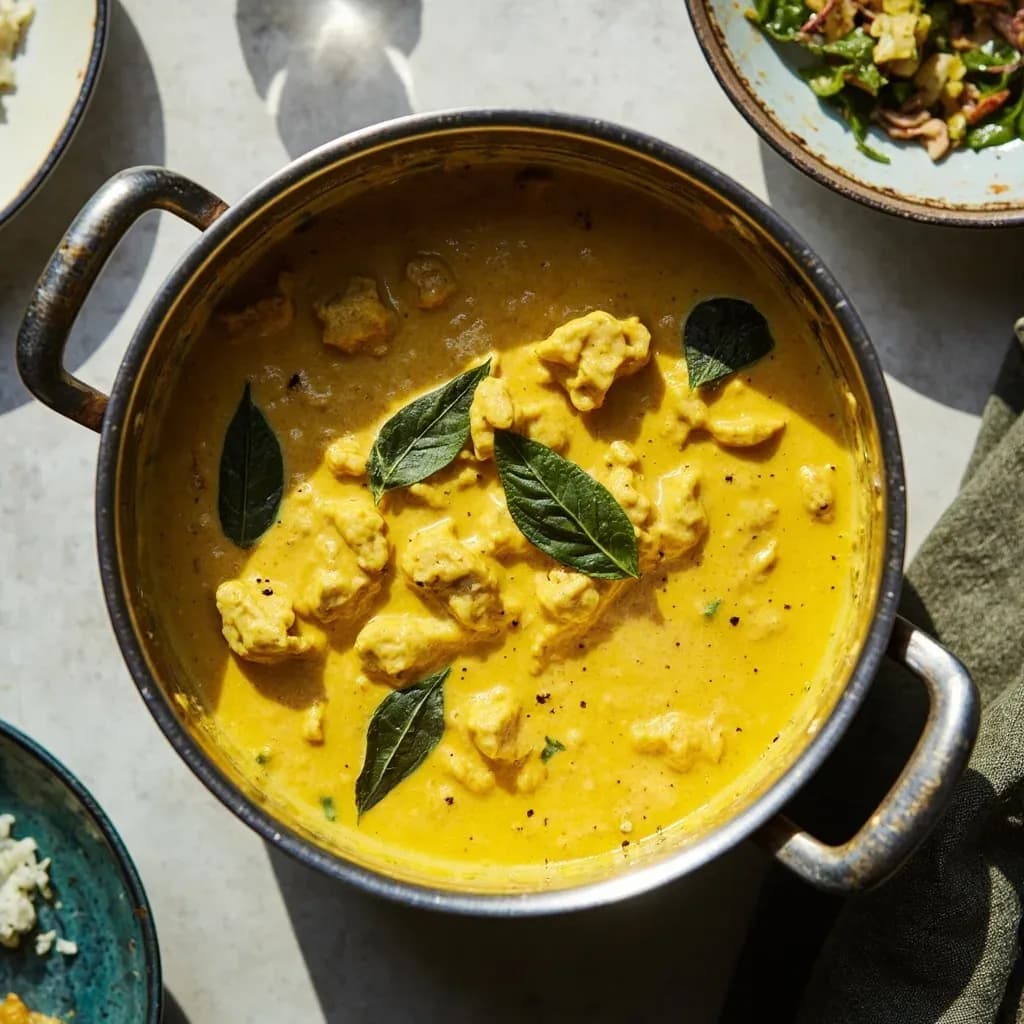
In moru curry and similar dishes, whisked yogurt or buttermilk is tempered with spices and warmed over low heat to add tangy sourness to the curry base. The trick is gentle heat and often a starch or constant stirring so the dairy doesn't split or curdle. The result is a smooth, lightly soured sauce typical of South Indian cooking.
Curd-based souring is the South Asian technique of building a curry's tang and body from yogurt or buttermilk rather than from tamarind, kokum, amchoor, or raw tomato. The result is a milder, rounder acidity—lactic rather than fruit—plus a milky sweetness and a soft, velvety thickness that no clear souring agent can deliver. It is the defining move behind an entire family of dishes: the thin, soupy Kerala moru curry eaten with steamed rice, the deep Punjabi kadhi studded with onion pakoras, the sweet-tangy Gujarati kadhi poured over khichdi, and the delicate Bengali fish curries finished with mustard paste and yogurt.
The technique works in tension with its own ingredient. Yogurt's casein proteins clump irreversibly once they pass roughly 80°C, and any extra acid in the pan—raw tomato, tamarind, vinegar, amchoor—lowers that threshold dramatically. The cook's job is to thread the needle: bring the yogurt to room temperature, stabilize it with a starch such as gram flour or cornstarch, fold it in off the heat while stirring constantly, and then warm the sauce only to a gentle shiver. Done right, the sauce pours like thin cream; done wrong, it becomes a pot of pale, watery curds in seconds.
Beyond flavor, curd-based souring adds body. A finished moru or kadhi clings to rice and flatbreads in a way thin rasam cannot, and it cools a hot thali like nothing else. It is the natural choice for fish (Dahi Maach, parts of Meen Molee) and for the vegetable gravies of summer, where lightness and digestibility matter as much as taste.
- Difficulty
- Medium
Types & varieties
Thin buttermilk tempered with mustard, fenugreek, dried red chilies, curry leaves, ginger and garlic; often finished with toasted coconut; classic with fish or aviyal.
Yogurt thickened with besan into a deep yellow sauce; fritters of onion or chickpea-flour batter are dropped in to simmer.
Sweet-tangy profile built with sugar and mild spices; thinner than Punjabi kadhi and typically served over khichdi.
Besan-yogurt base with no onion or garlic; thickened and eaten with rice alongside besan gatta dumplings.
Buttermilk simmered with vegetables such as okra, ash gourd, or cucumber and finished with a ground coconut-green chili paste.
Thinner, soup-like buttermilk rasam tempered with mustard and curry leaves; often served as a starter with rice.
Rohu or carp cooked in a yogurt sauce with mustard paste, ginger, and minimal chili; finished with whole garam masala in mustard oil.
Vegetables such as bhindi, baingan, mushroom, or paneer simmered in a spiced yogurt gravy without besan.
Yogurt-based gravy with pakoras and a tarka; note that Sindhi Kadi uses besan and tamarind without yogurt, a related but distinct technique.
How to do it
- 1
Prepare and stabilize the yogurt
Whisk 2 cups of full-fat yogurt (or 1.5 cups yogurt thinned with 1/2 cup water for a thinner moru) until completely smooth. Whisk in 1–2 tbsp besan or 1 tbsp cornstarch slurry per cup of yogurt. Bring to room temperature.
- 2
Build the base
In a heavy non-reactive pan, heat coconut oil or ghee and sauté chopped onion, ginger, garlic, and green chili over medium heat until soft but not browned. Add any vegetables, cooked lentils, or seared protein at this stage and cook through; season lightly.
- 3
Temper the spices
In a small tadka pan, heat 1 tbsp ghee or coconut oil. Add mustard seeds and wait until they pop, then add cumin, fenugreek seeds, dried red chilies, curry leaves, and a pinch of asafoetida. Pour the sizzling tarka over the base (or directly into the pan).
- 4
Add the yogurt off the heat
Remove the pan from the burner. Slowly pour the whisked yogurt in a thin stream while whisking the base continuously. This single move prevents most curdling.
- 5
Return to gentle heat
Place the pan back on the lowest flame. Stir constantly with a flat-bottomed spoon or whisk until the sauce is uniform and just heated through. It should shiver, not simmer, and never bubble on the surface.
- 6
Adjust seasoning and consistency
Taste and add salt carefully, a pinch of sugar if your style runs sweet, or a splash of water if too thick. Kerala moru should coat the back of a spoon loosely; kadhi should ribbon off a spoon.
- 7
Finish with a fresh tarka and herbs
Heat 1 tsp ghee, crackle a few curry leaves and a broken dried chili, and pour over the top. Garnish with chopped coriander or fresh curry leaves. Serve immediately with hot rice, appam, roti, or paratha.
- 8
Hold and reheat correctly
If the dish must sit, keep it warm in a bain-marie rather than on a direct flame. Reheat leftovers on the lowest setting with constant whisking; do not boil.
The Science Behind the Split
Yogurt is a gel of casein micelles suspended in water; once heated past about 80°C the micelles collapse and the sauce breaks into watery whey and rubbery white curds. Any additional acid—tamarind, raw tomato, vinegar, amchoor—lowers that threshold further. Two interventions counter it: starch, which thickens the aqueous phase and physically traps the proteins before they can clump, and fat, which coats the micelles and slows their aggregation. Full-fat yogurt with a tablespoon of besan per cup is therefore the most forgiving medium. Whisk it until pourable—a single visible lump becomes the nucleation point for further curdling—bring it to room temperature, and add it off the flame while the base is being stirred.
Regional Tempering Signatures
- Kerala moru curry: mustard, fenugreek, dried red chilies, curry leaves, ginger and garlic in coconut oil; often finished with toasted coconut bits.
- Punjabi kadhi: cumin, fenugreek, dried red chili, and asafoetida bloomed in ghee; ginger and garlic cooked into the base.
- Gujarati kadhi: minimal tarka—often just a few cumin seeds and a couple of curry leaves in ghee, since the sweetness and mild spices do most of the work.
- Bengali dahi maach: whole garam masala (cinnamon, cardamom, clove) bloomed in mustard oil, plus nigella seeds and green chili.
- Karnataka majjige huli: mustard and curry leaves tempered, then a coconut-green chili paste stirred in at the end for body and heat.
Common uses
Tips & pitfalls
- Whisk the yogurt until completely smooth and pourable—a single visible lump seeds curdling and spreads through the sauce.
- Stabilize with 1 tbsp besan or cornstarch per cup of yogurt; this is the single most reliable insurance against splitting.
- Always bring the yogurt to room temperature before adding it—cold yogurt hitting a hot pan separates almost instantly.
- Add the yogurt off the heat in a thin stream while whisking, then return to the lowest flame; never let the sauce reach a rolling boil.
- Use full-fat yogurt—the fat coats the casein proteins and resists curdling; low-fat and non-fat versions split readily.
- If the sauce does split, take it off the heat and whisk vigorously; a small ice cube whisked in often brings it back.
- Cook in a heavy non-reactive pan (stainless steel, brass, clay, or nonstick); aluminum and bare cast iron react with the acid and taint the flavor.
- For a vegan version, coconut yogurt works but splits more easily—double the stabilizer and keep the heat very low.
Good to know
- Also known as
- Moru Curry, Moru Kachiyathu, Moru Kuzhambu, Kadhi, Dahi-based gravies
- Primary cuisines
- Kerala, Karnataka, Tamil Nadu, Punjab, Sindh, Bengal, Sri Lankan
- Core medium
- Full-fat yogurt (dahi/curd) or buttermilk (chaas/moru); low-fat splits readily
- Stabilizer (optional)
- Gram flour (besan) or cornstarch slurry, roughly 1 tbsp per cup of yogurt
- Heat ceiling
- Hold at a bare shiver (~70–75°C); never boil once yogurt is incorporated
- Tempering fat
- Coconut oil in Kerala; ghee or neutral oil elsewhere (mustard oil in Bengal)
- Equipment
- Heavy-bottomed non-reactive pan (stainless steel, brass, clay, or nonstick), whisk, small tadka pan
- Best paired with
- Steamed rice, appam, idiyappam, roti, paratha
- Storage
- Refrigerate up to 1 day; reheat gently with whisking—do not boil
Also called
moru curry · yogurt curry souring
Related

Confit
Cook slowly submerged in fat for silky tenderness and keeping

Cure
Draw out moisture with salt and time to preserve and concentrate

Pickle
Steep in acidic brine for bright, tangy, crunchy preservation

Ferment
Let friendly microbes transform food into tangy, complex flavor

Marinate
Soak in a seasoned mix to flavor and tenderize before cooking

Brine
Soak in salt water so meat stays juicy and seasoned throughout

Dehydrate
Slowly dry out moisture to concentrate flavor and extend shelf life

Cold-Smoke
Perfume cured food with smoke without cooking it through