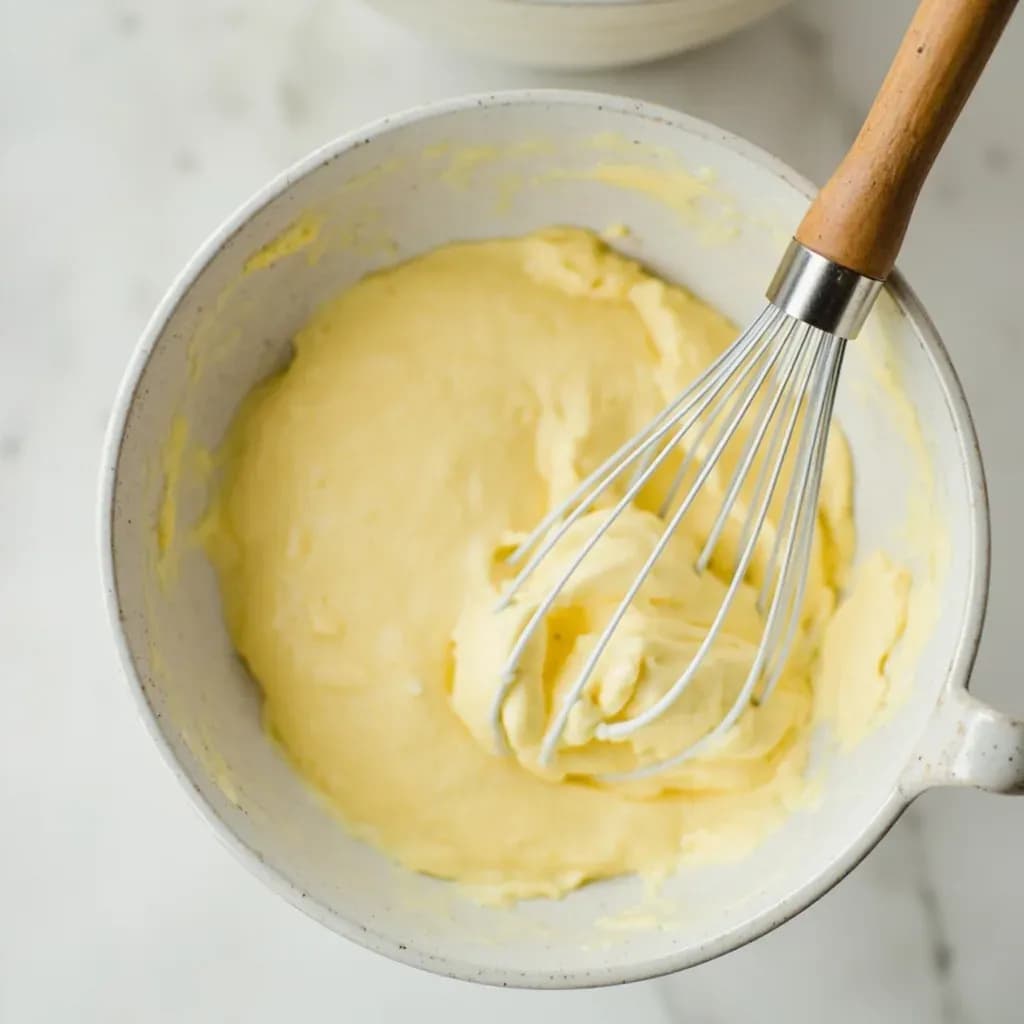
Prep & Assembly
Whisking
Beating ingredients with a wire whisk to blend, aerate, or whip them into volume.
Whisking uses a wire tool to rapidly beat air into liquids and to blend ingredients smoothly, whether thinning a sauce, smoothing yogurt, or whipping egg whites and cream into stable foams. The wires multiply the surfaces hitting the mixture, incorporating air bubbles that build volume and lightness. For whipped whites or cream, a clean, fat-free bowl and steady motion are critical to reaching firm, glossy peaks.
Whisking is the controlled agitation of ingredients with a wire tool to combine, aerate, or emulsify them, and it underpins more of the daily work in a kitchen than almost any other single motion. The wire loops shear liquids against one another and against the bowl, breaking surface tension so fats and waters can mingle, and pulling in air as tiny, evenly distributed bubbles. The result is everything from a smooth pancake batter to a glossy sabayon, and the difference between a sauce that splits and one that shines is almost always a matter of when — and how vigorously — a cook picked up the whisk.
What makes whisking a technique rather than just a tool is that the same implement performs very different jobs depending on speed, motion, and the moment at which ingredients are added. Slow, deliberate strokes bring a vinaigrette together; fast, broad sweeps from elbow and shoulder whip cream to roughly double its volume; a steady, rhythmic beat over a bain-marie builds the light, frothy foam of a zabaglione. Reading the goal — blend, aerate, or emulsify — is the first step to reading the mixture in front of you.
Hand whisking is also a sensory skill: resistance on the wires, the sound of the liquid against the bowl, the gloss of a foam, and the way a ribbon falls from the lifted tool are all signals. Recipes give times and speeds, but a practiced cook leans on feel, knowing when a foam has crossed from billowy to brittle long before the clock says so.
- Difficulty
- Easy
Types & varieties
Blending dry ingredients (flour, leaveners, salt, spices) evenly before adding wet.
Combining liquids or a liquid into a dry base, with a focus on homogeneity rather than air.
Maximum aeration — egg whites, heavy cream, sabayon. Achieved with fast, broad wrist-and-arm motion.
Slow, low-amplitude motion used to combine custards, curds, or delicate sauces without introducing unwanted air.
Continuous, steady whisking while slowly adding oil to water-based liquid (mayonnaise, vinaigrette, hollandaise) to build a stable suspension.
Whisking cold butter piece by piece into a warm reduction to thicken and gloss a sauce, e.g. pan sauces and beurre blanc.
How to do it
- 1
Match the whisk to the job
Choose a balloon whisk for aerating large volumes, a flat (roux) whisk for shallow liquids in a saucepan, or a French whisk as an all-purpose middle ground.
- 2
Stabilize the bowl and the cook
Set the bowl on a damp towel, silicone mat, or folded cloth, and stand with feet square and elbow close to the body so you can move the whole arm.
- 3
Combine before you aerate
Start with slow, wide circular motions to bring the ingredients into a uniform mixture. Rushing here splashes and incorporates too much air too soon.
- 4
Build the texture you want
Increase the speed and switch to figure-eight or side-to-side sweeps for air. For emulsions, keep a steady rhythm and feed oil slowly into the moving liquid.
- 5
Scrape and reassess
Pause every 30–60 seconds, run a spatula along the bowl's sides and bottom, and fold the unwhipped material into the whipped.
- 6
Read the visual cues
Stop at the stage the recipe calls for: 'just combined,' 'thickened and pale,' 'soft peaks,' 'stiff peaks,' or 'leaves a ribbon.' Going past the target is rarely fixable.
- 7
Finish cleanly
Lift the whisk out with a gentle twist rather than a straight pull, and tap it once against the bowl edge to release any clinging mixture into the batch.
Choosing a whisk
The shape of the whisk determines what it does best, and matching the tool to the task is half the technique.
- Balloon whisk: large, rounded head with many wires — the all-purpose whisk for whipping air into egg whites, cream, and batters.
- Flat (roux) whisk: two or three flat loops of wire, designed to reach the corners of a saucepan and deglaze pan sauces without splashing.
- French whisk: a slimmer, elongated balloon shape, useful for smaller bowls and lighter work like vinaigrettes.
- Coil whisk: a spring-shaped single wire, ideal for very thin liquids and delicate emulsions in narrow containers.
- Mini whisk: a small head for beating a single egg in a cup or emulsifying a small dressing in a ramekin.
Reading the mixture
Time is the loosest guide in whisking; visual and tactile cues are far more reliable, and a cook who learns to read them wastes fewer batches.
- Foamy: large, loose bubbles that don't hold shape — the first stage of whipping egg whites or cream.
- Soft peaks: the mixture mounds briefly when the whisk is lifted, then the tip curls over on itself.
- Stiff peaks: the mixture stands up in sharp, dry points that hold their shape when the whisk is moved.
- Ribbon stage: a beaten egg-and-sugar mixture falls from the whisk in a thick, satiny ribbon that holds on the surface for a few seconds before dissolving.
- Broken emulsion: a vinaigrette or mayonnaise that looks thin, glossy, and curdled — the cue to whisk in a teaspoon of warm water, or start over.
Common uses
Tips & pitfalls
- Bring eggs and cream to room temperature before whipping for the highest volume and stability.
- Stabilize the bowl by nesting it in a damp kitchen towel or setting it on a silicone mat — chasing the bowl costs you air.
- Drive motion from the elbow and shoulder, not just the wrist, to save fatigue and add air efficiently.
- For emulsions, add oil a few drops at a time at the start, then in a thin steady stream once the mixture thickens and 'breaks back' on itself.
- Scrape the bowl's sides and bottom with a spatula every 30–60 seconds; a whisk leaves dead zones of unmixed material.
- Stop whipping egg whites at soft, droopy peaks for folding into batters — over-stiff whites deflate badly and leave pockets in the crumb.
- Don't walk away from whipping cream; it goes from soft peaks to butter in under a minute once it turns.
- If egg whites won't foam, suspect grease: even a trace of yolk, butter, or oil in the bowl or on the whisk will defeat the foam.
Good to know
- Origin of the tool
- Wire whisks descend from medieval European kitchen tools; the balloon shape (French: fouet) was popularized in 18th–19th century French kitchens.
- Primary purpose
- To combine, aerate, and emulsify ingredients by rapidly agitating them with a wire tool.
- Motion types
- Circular sweeps, figure-eight, side-to-side slashes, and vigorous shaking — chosen by goal (blending vs. aeration).
- Ideal bowls
- Copper and stainless steel for whipping egg whites; glass and metal are fine for most other tasks. Plastic retains trace fat and inhibits foams.
- Time range
- Roughly 20–30 seconds for a vinaigrette; 1–2 minutes for pancake batter; 2–5 minutes by hand for egg whites or cream.
- Visual cues
- Foamy → soft peaks → stiff peaks for whipped egg whites or cream; 'ribbon stage' when a mixture falls in thick ribbons from the lifted whisk.
- Equipment by task
- Balloon whisk for aeration; flat (roux) whisk for pan sauces and shallow liquids; French whisk as a versatile all-rounder; coil whisk for delicate emulsions.
- Difficulty
- Easy to learn, but consistent hand-whisking is genuinely tiring; an electric mixer is a common substitute for stiff peaks.
Also called
Whisk · Whipping · Beating · Monter les Blancs · Frothing
Dishes that rely on it
Related

Whisk
Beat ingredients smooth and aerated with a looping wire motion

Sift
Pass dry ingredients through mesh to aerate and remove lumps

Strain
Pour through mesh to separate solids from liquid for a smooth result

Filter
Pass liquid through fine material to clarify out the smallest particles

Rice
Press cooked potatoes through small holes for fluffy, lump-free texture

Mash
Crush soft cooked food into a rustic, creamy purée

Grind
Crush food into a coarse to fine texture, from spices to meat

Grate
Shred food into fine bits against a sharp-toothed surface