Prep & Assembly
Mounting With Butter (Monter au Beurre)
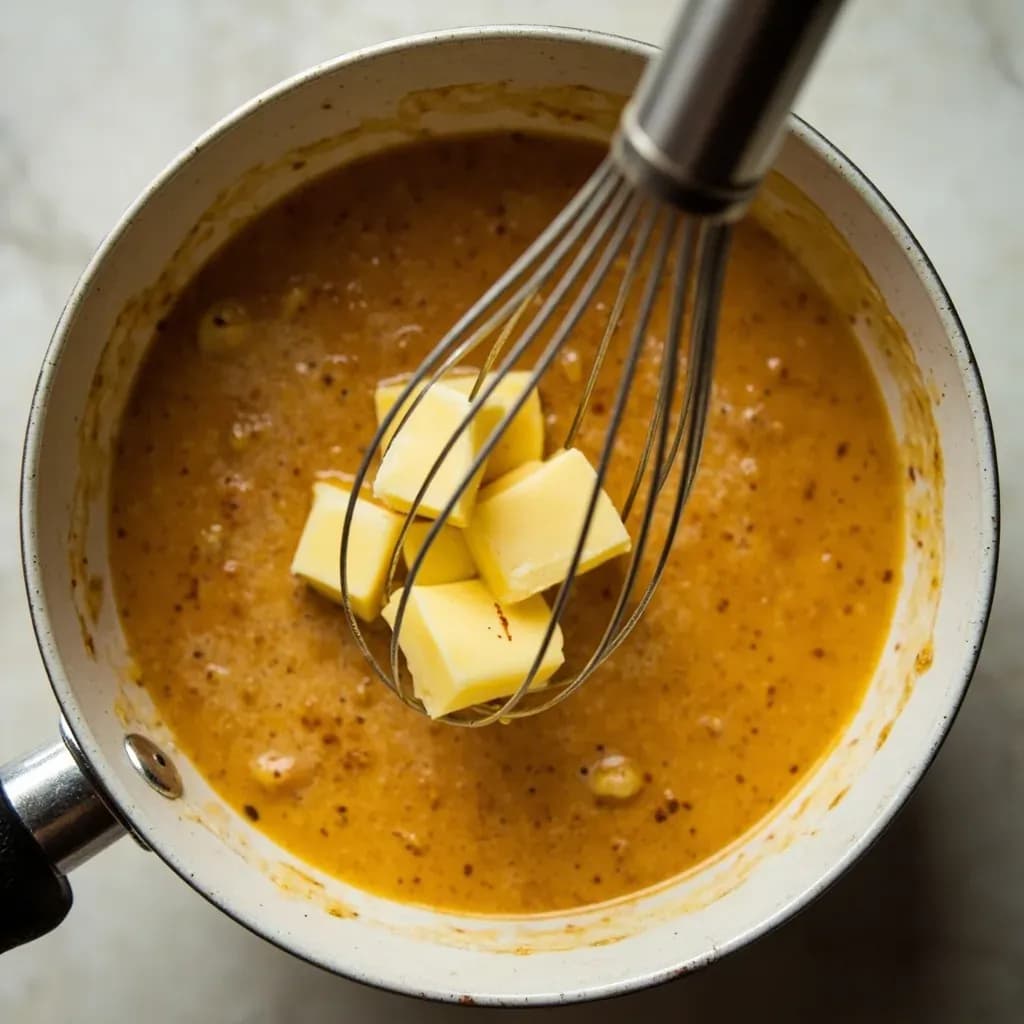
Whisking cold butter into a sauce for a glossy, rich finish.
Monter au beurre whisks cold cubes of butter into a warm sauce off direct high heat so the fat emulsifies into the liquid. This gives the sauce a glossy sheen, fuller body, and rounded flavor as a final enrichment. The sauce must stay below a boil, or the emulsion breaks and the butter separates into oily droplets.
Monter au beurre — literally, to mount or finish with butter — is the classical French technique of whisking cold, cubed butter into a warm sauce at the last moment to create a stable emulsion. The butter doesn't simply melt into the liquid; it is beaten in cube by cube until each piece is suspended in the sauce as tiny droplets of fat, giving the finished product a glossy sheen, a rounder flavor, and a velvety, almost airy mouthfeel. It is the finishing step that distinguishes a restaurant-quality sauce from a flat home reduction, and it serves as the structural backbone of entire families of French sauces from Hollandaise to beurre blanc.
The technique matters because butter is more than a flavoring here — it is an emulsifier and a texturizer. In egg-yolk sauces it stabilizes the lecithin emulsion and prevents the sauce from breaking; in wine and stock reductions it softens acidity, carries fat-soluble aromatics across the palate, and gives body without flour or cream. A sauce mounted properly should look like satin and coat the back of a spoon without running; one mounted carelessly turns greasy, grainy, or broken within seconds.
The behavior of the technique rests on temperature control. Butter must enter the sauce cold so its milk solids and water stay intact, and the sauce must be warm — typically 130–150°F (55–65°C) — but never boiling, because excess heat will cause the fat droplets to coalesce and the emulsion to split. Add the butter too quickly and it cannot emulsify; add it to a cold sauce and it sits in clumps; let the pan get away from you and the whole thing turns to oil. Mastering that narrow window of temperature and pacing is the whole of the technique.
- Difficulty
- Medium
Types & varieties
The standard method: cold, cubed butter whisked into a warm sauce off direct high heat.
Using clarified butter for a cleaner, more stable emulsion in pale or delicate sauces; lighter in flavor and color than whole butter.
Using browned butter for a nutty, toasted aroma; favored in fish pan sauces and certain reductions where the caramel notes are welcome.
The broader French finishing category that includes monter au beurre as well as the lighter gesture of passing a cold slab of butter across the surface of a sauce to prevent a skin.
How to do it
- 1
Finish the base sauce
Reduce and season the base — a stock or wine reduction, a deglazed pan fond, or an egg-yolk emulsion like Hollandaise — to its target consistency and flavor. Strain if needed. The base should be smooth, properly seasoned, and fully ready before any butter goes in, because seasoning adjustments become harder once the butter has been mounted.
- 2
Bring the sauce to the right temperature
Hold the sauce at roughly 130–150°F (55–65°C) — warm to the touch, just below a simmer. If it is boiling, pull it off the heat. Too cold and the butter will not emulsify; too hot and the emulsion will break.
- 3
Cut the butter
Cut cold, firm unsalted butter into small, even cubes of about 1 cm (½ inch). Work quickly so the cubes stay cold and do not soften on the cutting board.
- 4
Begin mounting off the heat
Remove the pan from the burner. Add one or two cubes of butter to the sauce and whisk continuously in small circles until each cube is completely melted and incorporated before adding the next.
- 5
Continue adding butter gradually
Add the remaining butter a few cubes at a time, whisking constantly, and return the pan to very low heat only if the sauce cools too much. As the butter emulsifies, the sauce should thicken slightly and take on a glossy, satin sheen.
- 6
Adjust and serve
Taste and adjust seasoning with salt and, if the sauce needs lift, a few drops of lemon juice, vinegar, or wine. Serve immediately; do not hold the mounted sauce at high heat and do not let it boil.
The science of the emulsion
A sauce mounted with butter is a delicate emulsion: tiny droplets of butterfat suspended in a watery liquid. Agitation from the whisk breaks the butter into small pieces, while the sauce's warmth keeps the fat fluid enough to disperse evenly. Milk proteins from the butter's milk solids, along with trace phospholipids from the milk-fat globule membrane, help slow the droplets' tendency to recombine. This is why cold butter, gradual addition, and continuous motion matter — they keep new droplets small and evenly distributed. Heat above roughly 180°F (82°C) overwhelms that stability: the fat melts completely, the proteins coagulate, and the sauce breaks into a clear liquid with a slick of grease on top.
- Cold butter melts slowly enough to be broken into small droplets by the whisk before it fully liquefies.
- Warm (not hot) sauce keeps the fat fluid so it disperses rather than clumping.
- Milk proteins and trace phospholipids in butter help stabilize the droplets in suspension.
- Excess heat (above ~180°F) collapses the emulsion and the butter separates as grease.
When the sauce breaks — and how to rescue it
A broken mounted sauce looks split, greasy, or thin, with beads of fat pooling on the surface. The cause is almost always excess heat, butter added too quickly, or butter that was too warm to begin with. In most cases the sauce can be rescued without starting over. The key is to cool the sauce slightly, then whisk energetically while slowly introducing fresh cold butter or a splash of warm water, which gives the emulsion a new scaffold to reorganize around. A bain-marie off the heat is often the safest place to do this.
- Pull the pan off the heat immediately and let it cool briefly.
- Whisk in a teaspoon of warm water or a fresh cube of cold butter in small circles.
- For a severely broken sauce, start a fresh tablespoon of warm base in a clean pan and slowly whisk the broken sauce into it.
- Never try to fix a broken sauce by reheating it — that deepens the break.
Common uses
Tips & pitfalls
- Keep the sauce warm but never boiling — temperatures above roughly 180°F (82°C) will break the emulsion and the butter will separate as grease.
- Cut the butter into small, even cubes so each piece melts and emulsifies at the same rate; uneven pieces lead to uneven emulsification.
- Add butter one or two cubes at a time, whisking until each is fully incorporated before adding the next — this controlled pacing is the heart of the technique.
- Use a wire whisk for thin sauces and a flat whisk or wooden spoon for thicker reductions to avoid splashing and to reach into the corners of the pan.
- Pull the pan off the burner between additions if the sauce is getting too hot, returning it to very low heat only as needed; this is safer than trying to mount over a flame.
- Use unsalted butter and season the sauce at the very end so the natural saltiness of the butter does not throw off the final balance.
- If the sauce breaks, whisk in a teaspoon of warm water or a fresh cube of cold butter off heat to bring it back together; for severe breaks, start a small amount of fresh warm base in a clean pan and slowly whisk the broken sauce into it.
- Never reboil or aggressively reheat a mounted sauce — the emulsion is fragile and will split. Hold finished sauces in a bain-marie at 120–140°F and use them within minutes.
Good to know
- French name
- Monter au beurre
- Literal translation
- To mount (or finish) with butter
- Category
- Sauce finishing technique from classical French cuisine
- Butter temperature
- Cold, firm butter at 35–40°F (2–4°C)
- Ideal sauce temperature
- 130–150°F (55–65°C); never boiling
- Butter form
- Cut into small, even cubes of about 1 cm (½ inch)
- Butter type
- Unsalted, high-quality, fresh butter preferred so seasoning stays in the cook's control
- Typical quantity
- 1–3 tablespoons (15–45 g) of butter per 1 cup (240 ml) of sauce
- Time required
- 1–3 minutes once the base sauce is ready
- Difficulty
- Moderate — easily broken by excess heat or rushed addition
- Effect on sauce
- Adds gloss, body, roundness, and a velvety mouthfeel; stabilizes emulsions
- Holding temperature
- 120–140°F (49–60°C) in a bain-marie; use within minutes
Also called
mounting-butter · monter-au-beurre
Dishes that rely on it

Related

Whisk
Beat ingredients smooth and aerated with a looping wire motion

Sift
Pass dry ingredients through mesh to aerate and remove lumps

Strain
Pour through mesh to separate solids from liquid for a smooth result

Filter
Pass liquid through fine material to clarify out the smallest particles

Rice
Press cooked potatoes through small holes for fluffy, lump-free texture

Mash
Crush soft cooked food into a rustic, creamy purée

Grind
Crush food into a coarse to fine texture, from spices to meat

Grate
Shred food into fine bits against a sharp-toothed surface