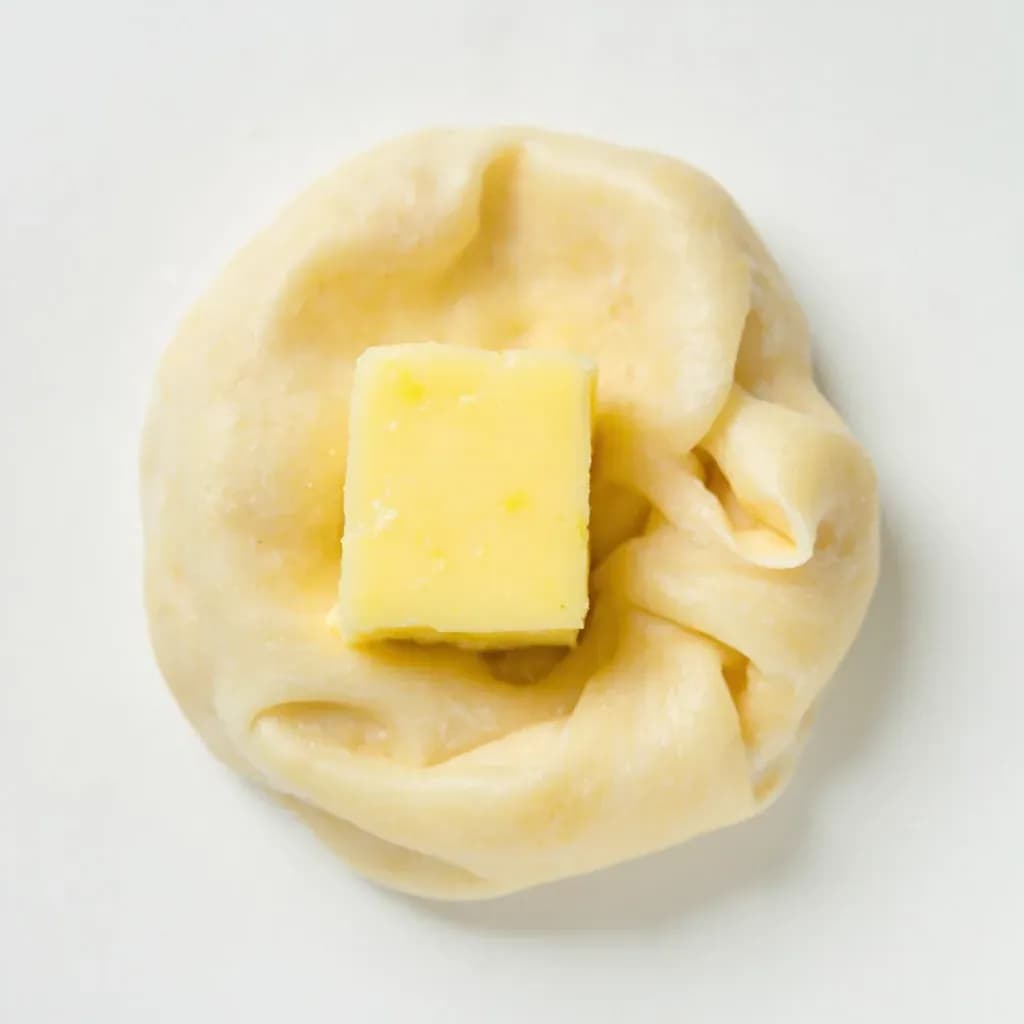
Prep & Assembly
Beurrage (Butter Block Enclosing)
Enclosing a shaped butter block inside the dough to begin laminating croissants and puff pastry.
Beurrage is the lamination step of pounding butter into an even slab and enclosing it within the détrempe dough before rolling and folding. Keeping the butter and dough at matched, cool plasticity is critical so the butter spreads into thin continuous layers instead of cracking or leaking. Successive folds multiply these layers into the flaky structure of croissants and puff pastry.
Beurrage is the deliberate enclosing of a shaped butter block inside the lean dough wrapper (the détrempe), and it is the foundation of every laminated dough. Once the dough and butter are locked into a single sealed package, each subsequent roll-and-fold multiplies the alternating layers of fat and dough, eventually producing the dozens to hundreds of paper-thin sheets that puff pastry and viennoiserie are built on.
The lock-in is a temperature act, not a folding act. The butter must be cold enough to stay solid, plastic enough to bend without shattering, and matched closely in temperature to the dough. If the butter is too cold it cracks the dough open; if it is too warm it absorbs into the flour and the layers vanish. Done well, beurrage sets up clean oven spring; done carelessly, no amount of careful folding will recover lost lamination.
This is also where the habits of laminated baking are formed: weighing the butter and dough, marking each completed turn, respecting chill times, and working in a cool kitchen. Those small disciplines are what separate flaky, shatter-crisp pastry from a laminated dough that comes out of the oven dense and uneven.
- Difficulty
- Hard
Types & varieties
Détrempe rolled into a square, butter placed diagonally in the center, and the four corners folded up and over to meet in the middle like a sealed envelope. The traditional approach for puff pastry and the most forgiving for square doughs.
Détrempe rolled into a rectangle roughly twice the size of the butter, butter placed on one half, and the unbuttered half folded over. Faster and favored in commercial bakeries.
Both short ends of a rectangle folded into the center, then folded in half. Used as the first lock-in when the recipe calls for book (double) turns throughout, especially for croissants.
How to do it
- 1
Prepare and chill the détrempe
Mix the laminated dough (a lean mixture of flour, water, salt, a little sugar, and a small amount of butter) and shape it into a flat disc. Wrap tightly in plastic and chill for at least 1 hour, preferably overnight, so the gluten relaxes and the butter firms up before enclosing.
- 2
Prepare the butter block
Place cold high-fat butter between two sheets of parchment paper. Pound it flat with a rolling pin to start, then roll it into a square or rectangle of consistent 6–8 mm (¼-inch) thickness. The block should be cold but pliable — a finger pressed to the surface should leave a slight dent without cracking or smearing. Return it to the fridge while you roll out the dough.
- 3
Roll out the détrempe
On a lightly floured, cool surface, roll the chilled détrempe into a square or rectangle roughly twice the size of the butter block, at a uniform thickness slightly greater than the butter so the dough will not tear when folded. Use a ruler to keep the edges straight and the corners square.
- 4
Position the butter
Place the butter block in the center of the dough. For the envelope method, rotate the butter 45° so it sits as a diamond inside the square. For the letter method, place the butter on one half of the rectangle, leaving a small border of dough on three sides.
- 5
Fold the dough to enclose the butter
Envelope method: bring the top and bottom corners of the dough up and over the butter, then fold the side corners in so all four points meet in the middle, like wrapping a gift. Letter method: lift the unbuttered half of the dough and fold it over the butter to cover it completely.
- 6
Seal the package
Press firmly along the overlapping seams with your fingertips or a bench scraper to seal the dough around the butter — no butter should be visible. The package should look like a sealed flat parcel, ready for its first turn.
- 7
Perform the first turn
Lightly flour the surface, place the package seam-side up, and roll it gently into a long rectangle about three times its width. For a single fold (tour simple), fold it in thirds like a business letter. For a book fold (tour double), fold both short ends into the center, then fold in half. This counts as turn one.
- 8
Chill and repeat
Wrap the folded dough in plastic, mark it (one finger poke per turn completed), and refrigerate 30–60 minutes. Repeat the rolling and folding for the remaining turns — 3 book folds for croissants and Danish, 6 single folds or 3 book folds for puff pastry — chilling between each, until lamination is complete.
Détrempe versus beurrage
In French pastry, the dough wrapper is the détrempe and the butter block is the beurrage. They are built separately, rested separately, and then brought together at the lock-in. Successful lamination depends on keeping both at a similar cool temperature — if the butter is markedly colder than the dough, it shatters when folded; if it is markedly warmer, it absorbs into the dough and the layers vanish. The enclosing step is what makes them one laminated package and is the moment where temperature discipline matters most.
Why high-fat butter matters
European-style butter at 82–84% fat (with only 16–18% water) is the gold standard for laminated doughs. The lower water content produces cleaner layer definition, more dramatic oven spring, and a more tender final pastry. Standard supermarket butter at around 80% fat still works but yields slightly less lift and a marginally tougher crumb; the difference is small in a single turn and compounds with each subsequent fold.
Envelope versus letter: are they equivalent?
Both methods produce essentially the same lamination; the difference is workflow. The envelope (French) method is slower but keeps the package square, which is convenient when many turns are performed on a square dough. The letter (English / rapid) method is faster, leaves a single straight seam rather than four overlapping corners, and is favored in production bakeries for that reason. Home bakers can use either — pick the one that matches the shape of dough your recipe calls for.
Common uses
Tips & pitfalls
- Use European-style butter (82%+ fat) — its lower water content yields cleaner layer separation and higher rise.
- Pound the butter block between two parchment sheets with a rolling pin before rolling; even thickness across the block is the single biggest predictor of even lamination.
- Target butter at 15–18°C: a finger pressed to the surface should leave a slight dent without cracking or smearing. If it shatters, it is too cold; if it feels greasy, it is too warm.
- Work in an 18–21°C / 65–70°F kitchen. A warm room melts butter into the dough and destroys the lamination before the oven is ever lit.
- If the dough springs back or fights you when rolling, stop, cover, and rest it 5–10 minutes — the gluten needs to relax before the next pass.
- If butter breaks through the dough on the first turn, patch the crack with a small piece of dough from the edge, then chill 15–20 minutes before continuing.
- Seal the overlapping edges firmly with fingers or a bench scraper — any gap is the path the butter will take to escape during baking.
- Mark each completed turn in the dough (e.g., 1, 2, 3 finger pokes) so you never lose count of folds.
- Use a ruler or pastry mat to size both the butter block and the détrempe — eyeballed ratios produce ragged, uneven layers.
- Dust very lightly with flour while rolling; excess flour folds into the dough and toughens the finished pastry.
- Chill all tools (rolling pin, bench scraper, surface if possible) for 10 minutes before starting — anything warm enough to soften the butter is working against you.
Good to know
- French terms
- Beurrage = the butter block; détrempe = the dough that wraps it
- Butter ratio (puff pastry)
- Roughly 1:1 by weight with the flour
- Butter ratio (croissant)
- About 30–40% of flour weight
- Ideal butter temperature
- 15–18°C / 60–65°F (plastic, dents to a light press)
- Ideal dough temperature
- ≈18°C / 65°F
- Butter block thickness
- 6–8 mm / ¼ inch, rolled to a uniform shape
- Preferred butter
- European-style, 82%+ fat (lower water, cleaner layers)
- Turns required
- 6 single or 3 book folds for puff; 3 book folds (≈27 layers) for croissants
- Rest between turns
- 30–60 minutes refrigerated
- Working environment
- Cool kitchen, 18–21°C / 65–70°F
- Difficulty
- Intermediate to advanced
Also called
Butter Block Pounding & Shaping · Butter Enclosing · Beurrage · Lock-In
Related

Whisk
Beat ingredients smooth and aerated with a looping wire motion

Sift
Pass dry ingredients through mesh to aerate and remove lumps

Strain
Pour through mesh to separate solids from liquid for a smooth result

Filter
Pass liquid through fine material to clarify out the smallest particles

Rice
Press cooked potatoes through small holes for fluffy, lump-free texture

Mash
Crush soft cooked food into a rustic, creamy purée

Grind
Crush food into a coarse to fine texture, from spices to meat

Grate
Shred food into fine bits against a sharp-toothed surface