Prep & Assembly
Folding
Gently turning a light mixture over itself to combine without knocking out air.
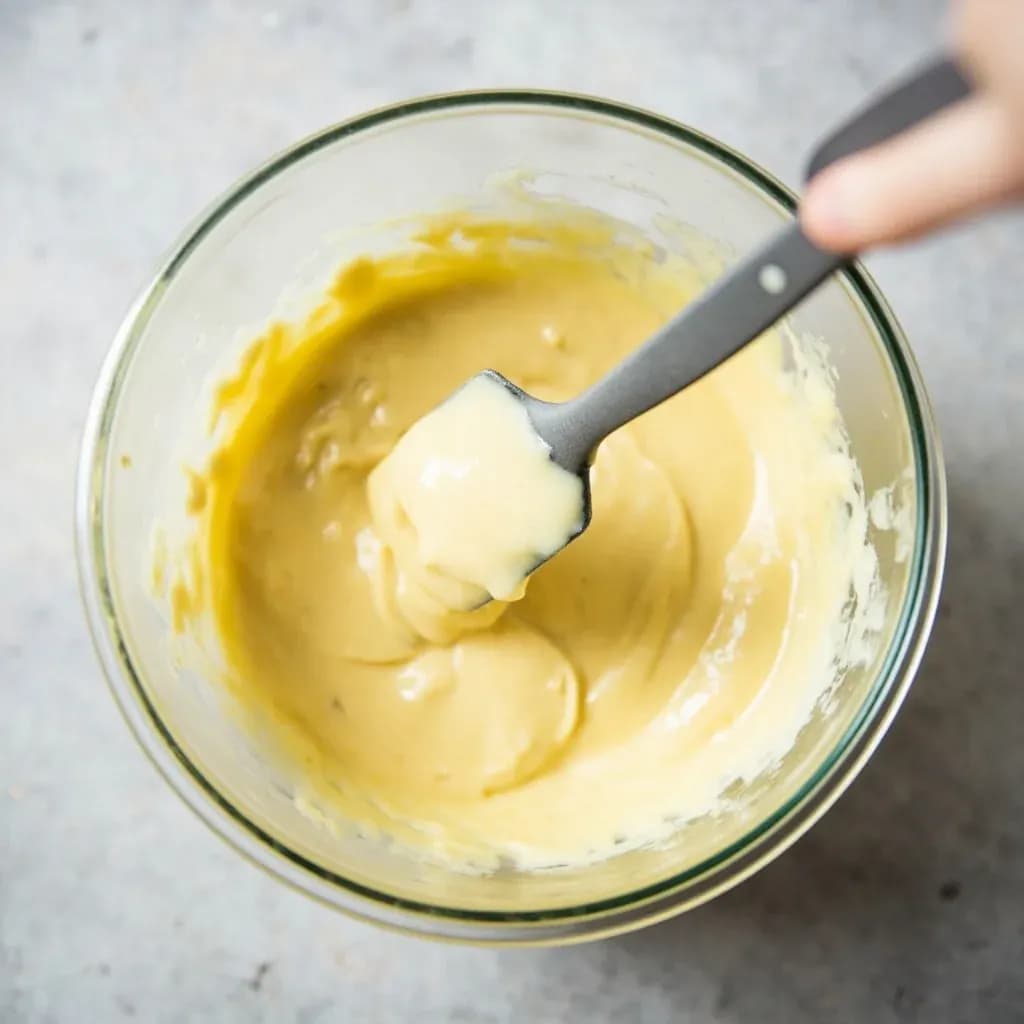
Folding is a gentle mixing motion that lifts and turns a batter or dough over itself, used to combine a delicate aerated component, like whipped egg whites or cream, into a heavier base without deflating it. A spatula cuts down through the center, sweeps along the bottom, and lifts up and over, rotating the bowl between strokes. It is also used for laminated and high-hydration bread doughs to build strength without aggressive kneading.
Folding is the gentle combining technique used to marry a light, aerated mixture with a denser one while keeping the air already trapped inside intact. Where whisking or beating drives air into a mixture, folding protects it: a flexible spatula cuts down through the center of the bowl, sweeps along the bottom, and turns the heavier base up and over the lighter foam, losing almost no volume in the process. It is the bridge between the two halves of almost every recipe that depends on trapped gas for its rise or its texture, from a chiffon cake to a chocolate mousse to a tray of macarons.
The behavior of a folded batter is easy to feel and easy to wreck. Egg whites, whipped cream, and sifted dry ingredients all need gentle handling — fragile networks of bubbles or particles that collapse or overwork under heavy stirring. Folding reorganizes that network rather than destroying it, distributing the lighter component through the heavier one with the minimum number of strokes. The reward is a batter that bakes tall and tender, a mousse that holds a soft peak on the spoon, or a macaronage that ribbons cleanly off the spatula.
Folding sits at the center of pastry and dessert technique, taught alongside whisking, whipping, creaming, and maceration as one of the core soft competencies. It requires no special equipment beyond a flexible rubber or silicone spatula and a bowl large enough to work in, and it rewards a relaxed hand, patience, and a willingness to stop a few seconds before you think you should.
- Difficulty
- Easy
Types & varieties
The standard down-across-up-and-over motion with a spatula, rotating the bowl a quarter turn between strokes; the default method for nearly all home recipes.
Whisk roughly a quarter to a third of the lighter mixture into the heavier base first to loosen it, then fold in the remainder in two or three additions; the safest approach for very airy foams.
Sift the lighter component (often dry ingredients or whipped whites) over the heavier base in stages, folding each addition in; the sifting step breaks up clumps and makes the fold itself gentler.
A few low-speed pulses with a stand mixer's paddle just until combined, used for large batches of cake batter where hand folding would take too long.
How to do it
- 1
Stage both mixtures
Place the heavier base in a large mixing bowl and have the lighter, aerated component (whipped cream, beaten egg whites, sifted dry ingredients) ready in a separate bowl. Bring them to a similar temperature where the recipe allows, and choose a bowl large enough to work in without the mixture climbing the sides.
- 2
Lighten the base
Scoop roughly one-third of the lighter mixture into the heavier base. Fold gently just until the base looks looser, slightly paler, and easier to move. This initial sacrifice makes the rest of the job faster and far gentler on the foam.
- 3
Add the lighter mixture in stages
Add the remaining lighter mixture in two or three additions, folding each in before adding the next. Each addition takes fewer strokes than the last because the base keeps getting lighter.
- 4
Perform the fold
Hold the spatula vertically and cut straight down through the center of the mixture to the bottom of the bowl. Slide the spatula along the bottom toward you, then turn the wrist so the mixture rolls up the near side and folds over the top. Rotate the bowl a quarter turn and repeat, keeping the blade flat against the bottom.
- 5
Watch for the combine
Stop as soon as the last visible streaks of the lighter mixture disappear. A few small lumps or faint marbling are fine; further strokes only deflate the air you are trying to keep.
- 6
Scrape and use immediately
Give the bowl one final scrape around the bottom and sides to make sure no pockets of unincorporated heavier mixture remain, then transfer the batter to its pan, ring, or mold right away. Standing time will quietly bleed out the air you have just worked to preserve.
The physics of a fold
A whipped egg white is a foam: millions of tiny air cells wrapped in denatured protein. A creamed butter and sugar mixture is an aerated fat with trapped gas. A pâte à bombe is a warm sugar syrup poured into beaten yolks, where it whips into a thick, pale ribbon. Each of these is built to hold air, and each of them collapses the moment you beat or stir it the way you would a custard.
- Folding is a translation movement, not a mixing movement: the spatula moves ingredients over each other rather than around each other.
- Each stroke should leave the batter looking slightly more uniform than before; if the surface is glossy and the volume has barely changed, the fold is working.
- Heat, time, and salt all destabilize a foam, so fold as late as possible in the recipe and bake or chill the result promptly.
How to read a folded batter
Knowing when to stop is the real skill of folding. A properly folded batter looks just-homogeneous: a uniform color, a satiny surface, and a volume close to what you had before combining. Overfolded batters look dull, feel heavy or gummy on the spatula, and bake into dense, uneven crumb.
- A few faint streaks or small lumps of the lighter mixture are acceptable and almost always disappear in the oven.
- A batter that is dropping in volume as you fold, or one that shows streaks of liquid pooling at the bottom of the bowl, has been overworked.
- For macaronage, the correct fold ends with a batter that flows in a thick, lava-like ribbon and disappears back into the rest within about 20 seconds.
Common uses
Tips & pitfalls
- Always add the lighter mixture into the heavier base, never the reverse, so the heavier mixture only needs to accept a smaller, more delicate addition.
- Use a large, wide bowl so the mixture has room to turn over itself without being crushed against the sides.
- Keep the spatula flat against the bottom of the bowl as you sweep; curling the edge of the blade forces air out of the foam.
- Stop the moment no white streaks remain — a few small lumps are far better than a deflated, overworked batter.
- Rotate the bowl a quarter turn with each stroke so the same ingredients are not repeatedly folded over themselves.
- Do not stir, beat, or whisk while folding; circular stirring drives air out of the mixture and will undo the work of whipping.
- For very stiff foams, sacrifice a small portion of the whites (or cream) to loosen the heavier base first; this makes the rest of the folding faster and gentler on the foam.
- Work at a comfortable counter height with a relaxed wrist and arm; tension translates directly into rough, deflating folds.
Good to know
- Technique type
- Gentle combining method
- Primary purpose
- Combine a light, aerated mixture with a denser mixture while preserving air
- Core motion
- Cut down through the center, sweep along the bottom of the bowl, and fold the mixture over itself
- Standard tool
- Large flexible rubber or silicone spatula
- Also known as
- Cutting and folding; in French pastry, "incorporer délicatement" or "plier"
- Difficulty
- Low to moderate; the technique is simple, but a light hand is essential
- Typical time
- Under 1–2 minutes per batch once staged
- Pairs with
- Whisking, whipping, sifting, and creaming, which build the structure folding is meant to protect
Also called
Fold In · Incorporer · Cut and Fold
Dishes that rely on it
Related

Whisk
Beat ingredients smooth and aerated with a looping wire motion

Sift
Pass dry ingredients through mesh to aerate and remove lumps

Strain
Pour through mesh to separate solids from liquid for a smooth result

Filter
Pass liquid through fine material to clarify out the smallest particles

Rice
Press cooked potatoes through small holes for fluffy, lump-free texture

Mash
Crush soft cooked food into a rustic, creamy purée

Grind
Crush food into a coarse to fine texture, from spices to meat

Grate
Shred food into fine bits against a sharp-toothed surface