Transform & Preserve
Turning (Cellar Care)
Regularly flipping aging cheeses so moisture distributes and rinds develop evenly.
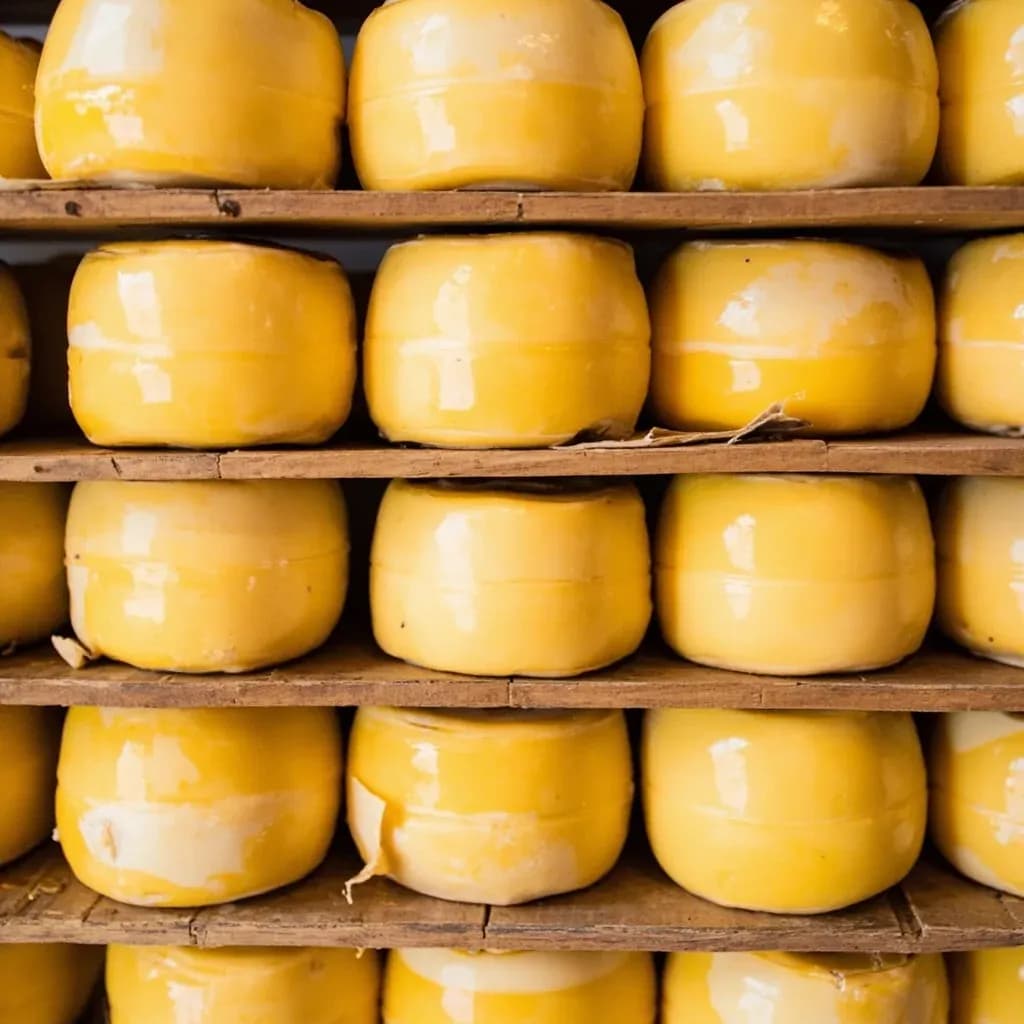
Turning is the cellar-care practice of periodically flipping cheeses as they age so internal moisture redistributes and the rind forms uniformly on all sides. Without turning, a wheel can settle, weep, or develop uneven texture and mold. The schedule, daily at first then less often, is part of the affinage routine that ripens cheese properly.
Turning — *retournage* or *tommelage* in French — is the regular practice of flipping an aging cheese wheel so the face pressed against the shelf becomes the face exposed to the cellar air, and vice versa. It is the most repetitive task in any affinage operation and, in many ways, the most important: the side in contact with the board sweats, traps moisture, and softens, while the exposed side dries, ripens, and develops rind. Without regular turning, that imbalance produces deformed wheels, sour or ammoniated contact patches, and rinds that look like a patchwork rather than a uniform coat.
The value of turning is cumulative rather than immediate. A single skipped turn rarely ruins a cheese, but the rind tells the story weeks later as uneven color, soft spots, or a wheel that has slowly slumped into a teardrop shape. Traditional affineurs have codified the practice into a fixed daily round — same hour, same order, same hands — because consistency, not intensity, is what produces an even, healthy rind. Turning also doubles as the moment of inspection: the affineur sees every face of the cheese, catches early defects, applies washes or brushes, and decides whether a wheel needs more humidity, more air, or a different shelf.
For a home affineur working with one or two wheels, the same logic applies at a smaller scale. A dedicated cool space, a calibrated hygrometer, food-safe boards, and a steady hand are enough to age most styles successfully — provided the schedule is actually kept. The discipline matters more than the equipment.
- Difficulty
- Easy
Types & varieties
Used for Camembert, Brie, Époisses, and Munster; prevents rind deformation and moisture pools on the contact face.
Applies to Tomme-style, raclette, and young Gruyère; every 2–3 days is typical.
Comté, aged Gruyère, and Parmigiano-Reggiano wheels are flipped about once a week, often on their own rotation schedule.
Washed-rind cheeses are flipped and the rind rubbed with brine, marc, beer, or spirits at each turn.
Natural-rind hard cheeses like Comté and Beaufort are brushed to remove unwanted surface molds during turning.
Large industrial cellars use slow-rotating racks or robotic arms to flip hundreds of wheels per cycle.
How to do it
- 1
Prepare the cellar and yourself
Confirm humidity and temperature are within the cheese's target range. Wash hands thoroughly and put on powder-free, food-safe gloves. Lay out clean turning boards and any wash or brine solution needed for the styles on the shelf.
- 2
Inspect each cheese in turn
Pick up each cheese carefully and check the contact face for moisture pooling, unwanted mold, rind slip, or physical damage. Note anything unusual in the cellar log before moving on.
- 3
Wash or brush the rind if required
For washed-rind styles, rub the rind gently with brine, beer, marc, or a spirit solution using a soft cloth. For natural-rind hard cheeses, brush the surface (frottage) to remove fugitive molds. Skip this step for dry-salt or bloomy cheeses unless the recipe calls for it.
- 4
Flip the cheese onto a clean face
Support the cheese from below with a board or a flat hand, lift cleanly, and set it down on its opposite side on a clean section of shelf or a fresh board. Never drop, drag, or pinch the cheese.
- 5
Space and arrange
Place the cheese with at least one wheel-width of clearance on all sides so air can move freely around it. Allow the previously wet face to dry in the moving cellar air before the next turn.
- 6
Log the turn
Record the date, the side that was previously face-down, the rind condition, and any action taken — washed, brushed, salted, or set aside for further ripening.
- 7
Clean boards and tools
Scrub used boards in hot water (and a food-safe sanitizer if needed), dry them completely, and return them to rotation. Replace cloths and refresh wash solutions rather than topping them up.
The daily round: consistency as craft
In a traditional cellar, turning is rarely a standalone task. It is folded into a routine — *retournage* (turn), *frottage* (brush), and *lavage* (wash) — that the affineur performs in the same sequence at the same hour each day. Cheeses are checked in a fixed order so nothing is missed, the contact face is inspected before it disappears under the wheel again, and the wash or brush is applied to the new exposed face before the cheese is set back down. This rhythm is not superstition: a stable routine produces a stable rind, because the microflora, the moisture gradient, and the salt migration all respond to predictable inputs. An affineur who turns in a different order, at a different time, or only when they remember will see the difference within a few weeks, even on the same wheels, in the form of mottled color and uneven rind thickness.
- Fix a time of day and an order of cheeses; do not improvise.
- Let the previously wet face dry in moving air before the next turn.
- Rotate boards out for cleaning periodically — a contaminated board spreads mold and slime faster than the air does.
Tools of the trade
A turning station needs very little. A flat, food-safe board slightly larger than the cheese base is the workhorse; thin plastic or stainless spatulas rescue stuck wheels; soft natural-bristle brushes handle the *frottage*; and clean cloths or sponges apply the wash. Gloves should be powder-free and food-safe, since direct hand contact introduces both moisture and contaminating flora. A cellar log — paper notebook, spreadsheet, or even date stickers on the wheel — closes the loop by making each turn traceable.
- Ripening shelves: untreated spruce/pine (traditional) or food-grade plastic/stainless (modern).
- Turning boards: rigid, smooth, slightly oversized; one per cheese is ideal.
- Rind brushes: soft natural or synthetic bristles for brushing natural rinds.
- Wash supplies: brine, beer, marc, or spirits, plus clean cloths.
- Hygrometer and thermometer: non-negotiable for any cellar above a few wheels.
- Cellar log: record date, side turned, rind observations, and any action taken.
Common uses
Tips & pitfalls
- Establish a fixed schedule — same time each day — and stick to it; irregular turning shows up as uneven rind color or thickness weeks later.
- Mark each cheese (date sticker, wax code, or stencil) so you can tell at a glance which side was last face-down.
- Wear powder-free, food-safe gloves and keep hands and tools clean; rind damage invites contamination that no amount of later turning will fix.
- Lift, do not drag: sliding a soft cheese across a board tears young rinds and leaves a sticky residue on the shelf.
- Rotate boards out for washing and drying periodically, use a clean section of board for each turn, and wash cheese-cloths on linen-wrapped styles to prevent mold transfer between cheeses.
- Leave at least one wheel-width of space between cheeses so air circulates on all sides and rinds dry evenly.
- Record every turn in a cellar log — date, side turned, rind observations — for traceability and quality control.
- Treat bloomy-rind cheeses gently once the Penicillium candidum coat has formed; pressing too hard flattens the bloom and leaves a fingerprint in the rind.
- For very soft or surface-ripened cheeses, use a flat, wide turning board or spatula to support the entire base rather than grabbing the edges.
- If a cheese sticks to the board, slide a thin plastic or metal spatula under it rather than pulling it up by the rind.
- For washed-rind cheeses, apply the wash or brine with a soft cloth or brush and let the cheese rest on a dry face before returning it to the shelf.
Good to know
- French term
- Tommelage (also retournage)
- Primary purpose
- Distribute moisture, prevent rind defects, and maintain cheese shape during affinage
- Typical frequency
- Daily for soft and washed-rind cheeses; every 2–3 days for semi-soft; weekly or less for hard
- Cellar conditions
- Generally 50–55°F (10–13°C) and 85–95% relative humidity, varied by style
- Traditional shelf material
- Untreated spruce or pine slats, often gapped for air circulation
- Modern shelf material
- Food-grade plastic, stainless steel, or epoxy-coated metal for sanitation
- Time per cheese (manual)
- Roughly 30 seconds to 2 minutes depending on size and rind sensitivity
- Skill level
- Beginner-friendly but requires consistency and gentle handling
- Equipment
- Ripening shelves, turning boards, rind brushes, brine/salt solutions, food-safe gloves, humidity/temperature monitor
- Origin
- As old as aged-cheese traditions; codified in French and Alpine affineur practice over centuries
Also called
Cheese Turning · Affinage Turning
Dishes that rely on it








Related

Confit
Cook slowly submerged in fat for silky tenderness and keeping

Cure
Draw out moisture with salt and time to preserve and concentrate

Pickle
Steep in acidic brine for bright, tangy, crunchy preservation

Ferment
Let friendly microbes transform food into tangy, complex flavor

Marinate
Soak in a seasoned mix to flavor and tenderize before cooking

Brine
Soak in salt water so meat stays juicy and seasoned throughout

Dehydrate
Slowly dry out moisture to concentrate flavor and extend shelf life

Cold-Smoke
Perfume cured food with smoke without cooking it through