Prep & Assembly
Whipping
Beating cream or eggs to incorporate air and build volume and structure.
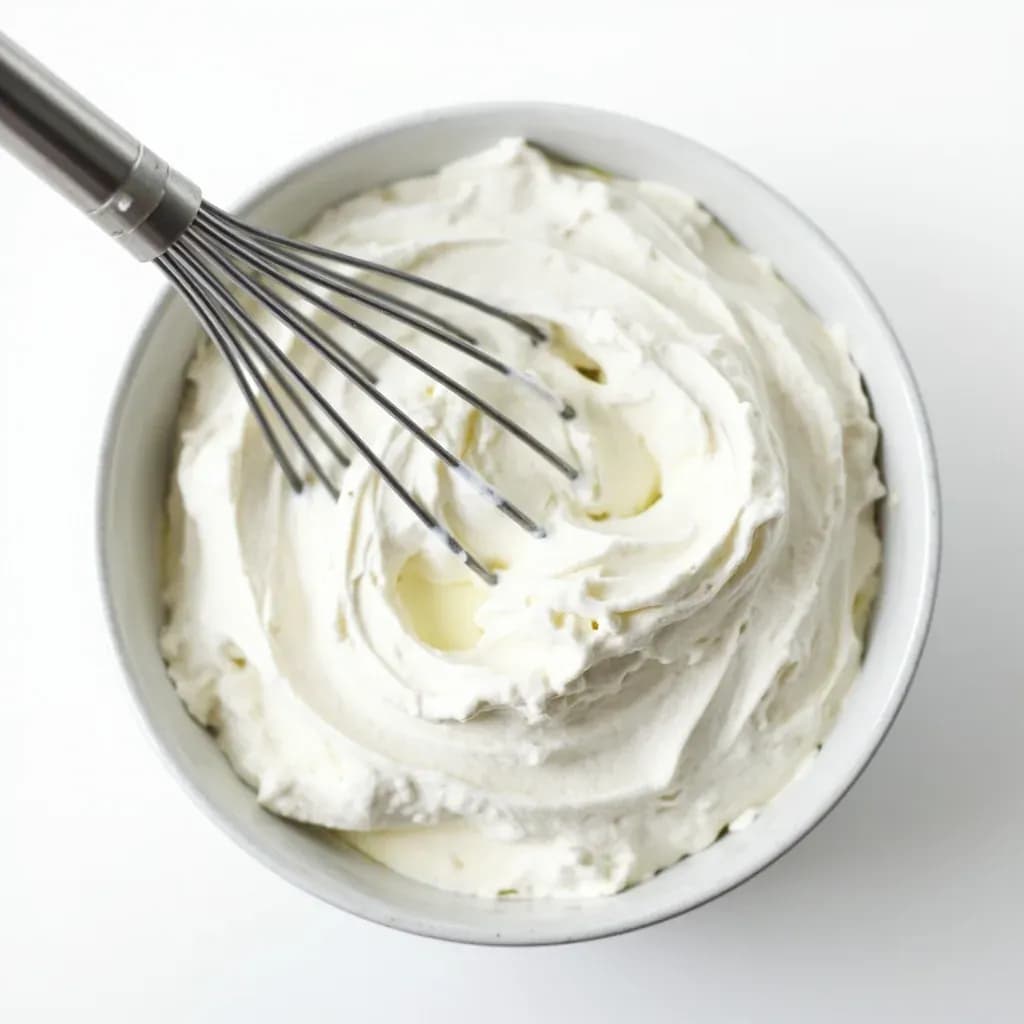
Whipping rapidly beats a liquid such as cream or egg whites to fold in air, creating foam, peaks, and lightness. It is essential for whipped cream, meringues, mousses, and sponge batters. The fat in cream or the protein in egg whites traps the air bubbles, so cold cream whips best while clean, fat-free bowls are critical for stiff egg-white peaks.
Whipping is the deliberate beating of a liquid — most often dairy cream or eggs (whites, yolks, or whole) — to force air into it and trap that air in a stable network. The air does work that chemical leaveners can't always manage on their own: it lightens heavy batters, lifts soufflés, holds a piped rosette on a slice of pie, and turns a thin custard into a mousse. Almost every classic preparation whose name ends in "Chantilly," "meringue," "mousse," or "foam" begins here.
Mechanically, whipping builds one of two kinds of foam, and which one you are making dictates everything that follows. In cream, fat globules are mechanically forced together by the whisk until they partially clump into a semi-solid lattice; that lattice surrounds each incorporated air bubble and holds the watery phase in place, which is why whipped cream stands in peaks. In egg whites, vigorous whisking unfolds dissolved proteins — primarily ovalbumin, conalbumin, and ovomucin — which migrate to the surface of each air bubble and set into a thin, elastic skin that stabilizes the foam as it cools. Both systems are fragile in their own way: cream collapses once the fat network over-coalesces (past stiff peaks, on the way to butter), while whites collapse the moment the protein film is broken by sugar added too soon, by hot syrup poured in too fast, or by the smallest trace of yolk fat.
The cook's job, then, is to manage temperature, timing, and additions so the foam reaches the peak the recipe asks for — and stops there.
- Difficulty
- Easy
Types & varieties
Dairy cream with at least 30% fat (U.S. heavy whipping cream is ≥36%); the standard base for whipped cream and Chantilly.
Whipped egg whites stabilized with sugar, in three classic styles: French (raw whites + sugar, folded in gradually), Swiss (whites and sugar warmed together over a bain-marie), and Italian (hot sugar syrup poured into whipping whites).
Whipped cream sweetened with sugar and usually flavored with vanilla; the cream's fat provides structure, and powdered sugar's cornstarch (if used) adds modest stability.
Whipped egg yolks aerated with hot Italian-style sugar syrup; used to enrich and lighten mousses, frozen desserts, and buttercreams.
Whipped egg yolks (often with whole eggs) over a bain-marie with sugar and Marsala or other wine, cooked to a light, foamy ribbon stage.
An emulsion of chocolate, cream, and milk whipped as it sets, yielding a mousse-like, sliceable texture used in plated desserts and cake fillings.
Liquid charged with N2O in a siphon, usually stabilized with lecithin or gelatin, to dispense warm or cold airs and espumas for modern plating.
Cream whipped with powdered sugar (cornstarch), bloomed gelatin, xanthan, mascarpone, or a small amount of cream cheese for hold times of many hours in pastry and layered cakes.
How to do it
- 1
Choose and prepare your base
For cream, use dairy cream with at least 30% fat; chill it to 4–7°C (39–45°F) along with the bowl and whisk. For egg whites, separate carefully with no trace of yolk, and bring the whites to about 20°C (68°F) for maximum volume; make sure the bowl and beaters are clean, dry, and completely grease-free.
- 2
Begin whipping slowly
Start at low speed to break the surface and disperse the fat (in cream) or begin denaturing the proteins (in whites). This stage typically lasts 30–60 seconds and prevents splashing and uneven aeration; it also lets you incorporate air in finer, more uniform bubbles.
- 3
Increase the speed
Once the mixture is moving and looking frothy, raise to medium or medium-high. The cream will thicken noticeably within a minute; whites will pass through a clear, foamy stage and turn white and billowy. Total whipping time is usually 1–3 minutes for cream and 2–4 minutes for whites at moderate speed.
- 4
Add sugar or acid at the right moment
For cream, add sugar and any flavorings (vanilla, liqueur, citrus zest) once soft peaks form, so they dissolve into the foam without deflating it. For whites, add cream of tartar or a small pinch of salt at the foamy stage, and stream in sugar gradually once the whites hold soft peaks — never at the start.
- 5
Whip to the target peak
Stop the machine and check the peaks by lifting the whisk. Soft peaks curl at the tip; medium peaks stand but tip over slightly; stiff peaks stand straight and hold their shape firmly. Stop at the stage your recipe calls for — don't chase 'extra' stiffness, especially with cream, which will cross over into butter.
- 6
Use immediately or stabilize
Use the whipped mixture right away for maximum volume, or stabilize it for hold times of several hours: powdered sugar, bloomed gelatin, cream cheese, or mascarpone for cream; cream of tartar (or a small amount of acid) for egg whites. Fold gently into batters in three additions, using a large flexible spatula and a cutting-and-turning motion to preserve the air you've worked to build.
The two foam systems
Almost every whip you'll do in a kitchen falls into one of two foam systems, and recognizing which one you're building is the fastest route to consistent results. The two respond to temperature, sugar, fat, and time in nearly opposite ways, which is why a tip that rescues cream can ruin whites (and vice versa).
- Fat-based foam (cream, whipped ganache): built from partially coalesced milk-fat globules that clump around air bubbles; needs cold ingredients (4–7°C) so the fat stays semi-solid; tolerates modest sugar and flavorings once soft peaks form; collapses abruptly when over-whipped, as the fat network tightens past peaks and expels water on the way to butter.
- Protein-based foam (egg whites, sabayon, pâte à bombe): built from denatured proteins — mainly ovalbumin, conalbumin, and ovomucin — that unfold and form a thin elastic film at the air-water interface; needs whites at ~20°C for maximum volume; is destroyed by any trace of yolk fat or oily residue, and limited by sugar added before soft peaks form; benefits from a small amount of acid (cream of tartar or lemon juice) and can be further stabilized by cooking (Swiss and Italian meringue) or drying (pavlova, meringue cookies).
Common uses
Tips & pitfalls
- Chill the cream, bowl, and whisk for 15–20 minutes before whipping; cold fat whips faster and gives a more stable network.
- Start at low speed to break up the fat, then increase to medium-high once the cream is moving — finer bubbles make a finer, more stable foam.
- Stop whipping cream the moment you reach stiff peaks; another 10–20 seconds and the fat network will expel water and you've started making butter.
- For egg whites, wipe the bowl and beater with a little white vinegar or lemon juice and dry thoroughly to remove any trace of grease that would stop the foam from forming.
- Add sugar to egg whites only after soft peaks form — sugar added at the start interferes with protein unfolding and limits volume.
- Use cream of tartar (about 1/8 teaspoon per 2 whites) when whipping high-sugar meringues; it keeps the foam glossy, white, and stable.
- Separate eggs while cold (the yolks are firmer and break less easily), but let the whites come to room temperature before whipping for the greatest volume.
- Avoid plastic bowls for whipping egg whites — they tend to hold a residue of fat. Use glass, stainless steel, or copper; copper bowls are a classic because copper ions react with conalbumin to further stabilize the foam.
Good to know
- Minimum fat for whipped cream
- Cream must contain at least ~30% milk fat to whip reliably; U.S. heavy cream and heavy whipping cream both qualify, while half-and-half (~10–12%) and single or light cream will not hold stable peaks.
- Best temperature for cream
- Cream whips best at 4–7°C (39–45°F); chilling the bowl and whisk for 15–20 minutes helps the fat crystallize and yields a more stable structure.
- Best temperature for egg whites
- Whites whip to greatest volume at ~20°C (68°F); cold whites whip more slowly but can be marginally more stable. Whites that are 24–48 hours old whip to greater volume than very fresh ones.
- Acid for egg whites
- A small amount of acid — about 1/8 teaspoon cream of tartar per 2 whites, or a few drops of lemon juice or vinegar — speeds protein denaturation and prevents over-beating.
- Sugar timing for meringue
- Sugar should be added only after whites reach soft peaks; adding it at the start inhibits protein unfolding and caps the foam's volume.
- Yield
- 1 cup (240 ml) of heavy cream roughly doubles to about 2 cups of whipped cream; 1 large egg white (≈30–35 g) yields about 3/4 to 1 cup of stiff foam.
- Equipment
- Balloon whisk (hand), rotary or electric beater, stand mixer with whisk attachment, or a whipping siphon charged with N2O. Copper bowls are classically used for whites because copper ions react with conalbumin to stabilize the foam.
- Grease sensitivity
- Even a trace of yolk fat, oily residue, or plasticizer will prevent whites from whipping; bowls and beaters must be scrupulously clean, dry, and grease-free.
Also called
Whipping (Batir) · Whip (Montare) · Beating
Dishes that rely on it


Related

Whisk
Beat ingredients smooth and aerated with a looping wire motion

Sift
Pass dry ingredients through mesh to aerate and remove lumps

Strain
Pour through mesh to separate solids from liquid for a smooth result

Filter
Pass liquid through fine material to clarify out the smallest particles

Rice
Press cooked potatoes through small holes for fluffy, lump-free texture

Mash
Crush soft cooked food into a rustic, creamy purée

Grind
Crush food into a coarse to fine texture, from spices to meat

Grate
Shred food into fine bits against a sharp-toothed surface