Transform & Preserve
Stabilizing
Adding agents like gums or lecithin to keep emulsions, foams, or suspensions from separating.
Stabilizing means incorporating ingredients that hold a mixture together so it does not separate, weep, or collapse over time. Cooks use stabilizers such as gelatin, xanthan gum, lecithin, or cornstarch in ice creams, sauces, dressings, and foams. The right stabilizer controls texture and shelf life without dominating flavor.
Stabilizing is a family of techniques that keep emulsions from breaking, foams from collapsing, particles from sinking, and liquids from weeping or running. The shared intent is to extend the life and reliability of a textured system, but the underlying mechanisms are distinct. Emulsions are held by amphiphilic molecules (egg yolk, lecithin, mustard) that park themselves at the oil-water boundary and lower interfacial tension. Foams are held by proteins or surfactants that form elastic films around air bubbles. Suspensions are held by hydrocolloid thickeners (xanthan, guar) that raise the viscosity of the continuous phase until gravity can no longer move the particles. Gels are held by networks — proteins like gelatin or polysaccharides like agar that trap liquid in a three-dimensional scaffold.
The choice of agent matters more than the amount. A small dose of the right stabilizer for the temperature, pH, and alcohol content of a system will outperform a heavy hand of the wrong one. Xanthan and guar work in nearly any system; gelatin requires neutral pH and refrigeration; agar tolerates heat and acid but gives a brittle set; lecithin produces neutral-flavor foams but is fragile in the presence of strong acid and fat. Understanding the agent is the work of stabilizing; the rest is measurement, patience, and a digital scale that reads to 0.1 g.
The toolkit is older than modernist cooking — egg yolk in mayonnaise, gelatin in aspic, mustard in vinaigrette — but it expanded dramatically in the 1990s when Ferran Adrià and the elBulli team introduced agar, lecithin, and sodium alginate to fine-dining kitchens. Today these are everyday tools: a quarter-gram of xanthan rescues a broken sauce, a pinch of gelatin stabilizes whipped cream for a wedding cake, and a sheet of agar turns consommé into a clear, sliceable terrine.
- Difficulty
- Medium
Types & varieties
Holds oil and water together using amphiphilic agents — egg yolk, mustard, lecithin, mono- and diglycerides. Mayonnaise is a permanent emulsion; a plain vinaigrette is a temporary one that re-separates by design.
Lecithin produces neutral-flavor savory and fruit airs; egg white and gelatin stabilize warm or sweet foams; gum arabic is the standard for cocktail foams and confectionery work.
Raises the viscosity of the continuous phase so particulates do not settle. Xanthan and guar are the workhorses because they suspend effectively at low concentrations and pour cleanly.
Agar and gelatin set on cooling and remelt on heating, which makes them ideal for layered or warm service. Agar's remelt point near 85°C is well above body temperature; gelatin's near 30°C is below.
Alginate cross-linked with calcium sets permanently and will not remelt — the defining property of basic spherification beads and caviar-style pearls.
Adds body without gelling, used in sauces, soups, and cocktails. Xanthan is shear-thinning — it thins under stirring and recovers viscosity on resting, which is why it pours smoothly from a spoon but coats food well.
Egg white and gelatin form elastic films around air bubbles. Sugar is added after soft peaks, not before, so the weight of the sugar does not collapse the foam.
How to do it
- 1
Diagnose the system
Identify what is failing: an emulsion breaking with oil separation, a foam collapsing with large bubbles or weeping, particles sinking, or a liquid that simply needs body. Each problem responds to a different class of agent — emulsifier, foam stabilizer, suspending hydrocolloid, or gelling agent — so the diagnosis drives the choice.
- 2
Pick the right agent
Match the agent to the conditions: hot or cold service, pH, alcohol content, and desired texture. Xanthan for general-purpose viscosity hot or cold; agar for clear hot-set gels; gelatin for melt-in-the-mouth sets that soften near body temperature; lecithin for neutral-flavor foams; egg white for baked or low-acid foams; alginate for spherification; carrageenan for dairy gels; HPMC for hot foams and gluten-free binding.
- 3
Pre-disperse when needed
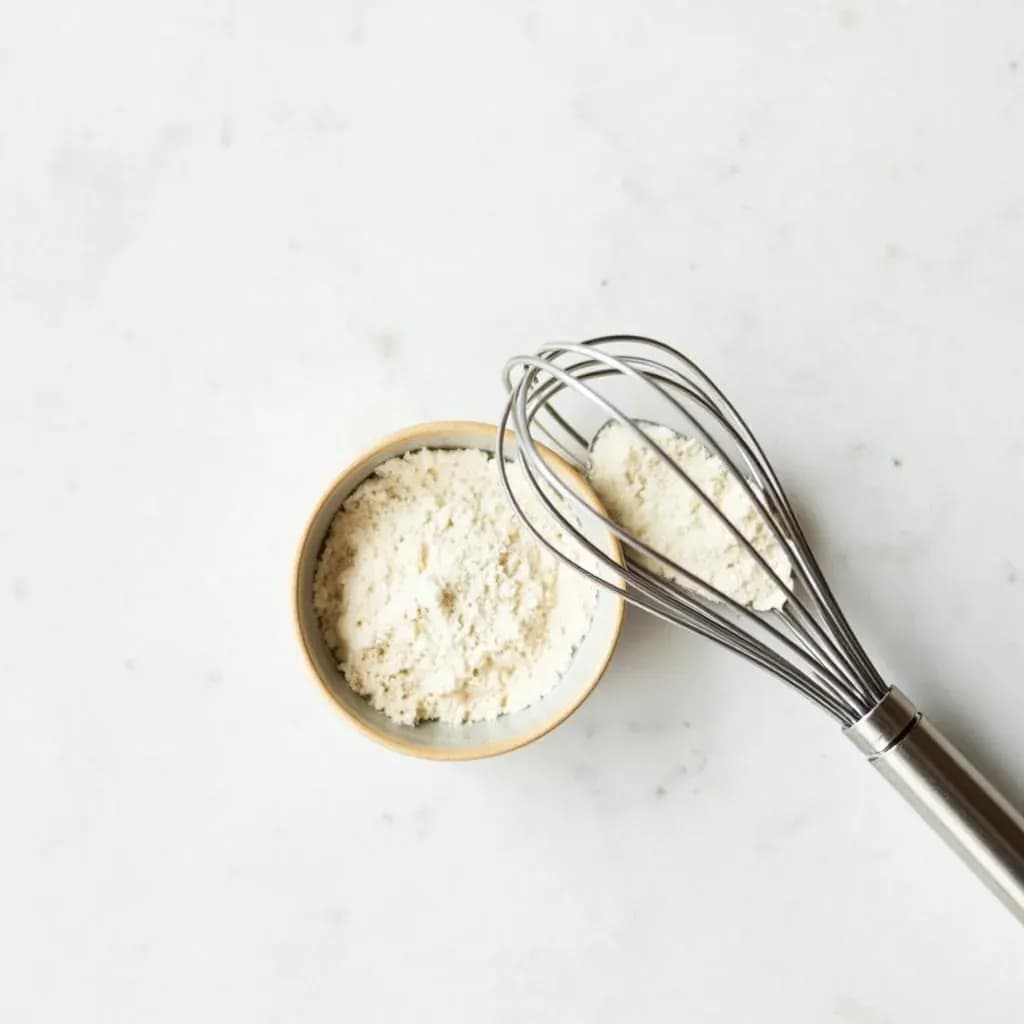
Hydrocolloid powders clump instantly when they hit water. Whisk the powder into an equal weight of sugar, salt, oil, or any non-aqueous liquid first, then add to the main liquid. Bloom gelatin and agar in cold water for 5 minutes before heating. Add HPMC to water already above 80°C, otherwise it will not hydrate.
- 4
Hydrate properly
Heat agar, gelatin, HPMC, and methylcellulose to their hydration temperatures — gelatin to 60–70°C, agar to a rolling boil, HPMC to 80–85°C. Xanthan, guar, and locust bean gum hydrate at room temperature under high shear; a stick blender will fully hydrate xanthan in 30–60 seconds.
- 5
Apply the right mechanical action
Emulsions need vigorous whisking or blending while oil is added slowly. Foams need air incorporation — an immersion blender for lecithin foams, a standing mixer for meringues, an iSi siphon charged with N₂O for long-lasting espumas. Suspensions just need enough shear to disperse the gum evenly without incorporating unwanted air.
- 6
Rest, chill, or set
Foams: rest 1–3 minutes for the bubble structure to stabilize and large bubbles to pop. Gels: chill or hold at setting temperature — gelatin around 4°C, agar at 40°C and below. Suspensions: let stand briefly to confirm viscosity holds; a properly suspended particle should not move perceptibly over 1 minute.
- 7
Test and adjust
Taste and check texture. If a sauce is too thin, add more gum 0.05% at a time and re-blend. If a foam collapses in 30 seconds, increase the surfactant or switch to a more robust protein. Spherification beads should bounce and burst cleanly on the tongue — adjust calcium or alginate concentration in 0.1% steps until the skin has the thickness you want.
Choosing the right agent
The first decision is what the system needs. If oil is separating from water, you need an emulsifier. If bubbles are popping or weeping, you need a foam stabilizer. If particles are sinking, you need a thickener. If you want a liquid to hold a shape, you need a gelling agent. Once the problem is named, the choice narrows quickly.
- Hot or cold service: agar and HPMC for hot work; gelatin for chilled service; xanthan for either.
- Acidity: xanthan and agar tolerate acid; alginate and carrageenan are damaged by it.
- Alcohol: high-proof liquids need more gum because alcohol disrupts hydrocolloid networks — increase xanthan 0.1–0.2% for cocktails above 30% ABV.
- Flavor neutrality: lecithin and methylcellulose are nearly flavorless; gelatin adds a light body flavor; agar contributes a faint marine note at high doses.
- Texture: agar gives a clean, brittle cut; gelatin gives a soft, melt-in-the-mouth wobble; locust bean gum gives an elastic, creamy set.
Common failures and their causes
Most stabilization problems trace to one of four causes: wrong agent for the conditions, insufficient hydration, acid or alcohol interference, or over-stabilization. Diagnose before adjusting, because doubling the wrong stabilizer rarely fixes the problem.
- Fisheye clumps in a sauce: the gum was added directly to plain water. Pre-disperse in sugar, salt, or oil.
- Foam collapses in under a minute: insufficient protein or surfactant, or a system too acidic for the chosen foam agent.
- Spherification beads turn mushy: the alginate bath is too dilute, or the rinse water was not clean.
- Agar will not set: agar was not boiled long enough to hydrate, or the system contains too much acid or sugar.
- Sauce feels slimy or ropy: too much xanthan or guar. Back off and rebuild from a thinner base.
Common uses
Tips & pitfalls
- Disperse gums in sugar, salt, or oil before hydrating in water. Adding them directly to plain liquid creates fisheye clumps that never fully dissolve, even with extended blending.
- Blend xanthan with high shear for 30–60 seconds. Under-blended xanthan leaves visible unhydrated particles and a grainy sauce.
- Let soy lecithin foams rest 1–3 minutes after blending so large bubbles can pop and a fine, even foam rises to the top.
- Charge an iSi siphon with N₂O, not CO₂, for stable, neutral-flavor foams. CO₂ adds carbonic bite and acidifies the system, which destabilizes many foams.
- Boil agar for at least 1–2 minutes. Under-boiled agar will not gel reliably, no matter how long you chill it.
- In acidic foams (citrus, vinegar), use gelatin or xanthan instead of pure egg white. Acid denatures egg white proteins and prevents stiff peaks.
- Rinse calcium-set spherification beads in clean water before storing them in a low-calcium bath. Residual calcium toughens the skin over time and turns the bead rubbery.
- Avoid sodium alginate in systems below pH 3.5 — it precipitates and will not gel cleanly. Switch to agar or gelatin for very acidic liquids.
- For stabilized whipped cream that holds piped shape for 12+ hours, even in a warm pastry case, use 0.3% xanthan and 0.5% gelatin bloomed in the cream before whipping.
- Resist the urge to over-stabilize. Total added hydrocolloid rarely needs to exceed 0.5% in sauces or 1% in foams. Small amounts of the right agent outperform large amounts of the wrong one.
Good to know
- Technique type
- Physical and chemical preservation of texture in emulsions, foams, suspensions, and gels
- Primary mechanisms
- Surface-active emulsifiers, viscosity-building hydrocolloids, network-forming gelling agents, and protein films around air bubbles
- Typical usage rates
- 0.05–2% of total weight for most gums; 0.3–1% for soy lecithin; 0.5–2% for gelatin
- Common agents
- Lecithin, xanthan, guar, locust bean gum, agar, gelatin, carrageenan, pectin, sodium alginate, methylcellulose, HPMC, gum arabic, egg yolk, egg white, mono- and diglycerides
- Temperature behavior
- Agar gels near 32–40°C and remelts near 85°C; gelatin sets around 15°C and melts near 30°C; xanthan works hot or cold; HPMC must reach ~80°C to hydrate, then gels on cooling
- pH tolerance
- Xanthan is stable across a wide pH range; alginate fails below pH ~3.5; carrageenan works best at pH 6–11; agar tolerates mild acid
- Sources of agents
- Seaweed (agar, alginate, carrageenan), bacterial fermentation (xanthan), seeds (guar, locust bean), animal and plant protein (gelatin, lecithin), citrus and apple pomace (pectin)
- Modern fine-dining debut
- Agar, lecithin, and alginate entered restaurant kitchens in the 1990s through the elBulli team led by Ferran Adrià
Also called
Texture Stabilization
Dishes that rely on it
Related

Confit
Cook slowly submerged in fat for silky tenderness and keeping

Cure
Draw out moisture with salt and time to preserve and concentrate

Pickle
Steep in acidic brine for bright, tangy, crunchy preservation

Ferment
Let friendly microbes transform food into tangy, complex flavor

Marinate
Soak in a seasoned mix to flavor and tenderize before cooking

Brine
Soak in salt water so meat stays juicy and seasoned throughout

Dehydrate
Slowly dry out moisture to concentrate flavor and extend shelf life

Cold-Smoke
Perfume cured food with smoke without cooking it through