Transform & Preserve
Spherification
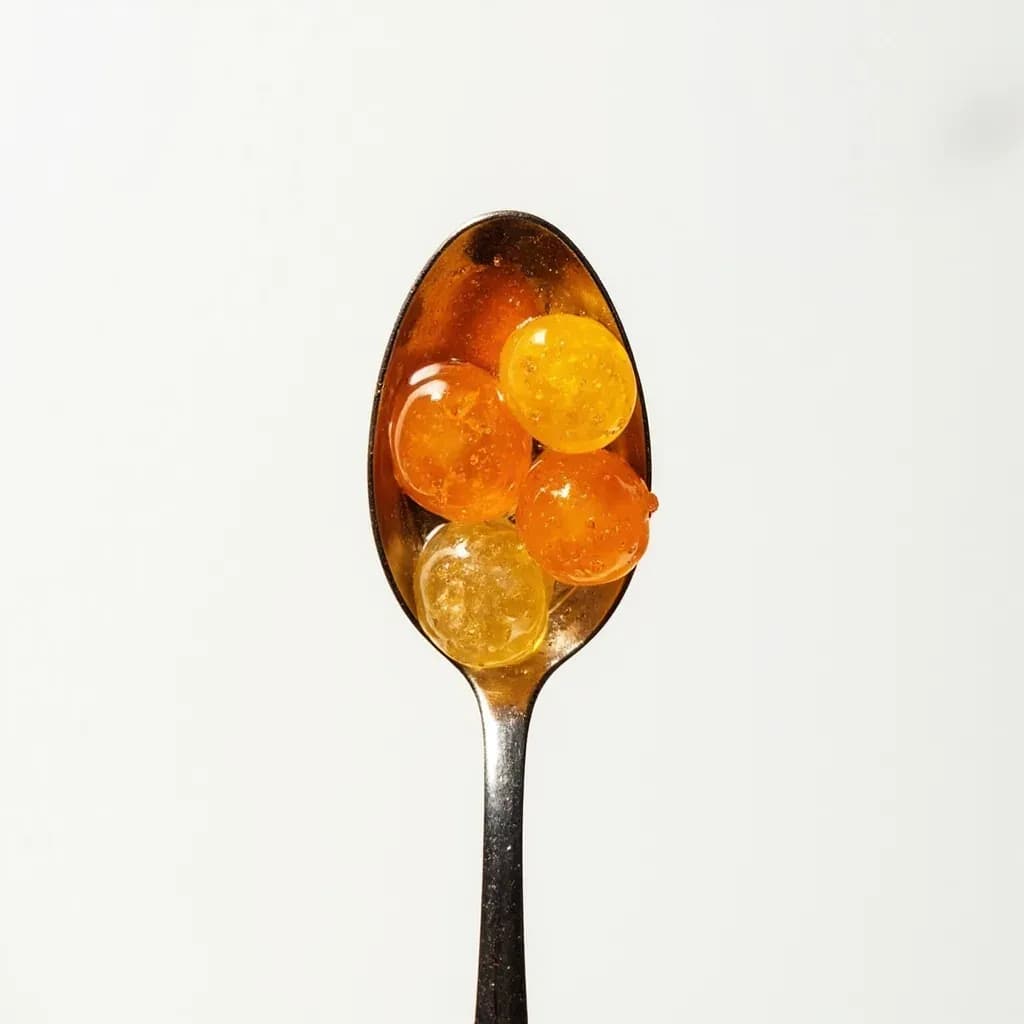
A modernist technique that gels a flavored liquid into juice-filled spheres with a thin membrane.
Spherification is a molecular-gastronomy technique that drops a liquid containing sodium alginate into a calcium bath (or vice versa), forming a thin gel skin around a liquid center. The result is a burst-in-the-mouth caviar or larger sphere that releases its flavor when bitten. Basic spherification gels from the outside in, while reverse spherification keeps the interior fully liquid for longer.
Spherification is a modernist technique that turns a flavored liquid into a self-contained orb with a thin, elastic membrane and a liquid center — the culinary equivalent of a soft-boiled yolk you can pop between your teeth. The magic is chemical rather than mechanical: sodium alginate, a polysaccharide extracted from brown seaweed, cross-links into a gel the moment it meets calcium ions. In the kitchen, a seasoned juice, purée, consommé, or cocktail can be coaxed into spheres ranging from faux caviar to egg-sized pearls, each delivering a controlled burst of flavor on the palate. The result is as much about texture and surprise as taste — a sphere is a sauce, a garnish, and a piece of edible architecture in a single bite.
Two distinct forms underpin the technique, and any cook must understand both before attempting it. Basic (or direct) spherification suspends sodium alginate in the flavored liquid and sets it by dropping it into a calcium chloride bath; it works beautifully for neutral, low-acid liquids but collapses once removed from the bath and refuses to gel in highly acidic ones. Reverse spherification flips the chemistry — the flavored liquid carries the calcium (added as calcium lactate or gluconate, or naturally present in dairy) and is dropped into an alginate bath, producing spheres that hold their shape out of water and tolerate acid and alcohol. Knowing which method to reach for, and respecting the small percentage tolerances of each ingredient, is the difference between a perfect pearl and a puddle.
- Difficulty
- Hard
Types & varieties
Sodium alginate is blended into the flavored liquid, which is then dripped or spooned into a calcium chloride bath. Best for liquids low in calcium and not too acidic. Spheres must be served from the bath or used immediately, as they lose structure once removed from calcium.
The flavored liquid is dosed with calcium lactate or calcium gluconate (or uses naturally calcium-rich dairy) and dropped into a sodium alginate bath. Spheres hold their shape when lifted out, tolerate acid and alcohol, and are the more forgiving method for most kitchen applications.
Tiny spheres formed by squeezing or syringing the liquid through a fine tip from a short height into a still bath. Used as a garnish on canapés, oysters, or plated accents.
Yolk- to egg-sized orbs scooped gently into the bath and shaped with a spoon. Sized to be eaten in one or two bites; perfect for consommé 'eggs' or cocktail spheres.
A calcium-bearing liquid is frozen into a sphere before being lowered into the alginate bath. The frozen core controls texture and slows flavor release until the sphere warms at the table.
How to do it
- 1
Choose the correct method
Use basic (direct) spherification for liquids without calcium and with pH above roughly 3.7 — clarified vegetable juices, light stocks, or herbal infusions. Use reverse spherification for dairy, fruit purées, citrus, wine, vinegar, or any strongly flavored liquid.
- 2
Prepare the flavored liquid
Strain the flavor base through a fine-mesh sieve so it pours in a clean, unbroken thread. For basic: blend in 0.5–1% sodium alginate by weight with an immersion blender. For reverse: blend in 0.5–1.5% calcium lactate or calcium gluconate. Add the powder slowly and blend until fully dissolved.
- 3
De-gas the mixture
Rest the alginate mixture in the fridge for 30–60 minutes, or vacuum-seal it, to draw out trapped air. Air bubbles become dimples and weak points in the membrane; removing them is the difference between glossy and pitted spheres.
- 4
Prepare the setting bath
For basic: dissolve 0.5–1% calcium chloride in cold water in a wide, shallow, still container. For reverse: dissolve about 0.5% sodium alginate in cold water, blend briefly, and let it rest. The bath should be deep enough to fully submerge the spheres without them touching the bottom on impact.
- 5
Form the spheres
For caviar, fill a squeeze bottle or syringe and drop from 5–10 cm into a still bath. For larger spheres, lower a measured scoop (a teaspoon or small ladle) of liquid gently just below the surface. Keep the flavored liquid at room temperature so the gel forms slowly and predictably.
- 6
Set the membrane
Leave spheres in the bath for 30 seconds to 3 minutes. Test by lifting one with a slotted spoon — the membrane should feel like a soft egg-yolk skin, springy and intact. Thin membranes (30–60 seconds) burst easily; thicker membranes (2–3 minutes) hold their shape out of water.
- 7
Rinse and store
Rinse each sphere briefly in clean, cool water — or lightly salted water — to remove surface bitterness from the bath. Hold in plain water in the fridge for no more than 1–2 hours before service; longer holding causes the membrane to leak and the core to dilute.
- 8
Plate and serve
Drain spheres well, plate immediately, and warn diners that the sphere is liquid inside. A small spoon, a tasting fork, or a single elegant bite is the right delivery — these are concentrated bursts of flavor, not fork-and-knife fare.
Understanding the two methods
The choice between basic and reverse is dictated by what is in your flavored liquid. Basic spherification demands a liquid that is low in calcium and not strongly acidic — think clarified vegetable juices, sweetened herbal infusions, or light stocks. Add calcium to that liquid and the alginate gels instantly, in the wrong place; add lemon juice and the reaction is suppressed. Reverse spherification sidesteps both problems: the liquid is fortified with calcium, then dropped into a bath where alginate is freely available to migrate inward and form a membrane. Because the alginate is on the outside, it can build a skin around even highly acidic or alcoholic cores.
For most cooks, reverse spherification is the better place to start. It tolerates the ingredients cooks actually want to sphere — citrus, wine, vinegar, dairy, fruit purées — and the spheres are robust enough to plate, photograph, and serve from a spoon.
- Basic: alginate in the liquid, calcium in the bath; serve from the bath or use immediately.
- Reverse: calcium in the liquid, alginate in the bath; spheres hold out of water.
- Reverse is more forgiving and the only option for acidic or alcoholic liquids.
Ingredient sourcing and food safety
Spherification is a chemical technique with a thin margin, and the materials matter. Sodium alginate is sold as a fine powder (food grade, E401) and a little goes a long way; calcium chloride (E509) is the standard setting salt for the basic method, while calcium lactate or calcium gluconate are preferred for reverse because they taste less metallic and dissolve more cleanly. Avoid industrial or pharmaceutical-grade salts unless explicitly labeled food safe, and avoid de-scaling or pool-grade calcium chloride, which may carry impurities.
- Sodium alginate: food grade (E401); 0.5–1% by weight in the liquid (basic).
- Calcium chloride: food grade (E509); 0.5–1% in the bath for basic method.
- Calcium lactate or calcium gluconate: preferred calcium source for reverse — cleaner taste and better solubility.
- Always weigh on a digital scale accurate to 0.1 g; volumetric spoons are not precise enough.
Common problems and quick fixes
Spherification failures are almost always traceable to one of four things: air in the liquid, the wrong pH, the wrong calcium/alginate balance, or a bath that is too shallow or too disturbed. A sphere that forms with dimples almost certainly had trapped air — de-gas longer or vacuum the mix. A sphere that never sets is fighting too much acid or too much calcium already in the liquid. A teardrop shape usually means the sphere hit the bath from too high, at an angle, or in a too-shallow container where it couldn't round out before setting.
- Dimples or weak spots: air in the flavored liquid — rest longer or vacuum.
- No gel at all: liquid is too acidic (basic method) — switch to reverse or buffer.
- Teardrop shape: bath too shallow, sphere landing from too high, or bath moving.
- Bitter off-flavor: skipped the rinse — pass spheres through clean water before serving.
- Hollow or collapsed cores hours later: held too long; serve within 1–2 hours of making.
Common uses
Tips & pitfalls
- Always use food-grade sodium alginate (E401) and food-grade calcium chloride, lactate, or gluconate — never de-scaling or pool-grade salts.
- De-gas the alginate mixture for 30–60 minutes in the fridge, or vacuum it briefly, to eliminate air bubbles that create dimples and weak spots.
- For basic spherification, avoid calcium-rich ingredients (dairy, hard water) and very acidic liquids like lemon, lime, passion fruit, and vinegar — they suppress gel formation.
- If the liquid is acidic or alcoholic, switch to reverse spherification: add calcium lactate or gluconate to the flavored liquid and drop it into a sodium alginate bath.
- Rinse finished spheres briefly in clean water to remove bitter calcium residue from the bath; skipping this is the most common flavor-killer.
- Control membrane thickness by setting time: 30–60 seconds for a delicate, easy-burst skin; 2–3 minutes for a thick, holdable membrane suitable for plating.
- Weigh ingredients to 0.1 g on a digital scale; small percentage changes in alginate or calcium are the line between a perfect sphere and a collapsed one.
- Serve spheres within 1–2 hours of making — they slowly leak liquid through the membrane and lose their signature burst over time.
Good to know
- Origin
- Developed by Ferran Adrià and the elBulli team in Roses, Spain, popularized from 2003 onward
- Gelling mechanism
- Ionic cross-linking of sodium alginate (from brown algae) by calcium ions
- Two main methods
- Basic (direct) and reverse, distinguished by where the alginate and calcium sit
- Bath concentrations
- 0.5–1% calcium chloride for basic; ~0.5% sodium alginate for reverse
- Alginate load in liquid
- 0.5–1% by weight for basic method
- pH tolerance
- Basic works above pH ~3.7; reverse tolerates acidic liquids including citrus
- Setting time
- 30 seconds to 3 minutes controls membrane thickness
- Setting bath temperature
- Cold water bath slows the reaction for more controlled membrane formation
- Service window
- Best within 1–2 hours; spheres slowly leak and may collapse beyond that
- Required precision
- Weigh to 0.1 g — small percentage changes decide success or collapse
Also called
Spherification (Modernist) · Basic Spherification · Reverse Spherification
Related

Confit
Cook slowly submerged in fat for silky tenderness and keeping

Cure
Draw out moisture with salt and time to preserve and concentrate

Pickle
Steep in acidic brine for bright, tangy, crunchy preservation

Ferment
Let friendly microbes transform food into tangy, complex flavor

Marinate
Soak in a seasoned mix to flavor and tenderize before cooking

Brine
Soak in salt water so meat stays juicy and seasoned throughout

Dehydrate
Slowly dry out moisture to concentrate flavor and extend shelf life

Cold-Smoke
Perfume cured food with smoke without cooking it through