Prep & Assembly
Scaling (Weighing Ingredients)
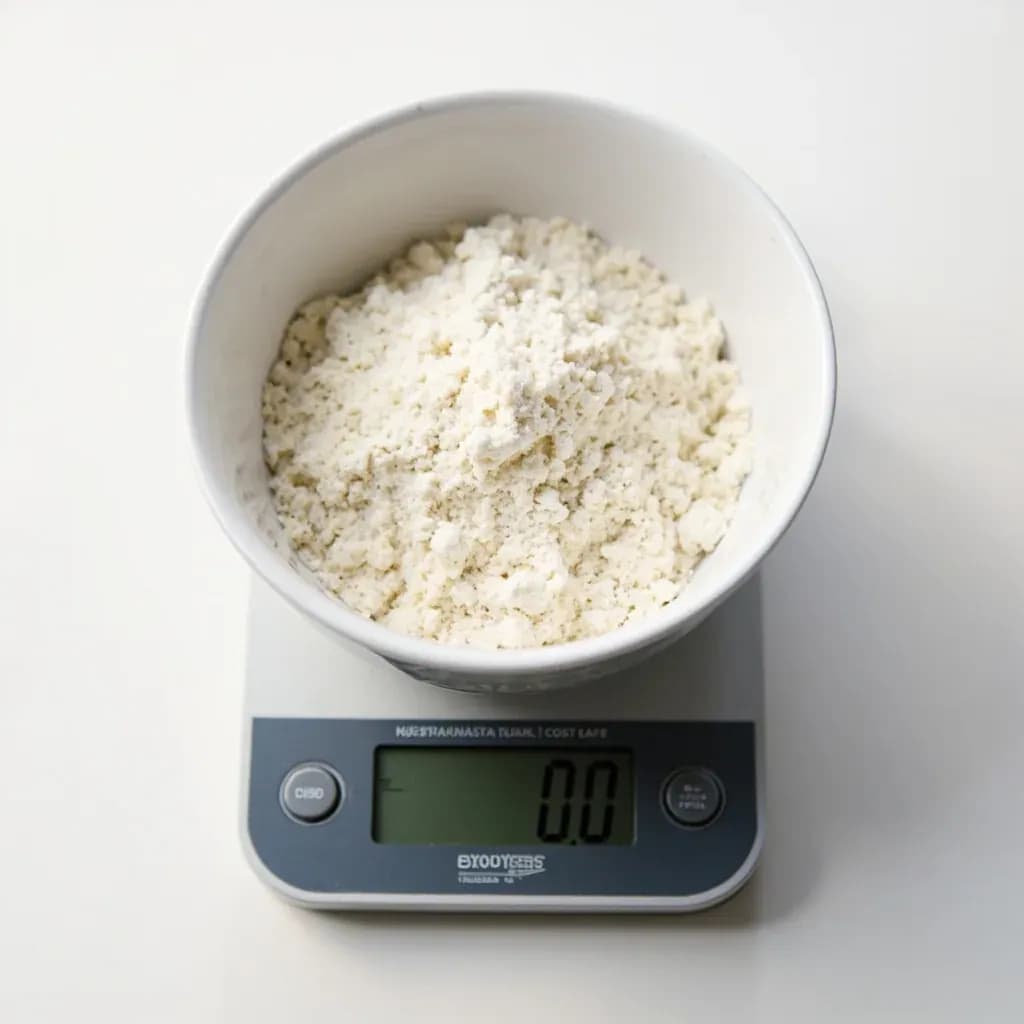
Weighing ingredients precisely for consistent, repeatable results.
Scaling weighs ingredients on a kitchen scale rather than measuring by volume, giving the accuracy that baking and large-batch cooking demand. Weight is consistent where cups vary with how flour is packed, so professional bakers always scale. It also enables baker's percentage, a system that expresses every ingredient relative to flour weight so recipes scale up or down cleanly.
Scaling is the practice of measuring ingredients by mass rather than by volume, using a kitchen scale. It is the single most effective habit a cook can adopt for repeatable results, particularly in baking, where the ratio of flour to liquid to fat determines crumb, tenderness, and rise. A cup of all-purpose flour can weigh anywhere from roughly 120 g (sifted and spooned gently) to more than 150 g (scooped and packed) — a 25 percent swing that will noticeably change a cake, cookie, or loaf. A scale reads the same number every time, regardless of how the ingredient settles into a cup, and that consistency is what turns a recipe into a formula you can trust.
The modern digital kitchen scale makes the practice almost frictionless. The tare function zeroes out the weight of a bowl, then re-zeros after each ingredient is added, so a full recipe can be built in a single vessel with no measuring cups in sight and almost no cleanup. In professional bread and pastry, scaling is the foundation of the baker's-percentage system, in which flour is set at 100 percent and every other ingredient is expressed as a percentage of flour weight — a framework that is essentially impossible to use accurately without a scale.
For everyday cooking — sautés, braises, soups — scaling is useful for portioning proteins, oils, and stocks, but it becomes critical wherever ratios drive the chemistry: doughs, batters, custards, frostings, meringues, macarons, and anything involving yeast, salt in small quantities, or chemical leaveners measured in fractions of a teaspoon.
- Difficulty
- Easy
Types & varieties
The modern default. Battery- or USB-powered, instant read-out, tare button, switchable units (g / oz / lb:oz). A 1 g or 0.1 g resolution covers almost all kitchen work.
The traditional French balance de cuisine — a two-pan scale with calibrated metal weights. No batteries, no drift, but slower to use and rare today.
A coiled spring and pointer dial, common in older U.S. kitchens as a hanging or platform scale. Less precise than digital and can lose accuracy as the spring fatigues.
Very high resolution (0.01–0.1 g) but low capacity, typically 100–500 g. Useful for spices, yeast, salt, leaveners, and other tiny precise additions.
Higher capacity (up to 30+ kg) and durable. Used in test kitchens and butcheries for large-batch work and costed production.
Integrated into a prep counter or pull-out drawer, common in professional and high-end home kitchens. Saves counter space and lets the cook weigh and prep in one spot.
How to do it
- 1
Set up the scale
Place the scale on a flat, hard, level surface — a stone counter or a sturdy cutting board, never a soft mat, a folded towel, or a wobbly table. Turn it on and let it settle for a few seconds before trusting a reading. Keep it out of direct sunlight and away from the edge of the counter where it can be knocked.
- 2
Place and tare the container
Put the mixing bowl, tray, or vessel you intend to work in on the platform. Press the tare (or 'zero') button so the display reads 0 g. The bowl is now invisible to the scale; whatever you add will read as net weight.
- 3
Add the first ingredient to target weight
Add the ingredient slowly, watching the display. For powders like flour, sugar, and cocoa, spoon loosely and let the scale settle before reading; do not compact or shake the bowl. Stop exactly at the target weight.
- 4
Cumulative-tare between ingredients
If you are building a recipe in one bowl, press tare again to zero the display, then add the next ingredient. Repeat for each component. Most scales can subtract their full rated capacity as tare, so you can keep zeroing until the bowl is nearly full. If you hit the tare limit, transfer the accumulated ingredients to a second bowl, tare it, and continue.
- 5
Verify and record
Write down the actual weights as you go, especially for recipes you intend to repeat or adjust. A notebook beside the scale, a note in your phone, or a margin note on the recipe all work. Future you will thank present you for noting that this batch of bread needed 380 g of water, not 400.
- 6
Clean, check, and store
Wipe the platform with a barely damp cloth — do not submerge or run water into the housing. Remove batteries if storing long-term to prevent corrosion. After any drop or hard knock, sanity-check the scale against a known weight (a 100 g calibration weight, a U.S. nickel at 5 g, a new penny at 2.5 g) before trusting it again.
Baker's Percentage: Why Professional Bakers Always Scale
Baker's percentage is the framework that turns bread and pastry from a list of ingredients into a working formula. Flour is fixed at 100 percent, and every other ingredient — water, salt, yeast, sugar, fat, eggs — is expressed as a percentage of that flour weight. A lean baguette dough might be 100% flour, 65% water, 2% salt, 1% yeast; a brioche might be 100% flour, 45% water, 40% sugar, 50% butter, 10% egg, 2% salt, 2% yeast. Change the flour weight to 800 g and the entire formula scales with you, with no math beyond multiplying each percentage by 8.
This system also exposes the levers you can actually pull. Hydration (water ÷ flour × 100) is the single most important variable in bread dough and is meaningless in cups. Salt percentage, fat percentage, and sugar percentage all read instantly off the formula. The system is impossible to use accurately without a scale, which is why no serious bakery, pastry shop, or test kitchen measures flour by volume.
For the home cook, even a light working knowledge of baker's percentage is transformative: it lets you swap flours, adjust hydration for a humid kitchen, or scale a sourdough recipe from four loaves to one without losing its character.
- Flour = 100% (the base unit; in flourless formulas, the primary dry ingredient — nut flour, sugar, etc. — is set to 100%)
- Hydration = water % ÷ flour %; typical lean bread 60–70%, ciabatta 75–85%, focaccia 80–90%
- Salt is almost always 1.8–2.2% of flour weight; less for sweet enriched doughs, more for rustic loaves
- To scale a recipe: pick a flour weight, then multiply every other percentage by that weight ÷ 100
- Cup measurements cannot be reliably converted to baker's percentages — you must know the weight of the flour
Choosing a Scale
A good kitchen scale is one of the cheapest pieces of equipment that will meaningfully change your cooking. For most home cooks a digital scale with 1 g resolution, a 5 kg capacity, a tare button, and switchable grams/ounces is plenty. If you bake seriously, step up to 0.1 g resolution — the extra precision matters for salt, yeast, and small quantities of leaveners. Pocket scales are a useful second scale for spice-level work, not a replacement for a full-size platform.
- Look for a tare button that re-zeros reliably; some cheap scales have a slow or sticky tare
- A stainless platform is easier to wipe clean than plastic and tolerates warm bowls
- Switchable units (g / oz / lb:oz) matter if you cook from U.S. and European sources
- Auto-off timers vary; longer is better so the scale does not die mid-recipe
- Store the scale somewhere accessible — a nearby drawer or a wall hook — so it stays within reach rather than buried in a back cabinet
Common uses
Tips & pitfalls
- Weigh flour and other fine dry ingredients directly into the bowl you plan to mix in — fewer dishes, no measuring cups to wash, and less chance of over-packing.
- Always tare with the empty container on the scale before adding the first ingredient, and re-tare (cumulative tare) between each addition if building a single-bowl recipe. Skipping this step is the most common weighing mistake and silently adds the bowl's weight to every ingredient.
- Use grams for almost everything in baking. The 1 g precision of a good digital scale is finer than any cup or spoon can offer, and the math stays clean when scaling up or down.
- If a recipe lists both cups and grams, trust the grams. The grams were the working measurement; the cups are a courtesy conversion that drifts by 10–25% depending on how densely the cup is filled.
- Place the scale on a hard, flat, level surface. A soft cutting board, a folded towel, or a wobbly counter will cause the reading to drift and the number to creep after you remove your hands.
- Never pour a heavy bag of flour directly onto the scale platform; always weigh into a bowl. A sudden load can shock the load cell and permanently bias the scale high or low.
- For sticky ingredients like honey, molasses, tahini, and yogurt, lightly grease the spoon or measuring cup with neutral oil or a quick spray of cooking spray. They slide out cleanly and you hit the true weight instead of leaving 10 g behind.
- Don't rest a hot saucepan on a plastic-bodied scale; the heat can warp the platform and damage the load cell. Use a trivet or let the pan cool briefly first.
Good to know
- Also called
- Weighing; portioning by mass; metric baking
- Primary tool
- Digital kitchen scale (most common); balance scale with weights (traditional); spring scale
- Standard units
- Grams (g) and kilograms (kg) preferred for precision; ounces (oz) and pounds (lb) used in U.S. recipes
- Typical resolution
- 1 g for general kitchen scales; 0.1 g for baking; 0.01 g for laboratory or pocket scales
- Typical capacity
- 5 kg (11 lb) for most home digital scales; up to 15 kg (33 lb) for commercial kitchen scales; 30+ kg for postal or parcel scales
- Key feature
- Tare function — zeros the scale with a container on it so ingredients can be added cumulatively in one bowl
- Baker's percentage
- System in which flour weight is set at 100% and every other ingredient is expressed as a percentage of flour weight — standard in professional bread and pastry
- Origin of 'tare'
- From the Arabic and Middle French 'tarha,' meaning 'to deduct' — the weight of the container is subtracted from the total
- Why it matters
- Volume measures of dry goods are inconsistent; 1 cup of all-purpose flour can range from ~120 g (sifted) to ~150 g+ (scooped), a ~25% variance
Also called
Weighing Ingredients · Baker's Percentage Formulation
Related

Whisk
Beat ingredients smooth and aerated with a looping wire motion

Sift
Pass dry ingredients through mesh to aerate and remove lumps

Strain
Pour through mesh to separate solids from liquid for a smooth result

Filter
Pass liquid through fine material to clarify out the smallest particles

Rice
Press cooked potatoes through small holes for fluffy, lump-free texture

Mash
Crush soft cooked food into a rustic, creamy purée

Grind
Crush food into a coarse to fine texture, from spices to meat

Grate
Shred food into fine bits against a sharp-toothed surface