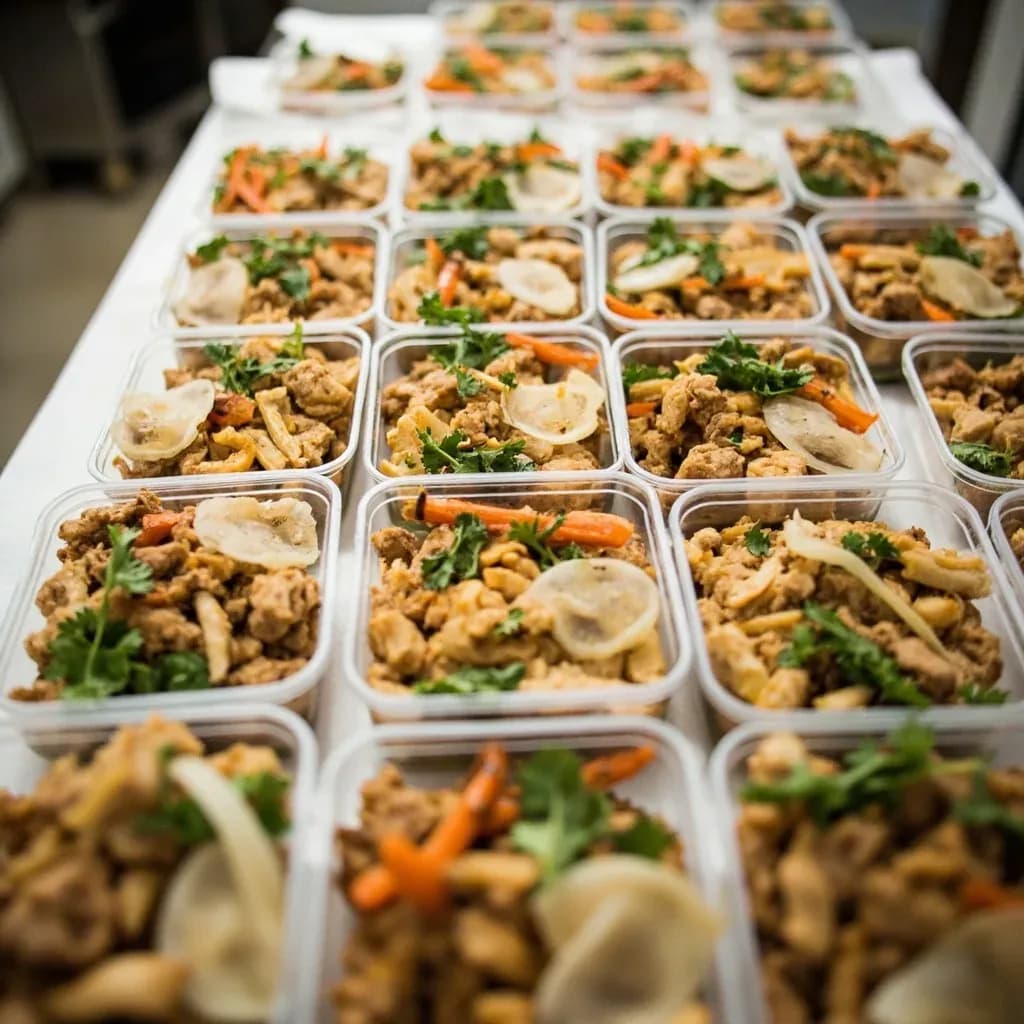
Prep & Assembly
Batch Cooking
Cooking large quantities at once to portion, store, and reheat over the week.
Batch cooking prepares food in bulk in a single session, then portions it for refrigeration or freezing to eat across the week. It saves time and energy and supports meal prep, freezer meals, and mix-and-match component cooking. Cooling food quickly and labeling portions with dates keeps batches safe, and some dishes like stews and braises actually improve after a day's rest.
Batch cooking is the practice of cooking larger quantities of food than needed for a single meal so the surplus can be portioned, stored, and reheated across the coming days or weeks. It is less a single technique than a system — a planning-and-execution strategy borrowed directly from professional kitchens, where mise en place and high-volume cookery have been the norm for over a century. The home version ranges from doubling a weeknight recipe for tomorrow's lunch to assembling twenty to thirty freezer meals in a single session.
The appeal is practical. A well-run batch session of two to three hours can replace two to five hours of weekday cooking, lower the per-meal cost of proteins and pantry staples, and remove the daily "what's for dinner?" decision that derails most home-cooking routines. For people managing specific diets, feeding a household with limited evening time, or stocking an emergency freezer, batch cooking is often the only reliable way to make home-cooked food the default rather than the exception.
Success depends less on cooking skill than on discipline around planning, food safety, and recipe selection. The classic beginner mistake is treating batch cooking as a marathon of finishing complete meals one after another; the real time savings come from overlapping ingredients across dishes and grouping tasks (all the chopping, all the roasting, all the portioning) the way a restaurant line does.
- Difficulty
- Easy
Types & varieties
Cook and portion 5 to 7 lunches and dinners in a single weekend session for the work week.
Intentionally cook double of a weeknight recipe so half becomes the next day's lunch or dinner with minimal extra work.
Large freezer-cooking sessions producing 20 to 30 meals assembled and frozen in one day.
Batch-prepare building blocks (grains, roasted vegetables, proteins, sauces) rather than full meals, then assemble fresh each day.
Raw or partially cooked ingredients layered in a freezer bag or pan (casseroles, dump-bag meals) to be cooked later.
Multiple sheet pans of mixed proteins and vegetables roasted simultaneously in a single oven.
Large-batch braises, stews, chilis, and pulled meats that yield many portions from one unattended cook.
Vacuum-sealed portions cooked low-and-slow in a water bath, then chilled or frozen and seared or finished to order.
How to do it
- 1
Plan the week and overlap ingredients
Decide on 4 to 6 dinners (and lunches if desired) for the coming week. Build the shopping list so proteins, aromatics, and pantry staples are shared across multiple dishes — one whole roasted chicken can anchor tacos, a soup, and a grain bowl without buying a second bird.
- 2
Shop and prep ingredients in waves
Shop with a written list grouped by store section so you move through the market once. Back home, do all the washing, trimming, and chopping before any heat goes on, storing cut vegetables in water-filled containers or wrapped in damp towels to stay crisp. Marinate proteins while you work on the other components.
- 3
Start with the longest-cooking items
Get things into the oven, slow cooker, or pot first: braises, roasts, whole grains, dried beans, and root vegetables. While they cook unattended, you'll have time and clear counters for everything else.
- 4
Cook proteins in batch
Roast or grill all the week's proteins on sheet pans (or one grill load): chicken thighs, sausages, tofu, tempeh, hard-boiled eggs, and so on. Cook each to its safe internal temperature, then rest before slicing or portioning so juices redistribute.
- 5
Roast and steam vegetables
Roast sturdy vegetables — broccoli, Brussels sprouts, sweet potatoes, peppers — on sheet pans with oil, salt, and high heat. Blanch or steam quick-cooking greens like green beans and asparagus, then shock in ice water to lock in color and stop the cooking.
- 6
Make sauces, dressings, and grains
Cook a large pot of grains (rice, farro, quinoa) and a jar or two of sauce (tomato, pesto, peanut, vinaigrette). Vinaigrettes keep 5 to 7 days in the fridge and freeze well in ice-cube trays for single portions.
- 7
Portion into containers and cool quickly
Divide each meal into individual or family-sized containers. Aim for the two-stage cooling rule: get food from 140°F down to 70°F within two hours, then from 70°F down to 40°F within another four hours. Use an ice bath for soups, stews, and chilis to speed cooling through the danger zone.
- 8
Label, date, and store
Every container gets the dish name and the date it was cooked. Anything to be eaten in 3 to 4 days goes in the fridge; everything else goes in the freezer in a labeled freezer bag or bin. Stack newest behind oldest (FIFO) so older food gets used first.
- 9
Reheat safely and finish fresh
Reheat refrigerated food to 165°F (74°C) in a microwave, oven, or on the stovetop. Add the fresh elements you held back — herbs, a squeeze of citrus, toasted nuts, a drizzle of finishing oil — right before eating so the meal doesn't taste like leftovers.
Food Safety and Storage
Batch cooking moves more food through the danger zone (40°F to 140°F) than day-to-day cooking, so cooling and storage discipline matters more than with a single meal. The two-hour / four-hour rule is the governing principle: get hot food from 140°F down to 70°F within two hours, then from 70°F down to 40°F within another four hours. Shallow containers no deeper than three inches, an ice bath for soups and stews, and leaving breathing room in the fridge are the three habits that make this work at home.
- Portion into shallow containers (≤ 3 inches deep) so heat escapes quickly — deep crocks and stockpots hold heat for hours.
- For soups, stews, and chilis, set the pot in a sink of ice water and stir occasionally to cut cooling time in half.
- Never stack eight hot containers in a closed fridge; the trapped heat keeps everything in the danger zone far too long.
- Refrigerated batch meals last 3 to 4 days; freeze anything you won't eat in that window.
- Reheat only the portion you plan to eat, and only once, to 165°F (74°C).
Common uses
Tips & pitfalls
- Slightly undercook vegetables, pasta, and grains when batch cooking — they finish during reheating and won't turn to mush.
- Hold back fresh, delicate, or textural add-ins (herbs, leafy greens, crispy toppings, dressings, avocado) and add them at serving time; they don't survive a microwave round-trip.
- Sauces freeze far better than dairy- or starch-thickened ones — freeze cream sauces, gravies, and pasta water separately, or add the dairy only on reheat.
- Salt concentrates as moisture evaporates in the fridge; season more gently than you would for a same-day dish, then adjust after reheating.
- Label every container with the dish name and the date it was cooked — undated leftovers are inedible leftovers, and the FIFO system only works when dates are visible.
- Do not batch-cook foods that don't reheat well: rare steak, delicate white fish (cod, sole), fried or breaded items, raw salads, soft herbs, or anything meant to be crisp or just-cooked.
- Spread cooked grains like rice, farro, and quinoa on a sheet pan to dry slightly, so they reheat without clumping into a single mass.
- Freeze meal components in the portion size you'll actually eat — a single-person freezer is not the place for family-size trays that get thawed and refrozen.
Good to know
- Category
- Meal preparation technique (Prep & Assembly)
- Also known as
- Meal prep, once-a-month cooking (OAMC), cook-once-eat-twice, component prep
- Refrigerator storage limit
- 3 to 4 days at 40°F (4°C) or below
- Freezer storage range
- 2 to 6 months depending on the food; 1 to 2 months for best quality
- Food-safety rule
- Cool cooked food from 140°F to 70°F within 2 hours, then to 40°F within 4 more hours
- Reheat target
- 165°F (74°C) internal temperature
- Origins
- Institutional kitchens (hospitals, schools, military) for over a century; entered home use as "Once-a-Month Cooking" via the 1986 book by Mimi Wilson and Mary Beth Lagerborg; "meal prep" surged with food blogs and Instagram c. 2013 onward
Also called
Meal Prep · Batch Prep · Freezer Meal Batching · Component Prep · Panning Up
Dishes that rely on it
Related

Whisk
Beat ingredients smooth and aerated with a looping wire motion

Sift
Pass dry ingredients through mesh to aerate and remove lumps

Strain
Pour through mesh to separate solids from liquid for a smooth result

Filter
Pass liquid through fine material to clarify out the smallest particles

Rice
Press cooked potatoes through small holes for fluffy, lump-free texture

Mash
Crush soft cooked food into a rustic, creamy purée

Grind
Crush food into a coarse to fine texture, from spices to meat

Grate
Shred food into fine bits against a sharp-toothed surface