Heat & Fire
Reheating to 165F
Bringing cooked, cooled food back to a safe internal temperature of 165F before serving.
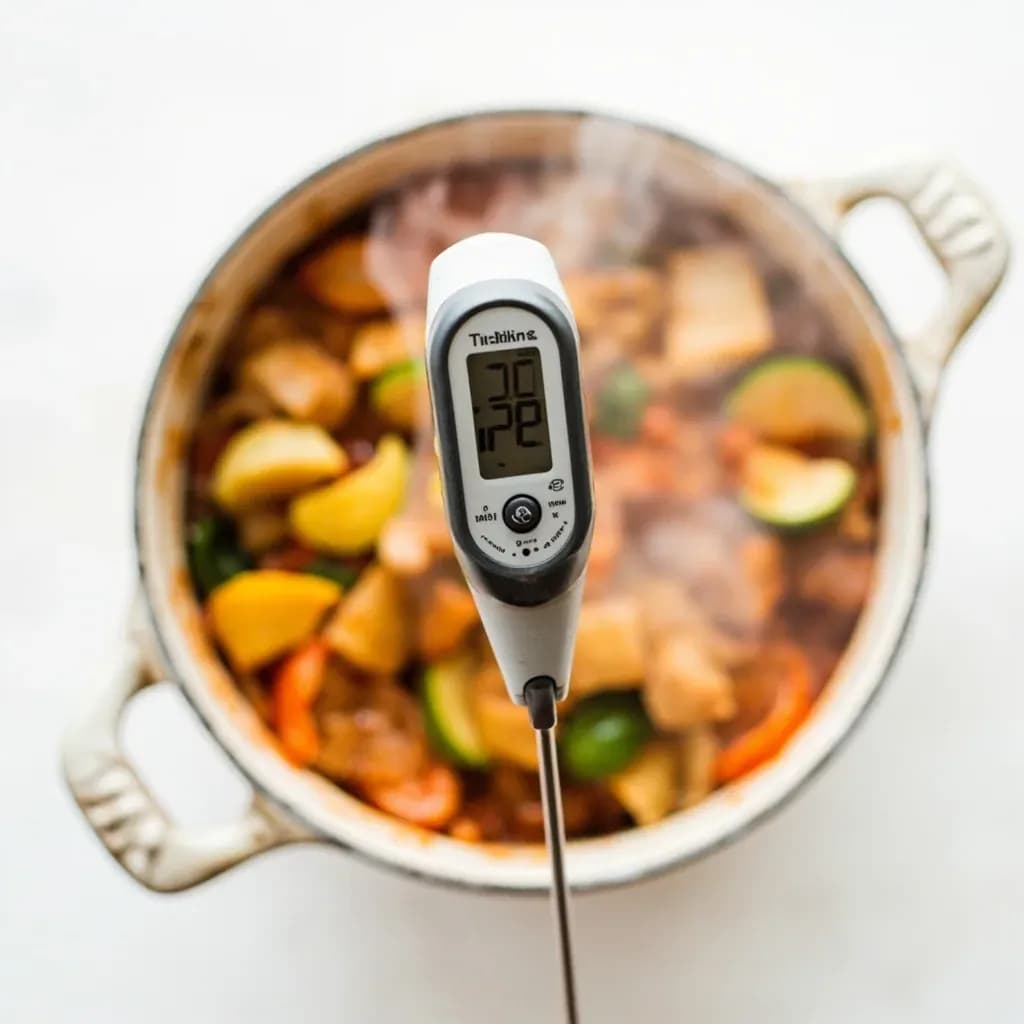
Reheating to 165F means warming previously cooked and refrigerated food until its internal temperature reaches 165F, the threshold that kills bacteria that may have grown during cooling and storage. It is a core food-safety step in professional kitchens, batch cooking, and catering. The temperature should be reached quickly and verified with a probe thermometer rather than judged by surface warmth.
Reheating to 165°F is the codified hot-hold reheat standard in the FDA Food Code, and the number most health inspectors in the United States expect to see on a calibrated thermometer when previously cooked food is being returned to service. It applies to food that has already been cooked, cooled, and stored — braises pulled from the walk-in, banquet trays from a cook-chill system, sauce bases held overnight — and it is distinct from both cooking raw product and from warming a single portion to eat right now. The target is 165°F (74°C) held for at least 15 seconds, reached within two hours of when the food went onto heat. Hit those marks, and the food is considered safe to drop into a steam table or holding oven at 140°F or above.
The reason 165°F sits well above normal cook end-points is that reheated food is starting from a vulnerable position. Even food that was cooled correctly to 40°F within six hours has spent time in a temperature band where slow-growing organisms like Listeria can recover. A higher reheat target gives a wider safety margin for vegetative pathogen destruction without requiring the food to be cooked to well-done. Quality is protected by speed and evenness: the faster the load crosses 165°F, the less the edges dry out and the less proteins overcook. A slow reheat in a barely-warm oven keeps food in the danger zone without ever actually sanitizing it, and the texture suffers in the bargain.
In a working kitchen, this is the technique behind every banquet, cafeteria, hospital, and catering line. Cook-chill and cook-freeze production depend on it, and so does any cook who brings stocks, rice, or braised meats back to temperature. The standard also resolves a common source of confusion: 165°F is the reheat number, not the cook number. Whole cuts of beef, pork, lamb, and fish cook to 145°F; ground meats to 155°F; poultry to 165°F. The reheat target is set higher because the food has already been through one heat cycle and is more likely to carry a residual pathogen load.
- Difficulty
- Easy
Types & varieties
Best for soups, sauces, gravies, and stir-fries; allows frequent stirring to break cold pockets.
Best for large volumes of solid foods such as casseroles and roasted meats; 325–350°F with covered pans and a splash of moisture.
Combines steam injection and forced air; the most even way to reheat plated proteins and vegetables at speed without drying them out.
The institutional workhorse for reheating soups, stews, and sauces in bulk; bottom and side-wall heating greatly reduces scorching.
Fast but uneven, with cold spots; recommended only for immediate service, never for hot holding. Stir and rotate at half-time.
Highly precise and can hold validated lower temperatures for extended times, but 165°F remains the safest single target for hot-hold reheat.
Used to reheat and hold simultaneously; the well must reach 165°F before it is counted on for holding duty.
How to do it
- 1
Confirm the food is safe to reheat
Verify it was cooled to 40°F (4°C) within 6 hours — 140 to 70°F in 2 hours, then 70 to 40°F in 4 hours — and has been stored at 40°F or below since. Discard anything that sat in the danger zone (40–140°F) longer than the rules allow, anything with off odors, or anything held refrigerated beyond your jurisdiction's limit (typically 7 days at 40°F or below).
- 2
Choose the reheat method and equipment
Match the method to the food: kettle or stovetop for liquids and stews; oven, combi, or steam-jacketed kettle for solids and large volumes; microwave only for immediate single-portion service. Preheat the equipment so the food enters a hot environment and starts crossing 140°F within the first few minutes.
- 3
Portion and stage the food
Use shallow pans no deeper than 2–3 inches so heat reaches the center within the 2-hour window. For solids, add a small amount of stock, water, butter, or sauce to prevent drying and speed conductive transfer. Loosen compacted foods (rice, pasta, braised meat) before they go on heat.
- 4
Bring all parts of the food to 165°F
Heat until the coldest internal point reaches 165°F (74°C). For large pans, stir, rotate, or flip midway. The target must be hit in 2 hours or less from when the food was placed on heat — anything still below 165°F at the 2-hour mark must be discarded, because it has spent too long in the danger zone to be safely rescued.
- 5
Verify with a calibrated thermometer
Check at least two spots: the geometric center of the pan and one corner or edge. In a kettle, test the bottom near the heat source and the side wall. For plated items, probe the thickest portion of the protein or starch. Use a calibrated thermocouple or instant-read thermometer — dial oven thermometers are not accurate enough for food temperature.
- 6
Move to hot holding or service
Once 165°F is reached, transfer the food to a steam table, holding oven, or hot well preheated to 140°F (60°C) or above. Hold only for the duration allowed by your jurisdiction, often 4 hours maximum for hot-held service.
- 7
Discard leftovers
Food that drops below 140°F in holding, or that was not consumed within the hot-hold window, must be discarded. Reheated food is not to be re-cooled and re-reheated — it has used its one reheat.
Why 165°F and not the original cook temperature?
This is the most common point of confusion in a professional kitchen. The cook temperatures in the FDA Food Code are written for raw animal proteins coming up from a safe cold state: 145°F for whole cuts of beef, pork, lamb, and fish; 155°F for comminuted (ground) meats; 165°F for poultry, stuffing, stuffed foods, and wild game. The reheat temperature is set higher than any of these because the food has already been through one heat cycle and a cool-down, both of which give pathogens an opportunity to recover, especially Listeria, which can grow slowly even at refrigerator temperatures. Heating to 165°F provides a comfortable margin for vegetative organism kill without pushing the food to a well-done texture. The 15-second hold is a small but real addition to that margin and is what makes the standard defensible to inspectors.
- 145°F — whole cuts of beef, pork, lamb, and fish (cook temp)
- 155°F — ground or mechanically tenderized meats (cook temp)
- 165°F — poultry, stuffing, and reheat of previously cooked food (both)
- 165°F also appears in USDA home guidance as 'reheat leftovers until steaming hot (165°F)'
Reheat for hot holding vs. reheat for immediate service
The 165°F / 2-hour rule is the legal standard for food that is going to sit in a steam table, hot well, or holding oven before being eaten. If a cook is pulling a single portion from the walk-in and plating it for a customer right now, the regulatory standard does not apply in the same way — though the USDA still recommends 165°F for home leftovers, and a cook who wants a wide safety margin will hit it anyway. The hot-hold reheat rule exists because holding food between 140°F and 165°F for long periods is not, on its own, enough to destroy organisms that grew during cooling; the food has to cross 165°F at least once on the way to the table.
Cooling is half the battle
Reheating to 165°F cannot rescue food that was cooled badly. The two stages are a matched pair: the FDA cooling rule (140 to 70°F in 2 hours, 70 to 40°F in 4 hours, total 6 hours) controls how much time pathogens are allowed to grow in the danger zone, and the reheat rule controls how much of that growth is reversed. A line cook who blast-chills a braise from 180°F to 38°F in 90 minutes is giving the reheat step the cleanest possible starting material; a cook who leaves the same braise on the counter overnight has already lost the war before the oven comes on.
Common uses
Tips & pitfalls
- Probe the coldest, thickest part of the load — usually the geometric center of a pan, not the edge where the thermometer reads the oven temperature.
- Use a calibrated thermocouple or instant-read thermometer; dial oven thermometers are not reliable for food internal temperature.
- Stir liquids and semi-liquids — sauces, stews, risotto, pasta, rice — at least every 2–3 minutes to break cold pockets that the probe can miss.
- Add a small amount of stock, water, or sauce before reheating solids to prevent drying and to speed conductive heat transfer into the center of the mass.
- Cover the pan (lid or foil) to trap steam and keep surface moisture; uncover only at the end if you need to drive off excess liquid.
- Reheat only the volume that will be served within 2 hours — reheating more than you need wastes the safety window and degrades quality through repeated heat cycles.
- Do not start the 2-hour clock until the food is actually on heat; pulling from the walk-in to a cold line wastes the window before reheating even begins.
- 165°F is the universal safe target for held service; for immediate eat-now service lower end-points are defensible, but 165°F removes all doubt and is what inspectors look for.
- Reheating at too low an equipment temperature (e.g., a 150°F oven) can keep food in the danger zone for too long — use equipment that crosses 140°F within the first 30–45 minutes.
- For rice, polenta, and other starches that clump, fold gently with a whip rather than stirring vigorously, which ruptures grains and turns the batch to paste.
- Common mistake: pulling food from the oven at 160°F 'because it will keep rising' — carryover is real but small in dense, cold food, and 160°F does not meet the reheat standard. Trust the probe at the coldest point.
- Common mistake: reheating in the same pan the food was cooked and cooled in without cleaning — a film of cooled fat insulates the new batch and slows the climb to 165°F.
Good to know
- Target internal temperature
- 165°F (74°C)
- Minimum hold at target
- At least 15 seconds
- Maximum time to reach target
- 2 hours from start of reheat
- Applies to
- Previously cooked, cooled RTE/TCS food intended for hot holding
- Authority
- FDA Food Code §3-403 (2022 edition); USDA FSIS guidance
- Danger zone (food safety)
- 40–140°F (4–60°C)
- Hot-holding minimum (after reheat)
- 140°F (60°C)
- Reheat frequency
- Once only; do not reheat leftovers more than one time
- Origin of standard
- Adopted in the 1993 FDA Food Code; refined in subsequent revisions; rooted in USDA pathogen destruction data
- Related cooling rule
- Cool from 140 to 70°F in 2 hours, then 70 to 40°F in 4 hours (total 6 hours) before reheat
Also called
Rethermalizing · Reheating to 165 · Rethermalization
Dishes that rely on it
Related

Sear
Blast the surface hot for a deep-browned, savory crust

Sauté
Cook quickly in a little fat over lively heat, tossing as you go

Stir-Fry
Toss bite-sized pieces over roaring heat for fast, smoky cooking

Pan-Fry
Crisp food in a shallow layer of hot fat, turning once or twice

Deep-Fry
Submerge in hot oil for an all-over crackling crust

Roast
Cook uncovered in dry oven heat for browned edges and tender centers

Bake
Cook with steady, surrounding oven heat — the soul of bread and pastry

Broil
Hit food from directly above with fierce overhead heat