Prep & Assembly
Hot Holding
Keeping cooked food at a safe serving temperature until it's plated.
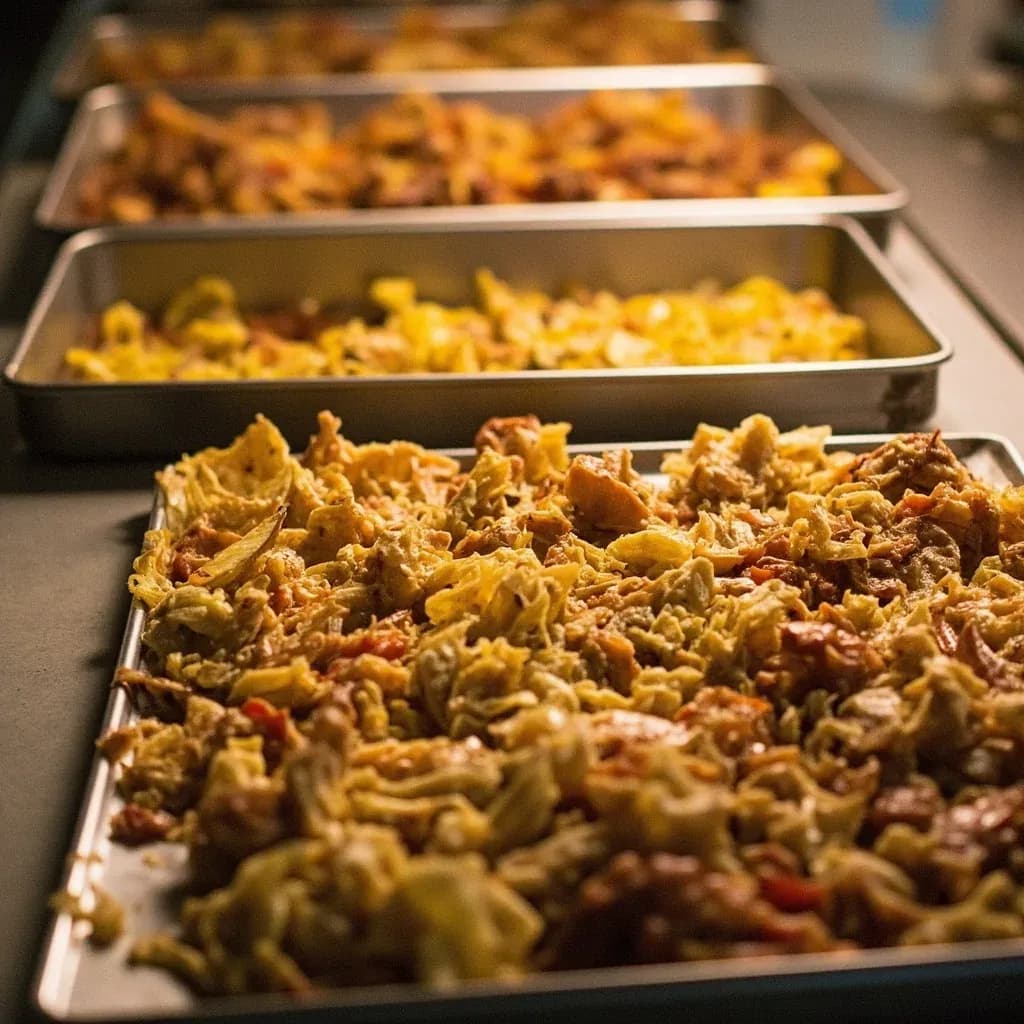
Hot holding maintains already-cooked food above the food-safety danger zone, typically over a steam table, in a warming oven, or on low heat, until it is served. It is standard in restaurants, buffets, and catering where dishes must wait between cooking and plating. Holding food too long can degrade texture and quality, so it is meant as a short bridge rather than continued cooking.
Hot holding is the practice of keeping fully cooked food at or above 140°F (60°C) from the moment it leaves the cooking line until it is plated or served. In a professional kitchen, banquet hall, catering operation, or buffet, food is rarely consumed the instant it is cooked; the gap between doneness and service can stretch from a few minutes to several hours, and that gap is where most foodborne illness in commercial settings is born. The technique exists to bridge that gap safely, holding the product in a band of temperature where the pathogens responsible for food poisoning — Clostridium perfringens, Staphylococcus aureus, Bacillus cereus, and Salmonella among them — cannot reproduce at meaningful rates.
The behavior of held food is shaped as much by equipment and pan depth as by the thermometer reading. Steam-table wells deliver gentle, even moist heat ideal for sauces, braises, and vegetables, but they will destroy the crispness of fried chicken in minutes. Dry holding cabinets, heat lamps, and induction bases preserve texture where steam would ruin it, at the cost of surface drying. Delicate emulsions like hollandaise or béchamel break or scramble under direct holding heat, so they are best kept in a bain-marie. A cook who treats hot holding as a single technique rather than a family of them will, sooner or later, hold the wrong food in the wrong equipment and serve a pan of either dangerous or ruined food.
The most important thing to understand about hot holding is what it is not: it is not a substitute for cooking, not a way to rescue underdone food, and not a buffer that lets a cook relax. The 140°F floor is a hard regulatory and microbiological minimum, and reheating food that has drifted through the danger zone does not reliably destroy the heat-stable toxins some bacteria leave behind. Done well, hot holding is invisible — the guest never thinks about it. Done badly, it is the most common single cause of a failed health inspection or a foodborne illness complaint.
- Difficulty
- Easy
Types & varieties
Pans of food sit over simmering water in a heated well; gentle, even moist heat. The workhorse of commercial hot lines, ideal for sauces, gravies, vegetables, braises, and pastas.
Insulated cabinet with a low-wattage element and circulating air. Use for proteins, breaded items, fried foods, and roasted vegetables that would weep or go soggy in steam.
Infrared or incandescent overhead lamps at the pass or carving station. Convenient and instant, but dries surfaces quickly and gives uneven heat through depth.
Drop-in hotel pans over a Sterno can or electric hot plate; the standard for catering, buffets, and banquet lines. Slow to preheat and uneven, but unmatched in portability.
Induction base or low-power burner under a hotel pan. Precise and responsive, but requires active stirring and supervision to avoid a scorched bottom.
Round, water-jacketed well built for soups, stews, chowders, mulled cider, and sauces; designed for long, gentle service.
Indirect, very gentle heat for delicate emulsions — hollandaise, béarnaise, béchamel, custards — that break or scramble under direct holding temperatures.
Reliable back-of-house workaround for grains, beans, braises, curries, and chili; thermostat-controlled and forgiving for long, unattended holds.
How to do it
- 1
Cook the food to its required internal temperature first
Bring the food to its regulatory doneness — 165°F for poultry and stuffing, 145°F with a 3-minute rest for whole-muscle meats, 160°F for ground meats — and hold it for the dwell time the recipe or code requires. Hot holding preserves the safety of properly cooked food; it does not cook it. A rare steak held all night is still a rare steak.
- 2
Rest briefly off the heat before transferring
Pull the food from the heat source and let it rest 2–5 minutes, uncovered, so carryover cooking stops and juices redistribute. This protects the final texture during what may be a long hold.
- 3
Preheat the holding equipment thoroughly
Turn the steam table, holding cabinet, chafing dish, or heat lamp on 10–15 minutes before service. Confirm with a probe thermometer that the well or cabinet air is at 140°F or above (150–165°F is safer) before loading food. An unpreheated well will silently drag food into the danger zone in the first few minutes of service.
- 4
Transfer food hot and promptly
Move the food in preheated, covered hotel pans. Minimize the time between cooking and the hold. A 30-second transfer into a preheated well is far safer than a 5-minute walk to an idle one.
- 5
Portion into shallow pans
Use 2½-inch-deep hotel pans rather than deep stockpots, and keep pans no more than two-thirds full. Greater surface area and shallower depth let heat from below and above reach the center quickly and stay there.
- 6
Cover and label with the start time
Fit lids — slightly vented for very thick sauces — and mark the time the food entered the hold on a label, ticket, or whiteboard. This makes FIFO rotation and end-of-service decisions unambiguous for the whole crew.
- 7
Maintain on a regular schedule
Stir sauces, stews, and braises every 15–20 minutes from bottom to top. Check drier items every 30 minutes. Probe the coolest, thickest part of the pan with a calibrated thermometer and adjust the equipment before the temperature drifts below 140°F.
- 8
Monitor the equipment itself
Watch water levels in steam wells, fuel in chafing dishes, and cabinet thermometers. Refill and reignite before they drop. A steam well that goes dry is no longer a holding well; it is a cooling rack.
- 9
Decide on service, cool-down, or discard at end of service
Food held continuously at 140°F or above can be served or cooled for later use via the two-stage cooling method (140°F to 70°F within 2 hours, then 70°F to 40°F within 4 more hours). Any food that fell out of temperature for longer than the code allows must be discarded; reheating it is not an option.
The food-safety science behind 140°F
The 140°F floor is not an arbitrary line; it sits just above the optimum growth temperatures of the bacteria most often implicated in hot-food illness. Clostridium perfringens, the leading cause of hot-food outbreaks, has a generation time of roughly 10 minutes at 113°F and stops reproducing meaningfully above 140°F. Staphylococcus aureus produces a heat-stable enterotoxin that is not destroyed by reheating, so any food that has spent significant time between 40°F and 140°F is unsafe regardless of how hot you bring it back. The FDA Food Code's two-stage cooling rule (140°F to 70°F within 2 hours, then 70°F to 40°F within 4 more hours) exists for the same reason: pathogens grow fastest in the middle of the danger zone, and you want food out of that band as quickly as possible in both directions.
- The danger zone (40–140°F) is where bacterial growth is fastest, not where bacteria die.
- Reheating contaminated food to 165°F kills most cells but does not destroy staphylococcal enterotoxin.
- Shallow pans cool and reheat faster than deep stockpots, which is why pan depth matters as much as temperature.
- A hold that 'looks fine' for two hours at 110°F is not a hold; it is an incubation.
Choosing the right equipment
Equipment choice is driven by moisture, texture, and service format. Steam and water-jacketed wells keep food moist and are right for nearly anything saucy or vegetable-forward, but they destroy crispness and can waterlog roasted items in 20 minutes. Dry cabinets and heat lamps are the answer for fried, breaded, and roasted foods, accepting some surface drying as the price of preserved texture. Heat lamps shine for short, à la carte holds at the pass and are less suited to long banquets. Induction bases and rice cookers are the most precise but require stirring and supervision. The professional default is a steam table for line work, dry cabinets for proteins and fried items, and a chafing dish for off-premise events where portability and fuel-can simplicity outweigh precision.
Common uses
Tips & pitfalls
- Preheat the holding equipment for 10–15 minutes before loading. The single most common failure in real kitchens is loading hot food into an unpreheated well, which drops the product out of the safe zone within minutes.
- Cook food only to its safe internal temperature, then rest it briefly off the heat before transferring. Hot holding is not a substitute for cooking, and overcooking now will compound into ruin during a long hold.
- Stir sauces, stews, and braises every 15–20 minutes to even out the temperature and prevent a hot-bottom / cold-top split that a surface reading will not show.
- Use shallow 2½-inch hotel pans rather than deep ones, and never fill them more than two-thirds. Surface area and shallow depth are what keep food above 140°F reliably.
- Never mix a fresh batch with food already in the hold. The older, cooler food will drag the new, hot batch into the danger zone and contaminate it.
- Hold fried, breaded, and roasted items in a dry-heat cabinet or under a heat lamp, not in a steam table. Steam destroys crispness in under 20 minutes.
- Use a calibrated probe thermometer in the thickest, coolest part of the pan. Equipment dials drift; the food temperature is the only number that matters.
- If a held item has been below 140°F for more than 2 hours total (or 1 hour in a hot kitchen above 90°F), discard it under standard food-code guidance. Reheating does not destroy staphylococcal enterotoxin.
Good to know
- Category
- Prep & Assembly — Food Safety & Service
- FDA Food Code minimum
- 140°F (60°C)
- UK / EU equivalent
- 63°C (some local codes 60°C)
- Danger zone avoided
- 40–140°F (4–60°C) — the band of fastest pathogen growth
- Hold-time cap
- No fixed limit while food stays at or above 140°F; the 4-hour cumulative rule applies to food held without temperature control in the danger zone, not to true hot holding
- Primary equipment
- Steam table, steam-well, holding cabinet, heat lamp, chafing dish, soup kettle, induction warmer, rice cooker, bain-marie
- HACCP status
- Critical Control Point (CCP) in most commercial HACCP plans
- Origin of the 140°F threshold
- 20th-century USDA/FSIS pathogen-growth research, codified in the FDA Food Code from its first edition in 1993 onward
Also called
Steam-Table Holding · Warming · Holding Hot
Dishes that rely on it
Related

Whisk
Beat ingredients smooth and aerated with a looping wire motion

Sift
Pass dry ingredients through mesh to aerate and remove lumps

Strain
Pour through mesh to separate solids from liquid for a smooth result

Filter
Pass liquid through fine material to clarify out the smallest particles

Rice
Press cooked potatoes through small holes for fluffy, lump-free texture

Mash
Crush soft cooked food into a rustic, creamy purée

Grind
Crush food into a coarse to fine texture, from spices to meat

Grate
Shred food into fine bits against a sharp-toothed surface