Knife Skills
Carving
Slicing cooked roasts, poultry, or cured meat into neat portions for serving.
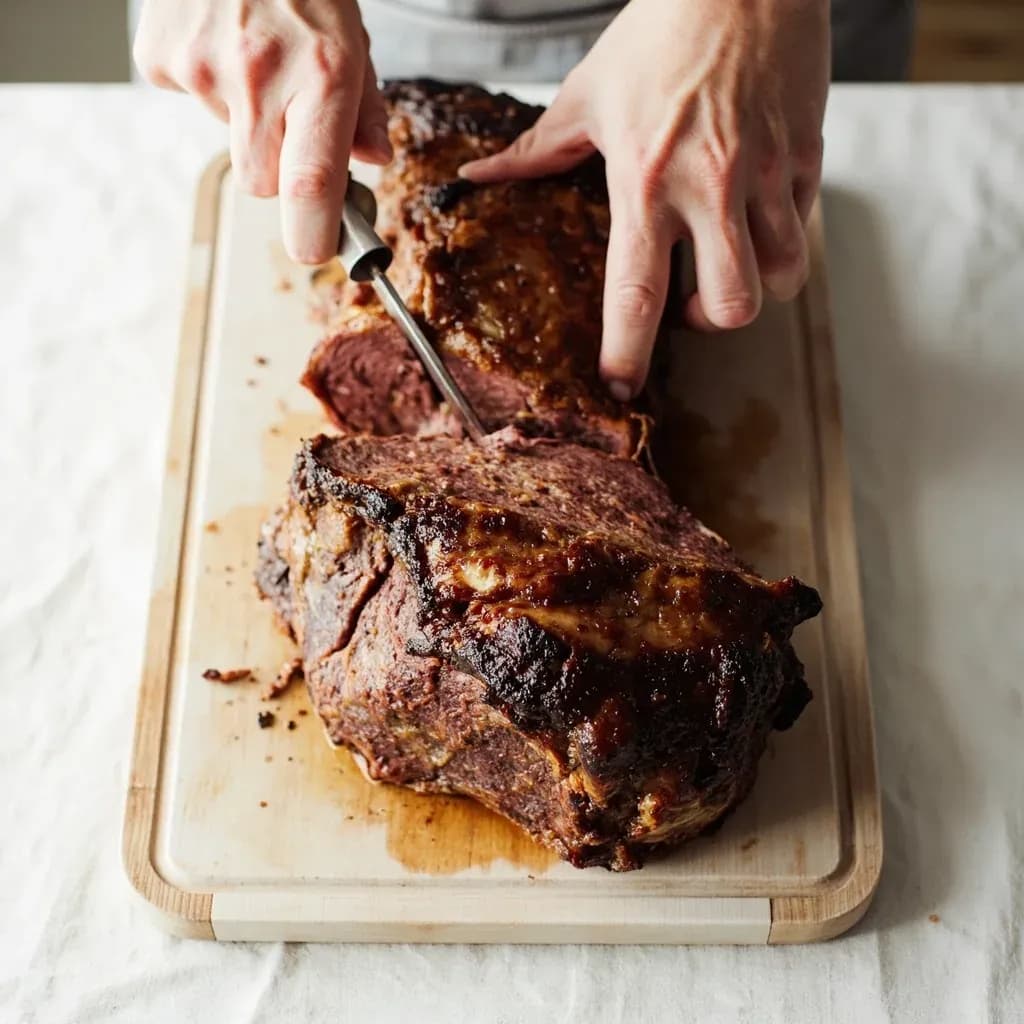
Carving is the skill of cutting cooked or cured meat into clean serving slices, from a roast or whole bird to hand-cut jamón. It's done after resting so juices redistribute, and slicing against the grain keeps each portion tender. Carving jamón is a specialty in itself, taking long, thin, even strokes off the bone with a flexible jamonero knife.
Carving is the controlled breakdown of a cooked, intact piece of meat — a standing rib roast, whole turkey, leg of lamb, ham, or whole fish — into uniform servings ready for the plate. It sits at the seam between butchery and presentation: the cook is portioning a single roasted item into many servings while preserving visual appeal, moisture, and the structure of the original cut. Done well, carving looks unhurried because it is unhurried; the slices fall away cleanly, the platter is glossy with juice, and almost nothing is lost to ragged edges or shredded fiber.
The technique is governed less by strength than by three habits. First, the meat is rested long enough for its juices to reabsorb into the muscle — skipping this step is the single most common reason a roast arrives at the table looking dry. Second, the knife is genuinely sharp, so it parts the fibers rather than tearing them. Third, the blade is drawn through the meat in a single, long pull perpendicular to the grain, with no sawing. Carving is the natural follow-up to roasting, braising, and smoking, and it pairs directly with gravy-making, because the juices that collect on the board and the exposed bones are prime material for the accompanying sauce or stock.
- Difficulty
- Medium
Types & varieties
Sliced across the rib bones; cuts are made between ribs, parallel to the bone, into ¼–½ in portions.
Legs and thighs removed at the joint, then breast carved in long, even slices off the carcass from the breastbone outward.
Often spatchcocked or simply split down the breastbone; thighs and drumsticks separated at the joint, breast halved or sliced.
Held on the bone or bone removed; sliced on the bias across the grain into ½ in cutlets.
Country-style: cut in a spiral around the femur, or sliced parallel to the bone starting at the shank end.
Ribs freed from the meat with a boning knife, then loin sliced across the grain at ½ in.
Top fillet lifted off the backbone, then the skeleton lifted out to release the bottom fillet — the classic sole or salmon carve.
Sliced against the grain at about pencil-width; cutting with the grain turns tender brisket into rubber.
Hand-carved at an extremely acute angle with a long, thin ham knife to produce paper-thin slices.
How to do it
- 1
Rest and stabilize
Transfer the roast or bird to a carving board and tent loosely with foil. Allow 10–20 minutes for most roasts, 20–30 for a whole turkey or large goose. This reabsorbs juices and firms the surface for cleaner slices.
- 2
Sharpen and set up
Hone the carving knife on a steel, then lay out a warm platter, the carving fork, and a damp cloth for wiping the blade. Position the roast with the most attractive side up and the grain running left-to-right.
- 3
Anchor the meat
Drive the carving fork firmly into a stable, non-serving surface — a thick end-piece of fat or the back of the carcass. The fork should hold the roast still without flexing.
- 4
Identify the grain
Look closely at the exposed face of the meat. The grain is the direction the muscle fibers run. Every slice will be cut perpendicular to this direction.
- 5
Make the first cut
With the knife held vertical and the tip resting at the far side of the roast, draw the blade through the meat in one long, smooth pull — no sawing. End with the heel of the blade, not by pressing down.
- 6
Maintain even thickness
Move the fork back as you progress and repeat the single-pull stroke. Aim for ¼–½ in slices depending on the meat, and lay each slice in a slightly overlapping row on the warm platter.
- 7
Carve poultry: remove the legs first
For a whole bird, pull a thigh outward to pop the ball-and-socket joint, slice through the skin, and cut through the joint to release the leg and thigh together. Repeat on the other side.
- 8
Carve poultry: slice the breast
Make a long vertical cut along one side of the keel (breast) bone, then run long horizontal slices from the breastbone outward to the wing side, letting each slice fall cleanly onto the platter.
- 9
Handle bones and racks
For bone-in roasts such as rack of lamb, prime rib, or crown roast, cut between the bones with the knife tip to release each portion, then slice the meat between them. Save the bones for stock or sauce.
- 10
Rest the slices briefly and serve
Once carved, slices can rest 2–3 minutes on the warm platter. Spoon collected juices from the board over the slices just before bringing to the table.
Slice thickness by cut
Thickness is not a style choice — it is dictated by the structure of the meat. Lean and tender cuts hold together at thin thicknesses and reward them with tenderness; tougher or fattier cuts need more thickness to keep the slice from drying out or falling apart on the fork.
- Roast beef and tenderloin: ¼–½ in — the meat is tender and the slices should be neat enough to layer on a plate.
- Ham: ⅛–¼ in — cured ham is dense and benefits from thin, almost translucent slices.
- Turkey breast: ¼ in — thin enough to feel delicate, thick enough to stay juicy on a warm platter.
- Lamb, pork loin, beef rib: ½ in — the meat has more fat and connective tissue, and a thicker slice carries the juices better.
- Brisket and smoked meats: about pencil-width (¼ in) — slice across the grain so the long fibers are short on the plate.
Common uses
Tips & pitfalls
- Sharpen the carving knife on a whetstone or steel immediately before use — a dull blade tears fibers and squeezes out juices onto the board.
- Rest the meat tented with foil before carving; cutting hot meat can lose a quarter cup or more of juice per roast.
- Anchor the roast with the tines of a carving fork, but pierce only the less-presented side, or use a guard-tined fork, so the holes aren't visible on serving slices.
- Carve on a board with a juice groove and tilt it so the collected juices can be spooned back over the slices on the platter.
- For turkey, remove the legs first while the bird is breast-up, then carve the breast in long, even slices from the keel bone outward — do not try to split the bird in half first.
- Hold the knife perpendicular to the surface and use one long pull per slice; a back-and-forth saw drags and tatters the cut.
- Don't carve more than can be served in one pass; keep already-carved slices on a covered warm platter so the remaining roast doesn't dry out while you work.
- Save the carcass, trim, and pan drippings for stock or gravy — carved bones carry a great deal of flavor.
Good to know
- Definition
- The technique of portioning cooked whole roasts, poultry, and large cuts of meat into uniform slices or pieces for service, using a long-bladed knife and a stabilizing fork.
- Origin of term
- From Old English 'ceorfan' (to cut); formal table carving was codified in European dining etiquette during the 17th–18th centuries, when matched carving sets became standard silverware.
- Key tools
- Carving knife (long, narrow, 8–12 in blade), carving fork (long, two-pronged, sometimes guard-tipped), slicing knife, sharpening steel, and a grooved board or warm platter.
- Rest before carving
- Roasts should rest 10–20 minutes; whole turkey or large birds 20–30 minutes. Resting lets juices reabsorb so they don't flood the cutting board.
- Slice direction
- Always cut perpendicular to (across) the muscle grain. With-the-grain slices feel chewy regardless of tenderness.
- Typical slice thickness
- Roast beef ¼–½ in; turkey breast ¼ in; ham ⅛–¼ in; lamb ½ in; pork loin ½ in; brisket about pencil-width.
- Knife motion
- Long, smooth, single pulls — not a sawing stroke. Let the edge do the work; gravity and a sharp blade, not force, produce clean slices.
- Difficulty
- Moderate. Skill is governed almost entirely by knife sharpness, knowledge of the carcass, and adequate resting time.
- Service temperature
- Carved meat is best served warm — roughly 130–140°F for medium beef, 150–155°F for poultry after a brief rest.
- Yield note
- A properly carved roast loses very little to waste. With poultry, the goal is to reclaim breast, thigh, and drumstick meat cleanly off the carcass for presentation or stock.
Also called
Hand Ham Carving (Cortar Jamón) · Carving a Roast
Dishes that rely on it
Related

Chop
Cut into rough, irregular pieces — the everyday workhorse cut

Dice
Cut into uniform cubes for even cooking and a tidy look

Mince
Cut as fine as possible so flavor melts evenly into the dish

Slice
Cut into even, flat pieces for consistent cooking and presentation

Julienne
Cut into thin matchsticks for fast cooking and elegant garnish

Brunoise
Cut into tiny, precise cubes — the finest dice in the kitchen

Chiffonade
Roll and slice leafy greens into delicate ribbons

Batonnet
Cut into tidy sticks, thicker than julienne — think classic fries