Appliances & Heat
Chafing Dish
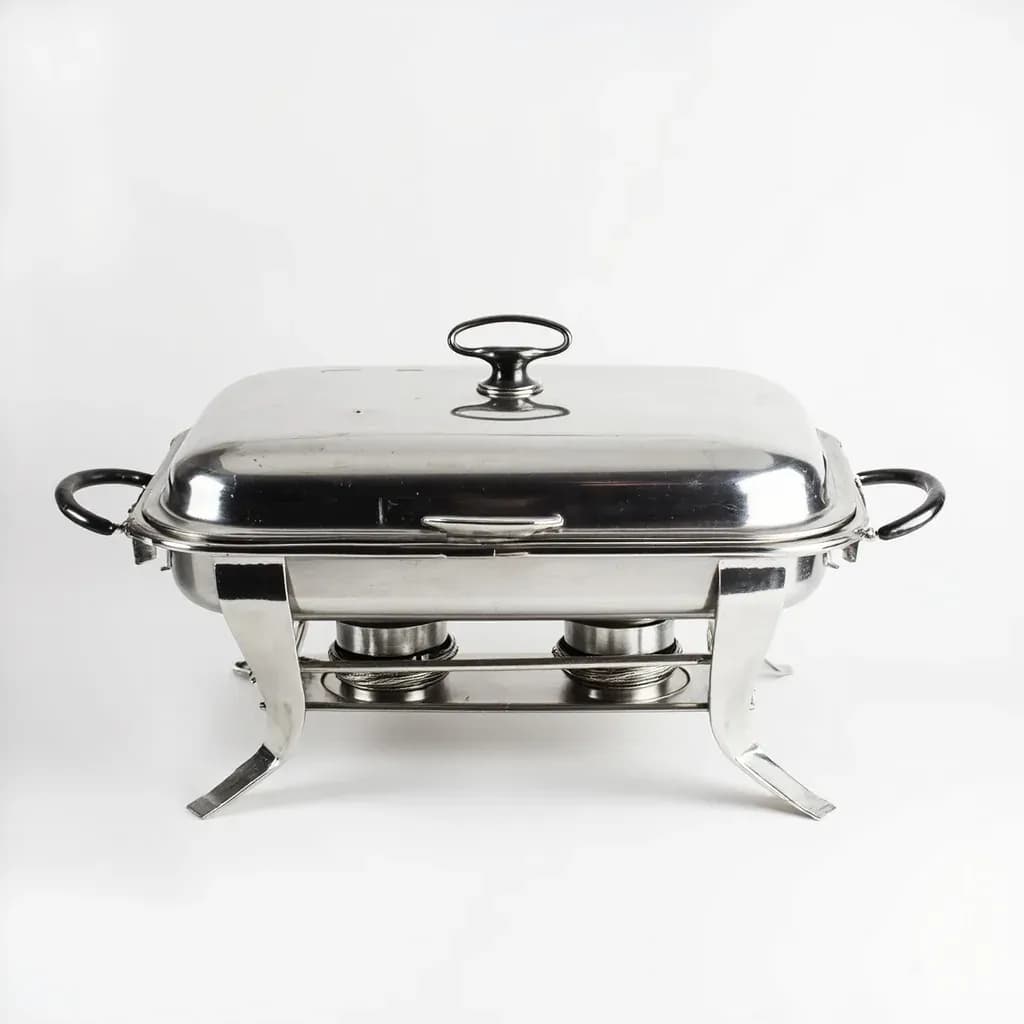
A buffet warmer that keeps cooked food hot over a gentle flame or fuel canister for service.
A chafing dish holds a food pan above a water bath that is warmed from below by a fuel canister or electric element. The indirect heat keeps prepared dishes hot and moist for buffets and catered events without overcooking them. It is a holding and serving tool rather than a cooking vessel, common at banquets, brunches, and parties.
A chafing dish (often shortened to "chafer") is a two- or three-pan buffet warmer built around an indirect heating principle: a burner or fuel canister heats a water pan, and the steam from that hot-water bath gently warms a food pan nested above it. That water layer is the defining feature — it turns a small flame into a steady heat source capped just under 212 °F / 100 °C, hot enough to keep food safely above the 140 °F / 60 °C holding line without continuing to cook, dry out, or scorch. Because the heat is buffered by steam, a delicate béchamel, a braised short rib, and a pan of roast vegetables can sit side by side without individual burner adjustments.
In practice, a chafer is a holding device, not a cooking device. Food is brought to temperature in the kitchen, transferred hot to the chafer, and the frame plus water bath does the rest through a service window of roughly two hours per standard 7 oz canned-heat can. The setup consists of a frame, a lower water pan, an upper food pan (usually a 12 × 20 in full-size hotel pan or 12 × 10 in half size), and a lid. The most common fuel is denatured-alcohol gel ("canned heat" such as Sterno), though butane burners, electric elements, and induction bases are all in regular use.
Chafers are the backbone of buffet, family-style, and catering service because they package heat, moisture, and a clean serving surface into a single movable station. They also let a cook stage finished components at a carving or omelet station and keep plated food warm during a restaurant service lull — any situation where holding temperature, not active cooking, is the goal.
Alternatives
Types & varieties
The catering workhorse — lightweight, stackable, inexpensive, and easy to clean
Lid retracts on a track so guests can serve without lifting it; preserves heat and reduces contamination
Lid opens on a back hinge; common on formal buffets and traditional silver-plate sets
Decorative traditional service for weddings and formal dinners; heavy, requires polishing
The standard configuration: a frame that holds a canned-heat can or butane canister below the water pan
Adjustable flame with a refillable canister; favored for carving stations and high-end catering
Magnetic stainless food pan heated by an induction hob placed beneath the frame; no open flame, even heat, indoor-safe
Built-in heating element plugged into a wall outlet; standard in hotels and institutional dining rooms
Specialty shapes for soup tureens, sauce courses, and curved buffet lines
The water bath: why it is the whole point
Every chafer design — from a basic wire frame to a polished silver heirloom — is built around the same trick: a layer of hot water between the flame and the food. Water cannot exceed 212 °F / 100 °C at standard atmospheric pressure, so the food pan ceiling is fixed just under boiling no matter how aggressively you crank the burner. That cap is what makes the chafer useful for holding rather than cooking. A pot of stew placed directly over a Sterno will reduce and scorch within an hour; the same stew in a chafer sits in a humid steam bath that holds serving temperature and keeps the surface moist.
The water also acts as a thermal mass. The fuel can's flame fluctuates as the gel burns down or wind drafts buffet linens, but a well-filled water pan smooths those swings. This is why the water pan is filled with hot water to start and topped off during service — a half-empty water pan with a dry spot directly above the burner is the most common cause of scorched food in a chafer.
- Water pan depth: typically 2.5–3 in, filled 1–2 in deep with hot water
- Pre-fill with HOT water, not cold, to avoid dropping the food pan temperature on start-up
- Top off the water level during service as it boils away
- Use distilled water in hard-water areas to limit mineral scale in the pan
Fuel choices and timing
Canned-heat (denatured alcohol gel) is the default because it is cheap, shelf-stable, and approved for indoor food service in most jurisdictions. The trade-off is a fixed burn time of about 2 hours per 7 oz can at full open flame and a faint combustion odor that requires reasonable ventilation. Butane burners give an adjustable flame and longer continuous run with refillable canisters, but they cost more and require more care around linens and loose fabric. Electric and induction chafers eliminate open flames and combustion byproducts entirely and are the safest choice for enclosed indoor service, though they tie you to a power outlet.
- Two cans per chafer is the rule of thumb for any event running past 3 hours
- Butane and alcohol fuels consume oxygen; ensure adequate ventilation
- Induction and electric chafers are the best choice for indoor or wind-exposed setups
Holding vs. cooking
A chafer keeps food warm; it does not cook it. Food that goes into a chafer should already be fully cooked and at or above serving temperature (around 140–160 °F / 60–70 °C for most proteins and stews). Anything raw or underdone will spend its time in the chafer slowly creeping toward the danger zone rather than reaching a safe finish. The exception is live-action stations — omelet, pasta, stir-fry, carving — where the chafer holds a finished component (sliced roast, blanched vegetables, cooked noodles) while the cook finishes each portion to order on a separate heat source.
Common uses
Tips & pitfalls
- Pre-heat the empty chafer for 10–15 minutes with the water pan full of hot water before plating food in it; plating cold food into a cold chafer is the fastest way to lose the safe-holding window.
- Pre-fill the water pan with HOT water, not cold; cold water drops the food pan temperature and slows recovery on start-up.
- Top off the water level during service — once the water boils away, the burner starts scorching the food pan directly and the food follows.
- Close the lid between servings. Every opening drops the food temperature noticeably, especially in roll-top and hinged-lid designs.
- Replace canned-heat cans proactively; a dead can mid-service is the most common buffet failure. For events over 3 hours, plan two cans per chafer or switch to electric or induction.
- Do not crank a butane burner to maximum under a delicate sauce — the water bath is meant to buffer heat, and a full flame under a low-water pan scorches in minutes.
- Keep the fuel can fully shielded by the frame and clear of linens, paper, and loose sleeves; sleeve fires are a real catering incident.
- Place chafers on a stable, level, non-flammable surface. Never directly on wood, plastic, or fabric tablecloths without a trivet or hard surface beneath.
Good to know
- Etymology
- From Middle English 'chafen' and French 'chauffer' meaning to warm — the same root as 'chauffeur'
- Standard full-size food pan
- 12 × 20 in (US hotel pan) / 530 × 325 mm (GN 1/1 metric)
- Half-size food pan
- 12 × 10 in / 265 × 325 mm (GN 1/2)
- Primary heat source
- Indirect steam from a 1–2 in (2.5–5 cm) hot water bath heated by a fuel can, butane burner, electric element, or induction hob
- Safe-holding temperature
- Food held above 140 °F / 60 °C; the water bath caps pan temperature just under 212 °F / 100 °C, preventing scorching
- Common fuel
- Canned heat (denatured-alcohol gel such as Sterno); also butane burners, electric elements, and induction
- Fuel burn time
- A standard 7 oz / 200 g canned-heat can burns roughly 2 hours at full open flame
- Service-window rule of thumb
- Plan two cans per chafer for any event running longer than 3 hours
- Typical empty weight (full-size)
- 8–15 lb / 3.5–7 kg depending on frame style and material
Also called
chafer · buffet warmer · holding tray
Related

Stovetop
The everyday burners where most cooking actually happens

Oven
Enclosed dry heat for roasting, baking, and braising

Grill
Live-fire or gas grates for char, smoke, and high heat

Smoker
Low, slow heat and wood smoke for barbecue and brisket

Air Fryer
Countertop convection that crisps with little or no oil

Slow Cooker
Set-and-forget low heat for stews, beans, and braises

Pressure Cooker
Sealed steam pressure that cooks tough food in a fraction of the time

Rice Cooker
Foolproof, perfectly steamed rice every single time