Appliances & Heat
Steam-Jacketed Kettle
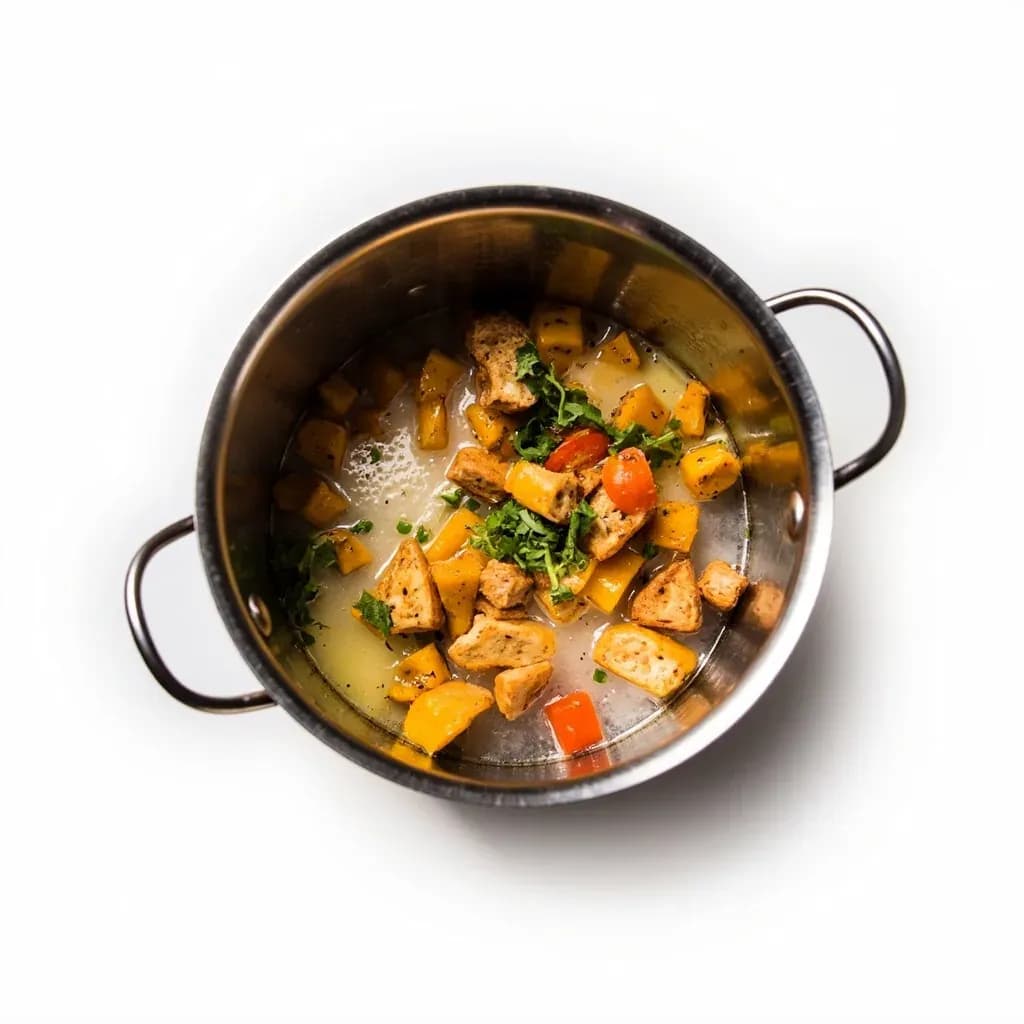
A large double-walled vessel heated by steam between its layers for gentle, even bulk cooking.
A steam-jacketed kettle is a large commercial cooking vessel with a hollow double wall through which steam circulates to heat the contents evenly from all sides. It cooks soups, sauces, stocks, and stews in high volume with far less scorching than direct-flame pots. Common in institutional and production kitchens, many tilt for easy emptying of finished batches.
A steam-jacketed kettle is the workhorse of high-volume cooking: a stainless steel pot wrapped in a welded outer shell (the jacket) into which pressurized steam is introduced. The steam transfers heat through the wall of the inner pot, so the food itself never sits over a flame or a hot element. Because the jacket surrounds the vessel on the sides (and, in full-jacketed models, the bottom), heating is remarkably even and there are no localized hot spots to scorch dairy, starch, or sugar. Temperature is controlled by regulating jacket pressure — there is no flame to adjust at the pot, no element to cycle on and off, just a steady bath of condensing steam delivering latent heat at a predictable rate.
This indirect-heat principle is what makes the kettle valued for delicate work at scale. Stocks come off clear because the liquid can be held at a low, gentle simmer. Custards, milk-based sauces, and cheese-milk cook gently with far less risk of scorching or breaking. Jams and reductions cook down without the seizing and burning that plague stockpot work. In a school cafeteria, a hospital production kitchen, or a brew house, the kettle replaces an entire battery of stockpots and burners, frees up hood space, and lets one cook move a hundred gallons of product through a single, controllable heat source.
For the working cook, the kettle behaves less like a pot and more like a controllable heat reservoir. You set the jacket pressure, the food climbs to a target temperature, and it stays there. Draining a tilting kettle is faster and safer than ladling, and the inner surface — typically stainless — is tough enough for daily wash-down. The trade-off is capital cost, footprint, and the fact that an empty or dry-fired kettle is a real mechanical liability, not just a burned pot.
Alternatives
Types & varieties
2–20 qt self-contained electric or direct-steam; the entry point for small restaurants, test kitchens, and cafés
20–200 gal, non-tilting, drained through a bottom valve; the institutional default for cafeterias, hospitals, and commissaries
Pivots on a trunnion to pour directly into hotel pans, a pump, or a holding cabinet; hand-crank, motorized, or hydraulic tilt
Steam wraps only the lower two-thirds of the pot; suited to products that need a cooler, less-agitated top zone
Integral electric boiler in the base; no house steam line needed, simpler installation and permitting
Integral gas-fired generator for high recovery on the largest floor models, where steam demand is heavy
Plumbed to a building or central boiler; quieter, no onboard generator, but requires an in-house steam source and a properly sized steam trap
Factory-certified to ASME Section VIII for full jacket pressure; required by code in many jurisdictions and distinct from atmospheric-style steam cookers that look similar
Fitted with a scraper-agitator that sweeps the wall to prevent scorching of thick products like jam, caramel, or cheese curd
Why steam, not flame
Steam cooking looks like simmering but works on a different physical principle. Each gram of condensing steam releases about 540 calories of latent heat, far more than the sensible heat a wall of hot air or a flame can deliver to the food. The inner kettle wall therefore reaches a stable temperature set by the jacket pressure, and the food rises to that temperature smoothly rather than being driven from below. The result: no nucleation points burning onto the bottom, no scorching where a flame licks the side, and very tight control over a long cook. It is the same logic as a double boiler, scaled up to a hundred gallons.
- Jacket pressure is the only knob that matters — 5 psi for a gentle simmer, 30 psi for a rolling, jam-grade boil
- Because the steam condenses and gives up heat, recovery after loading cold product is fast and predictable
- The jacket is a true pressure vessel and must be treated like one: relief valves tested, blow-downs performed, scale cleared
Working with very large batches
Cooking at scale introduces problems a home cook never meets. A 60-gallon kettle of stock, a 40-gallon kettle of jam, or 100 gallons of oatmeal each behave differently from a stockpot on a burner, and the kettle handles them best when you plan headspace, fill temperature, and evaporation ahead of time.
- Stocks: hold the jacket below a gentle simmer (low single-digit psi) to keep the liquid clear; pull the steam early and let residual heat finish the cook
- Jams and reductions: climb to about 220 °F and hold; use a floor paddle, not a whisk, to keep the wall clean
- Dairy and custards: preheat the kettle with hot water, dump it, then add the cold milk — this prevents the first seconds of contact from scorching proteins onto cold metal
- Grains and beans: figure roughly 1.5× to 2× the home-cook water ratio, since kettle evaporation is gentle and the starches need room to swell
- Drain slowly through the bottom valve on a stationary kettle; on tilting models lock the tilt mechanism fully before you fill
Common uses
Tips & pitfalls
- Do not run a steam-jacketed kettle dry. A dry jacket overheats almost immediately, damages welds and gaskets, and on self-contained units can destroy the steam generator — this is the single most expensive mistake in a kettle kitchen.
- Pre-fill with hot water and dump it before adding dairy, starch slurries, or sugar work. A cold inner wall plus thin, protein- or sugar-rich liquid is the classic scorch scenario, and a preheated kettle eliminates it.
- Leave 20–25% headspace. Foam-prone products (stock, beans, milk, fruit purées) climb fast when jacket pressure rises, and a boil-over from a 100-gallon kettle is a serious cleanup and burn hazard.
- Use a floor paddle or high-temp plastic scraper — never a whisk. Whisks whip in air and cannot reach the sidewall, which is exactly where scorching begins on long cooks.
- Crack the bottom drain valve slowly on a stationary kettle; the contents are still above serving temperature long after the steam is shut off, and a slug of 50 gallons of 200 °F stock through an open valve is dangerous.
- Blow down and rinse the jacket annually (more often in hard water). Boiler scale insulates the wall, slows recovery, and can foul the steam trap — a kettle that 'won't get hot anymore' is usually a scaled jacket, not a broken unit.
- Verify the pressure relief valve is unobstructed and tested before every service. A relief that is stuck or capped turns a useful kitchen tool into a pressure-vessel incident.
- For tilting kettles, fully engage the tilt lock before filling. A partially loaded 80-gallon kettle that shifts mid-fill is a topple and a crush injury waiting to happen.
Good to know
- Heating principle
- Pressurized steam fills the jacket; as it condenses on the inner wall it gives up latent heat, which conducts evenly into the food
- Jacket pressure vs. temperature
- 5 psi ≈ 227 °F; 15 psi ≈ 250 °F; 30 psi ≈ 274 °F; 40 psi ≈ 287 °F — the gauge, not a flame, sets cooking temperature
- Typical capacities
- Tabletop 2–20 qt; floor models 20–200+ gal; most common institutional sizes 40, 60, 80, and 100 gal
- Configurations
- Countertop vs. floor-standing; tilting (hand, motorized, or trunnion) vs. stationary; 2/3-jacketed vs. full-jacketed
- Power source
- Direct steam from a building boiler, or self-contained with an integral electric or gas-fired steam generator
- Vessel material
- Inner pot stainless steel (standard); older or specialty units in copper or mild steel with food-grade plating
- Safety
- ASME Section VIII pressure-vessel certification, pressure relief valve, and low-water cutoff on self-contained models
- Cost range
- Countertop self-contained electric roughly $3,000–$10,000; floor tilting gas models $15,000–$60,000+
Also called
Double-Jacketed Kettle · Steam Kettle · Jacketed Kettle
Related

Stovetop
The everyday burners where most cooking actually happens

Oven
Enclosed dry heat for roasting, baking, and braising

Grill
Live-fire or gas grates for char, smoke, and high heat

Smoker
Low, slow heat and wood smoke for barbecue and brisket

Air Fryer
Countertop convection that crisps with little or no oil

Slow Cooker
Set-and-forget low heat for stews, beans, and braises

Pressure Cooker
Sealed steam pressure that cooks tough food in a fraction of the time

Rice Cooker
Foolproof, perfectly steamed rice every single time