Appliances & Heat
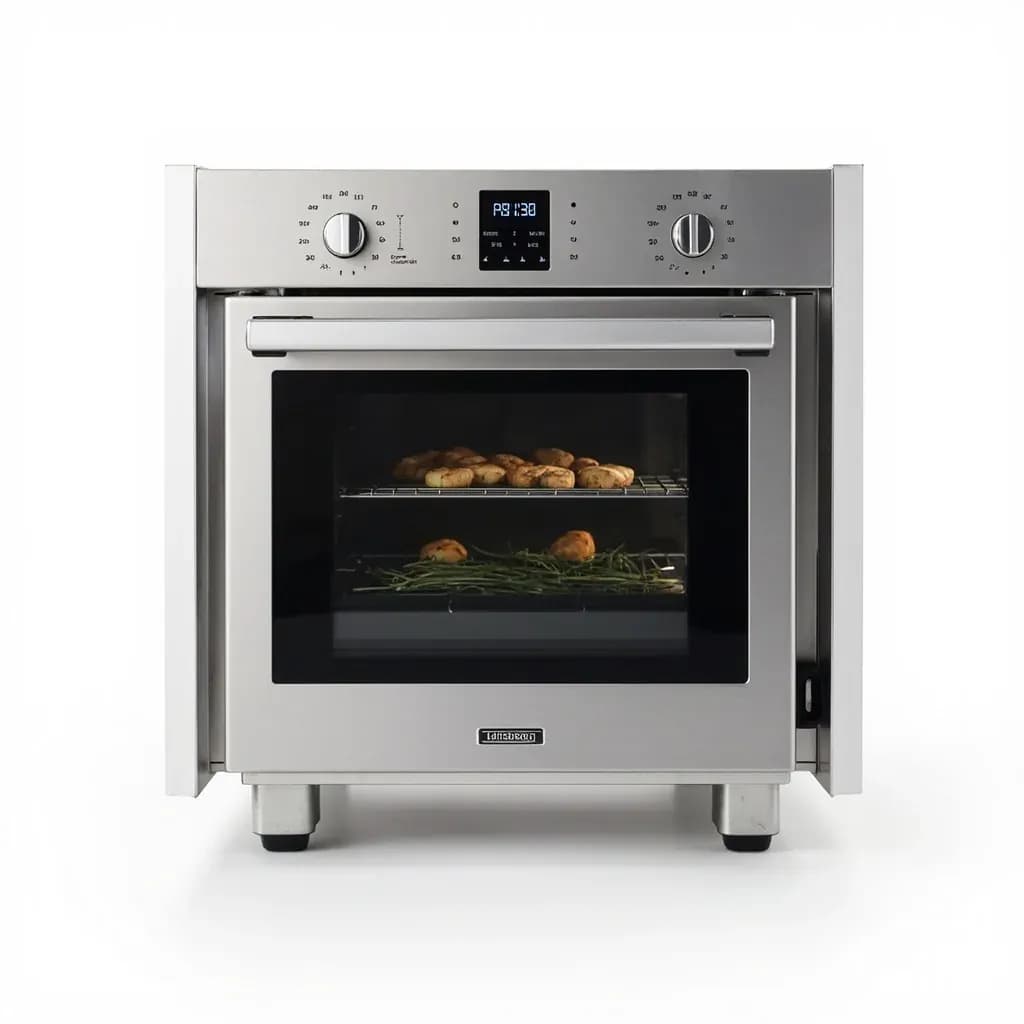
Combi Oven
Pro oven combining convection heat and steam for precise, versatile cooking.
A combi oven is a professional oven that blends convection (dry hot air) with injected steam, letting cooks dial in any mix of the two. This versatility allows roasting, baking, steaming, poaching, and proofing in one appliance with precise temperature and humidity control. Combi ovens are valued for even cooking, high yields, and reproducible results in commercial kitchens.
A combi oven — short for combination, sometimes called a combi steamer — is a tightly gasketed, fan-assisted oven that lets the cook dial in any ratio of dry convection heat to injected steam, or run either mode on its own. The three-way control over temperature, humidity, and airflow turns the chamber into a precision cooking environment: you can roast a chicken, steam a tray of asparagus, proof a pan of brioche, or hold a hotel pan of braised short rib at service temperature, all in the same box. For a working cook, the most important thing to internalize is that humidity is now a knob you can turn, not a side effect of what you happen to be doing.
What separates a combi from a conventional convection oven is the steam circuit. Water — filtered or softened — is either boiled in a separate generator and piped in as saturated steam, or sprayed onto hot fins inside the chamber to flash into vapor. Once the cook stops thinking of the oven as just hot air and starts thinking of it as a chamber that also contains water vapor, the technology begins to make sense. Browning, crisping, and dry-heat roasting all want low humidity; steaming, gentle cooking, and reheating all want high humidity; most savory work lives somewhere in between.
The practical payoff is consistency. Core probes, programmable recipes, and automatic cleaning have made combis the backbone of hotel banqueting, central production kitchens, school food service, and modern pastry shops. They also save labor: a single unit can replace a separate steamer, a holding cabinet, a proof box, and a low-temperature circulator, while letting a cook press one button for the 30 menu items that run every shift.
Alternatives
Types & varieties
A separate boiler produces saturated steam on demand; faster steam recovery, higher humidity ceilings, but more plumbing and maintenance
Water is sprayed directly onto heated fins in the chamber to flash into steam; lighter, cheaper, easier to install, slightly slower to recover
Direct-fired gas burner heats air and steam; lower running cost where gas service is available
Electric heating elements; easier installation, no flue, common in countertop and smaller floor models
Three- to six-pan capacity, fits on a stand; suited to cafés, small restaurants, and R&D kitchens
Six- to twenty-plus-pan capacity; the workhorse of hotels, banqueting, and central production
Doors on both sides so trays enter from the kitchen and exit into the service area; reduces cross-traffic in banqueting
Built-in extraction and condensation; allows installation under most ceilings without a separate canopy
The three-mode mental model
Every combi oven offers the same three operating modes, and learning them is the difference between fighting the machine and getting the most out of it.
- Dry heat (convection only): use for roasting, baking, gratins, anything you want to brown or crisp. Behaves like a powerful convection oven.
- Steam only: use for vegetables, fish, dumplings, custards, gentle cooking below 212°F, and low-temperature work analogous to sous-vide. No browning occurs because the chamber is saturated.
- Combi (steam + convection at a chosen ratio): the default for most savory work. The percentage of humidity is the new dial — high humidity for confit, low humidity for skin-on poultry, anything in between for braises and roasts.
Daily care and longevity
A combi is more demanding than a conventional oven because steam and food residue attack seals, fans, heating elements, and the steam circuit. Treat the cleaning cycle as part of the cook's day, not an afterthought.
- Run the automatic cleaning cycle at the end of every service, while residue is still soft; overnight baked-on soil shortens seal and fan life.
- Use filtered or softened incoming water; hard water deposits scale in the boiler, on fins, and in the steam lines — scale is the single most common cause of combi failure.
- Wipe the door gasket daily and inspect it weekly; a torn gasket leaks steam and forces the unit to work harder for the same chamber temperature.
- Follow the manufacturer's descaling schedule even with a softener, and never run the cleaning cycle with plain water in place of detergent — it will not remove polymerized fat.
Common uses
Tips & pitfalls
- Choose perforated GN pans for steam so vapor circulates around the food; reach for solid pans when you want to retain moisture or roast in drippings
- Leave at least 1 inch (2.5 cm) between pans and the chamber walls, and don't crowd the racks — in combi mode the air and steam are the cooking medium, and blocked airflow leaves cold spots
- When adapting a conventional recipe, drop the set temperature by about 20–25°F (10–15°C) at first; steam transfers heat more efficiently than dry air and a straight conversion will overshoot
- Open the door decisively and close it fast; every opening costs the chamber its temperature and humidity, especially in steam mode
- Probe proteins with a core probe rather than relying on time — combi ovens cook more evenly than conventional ovens and time tables from old recipes no longer apply
- For bread, run high steam for the first 60–80 percent of the bake, then vent to dry heat for the final minutes to set the crust and color
- For roasted poultry, start in combi mode (steam + convection) to render subcutaneous fat without drying the breast, then finish in dry convection to crisp the skin
- Common mistake: treating a combi like a regular convection oven and never engaging the steam — it will underperform a standard convection oven on plain roasting because the heat-transfer dynamics are different
- Common mistake: sealing loads in aluminum foil unless the recipe requires it; foil blocks the steam and humidity control that the oven is trying to deliver, and it leaves the food sitting in condensate
- Common mistake: putting plastic, wood, or non-oven-safe latches into a steam cycle — the chamber reaches 100 percent humidity and any heat-sensitive material will warp or leach
- Save a dedicated 'plate retherm' program around 250–265°F with moderate steam for banqueting; it revives food far better than a microwave or salamander and is worth the five minutes of setup
Good to know
- Type
- Professional combination oven (combi steamer) that combines forced-air convection heat with injected steam at any ratio from 0 to 100 percent
- Also called
- Combi steamer, combination oven, steam-convection oven
- Origin
- Developed in Europe for professional kitchens in the late 1970s, built on technology that merged separate steamers and convection ovens
- Temperature range
- Approximately 86–572°F (30–300°C) in dry/convection mode; 86–212°F (30–100°C) in pure steam mode
- Steam generation
- Boiler (separate generator) for faster recovery and higher humidity ceilings; boilerless (water injected onto heating fins) for lower cost and simpler installation
- Pan system
- Gastronorm (GN 1/1, 2/1, 1/2, 1/3) on European units; full-size sheet pan (18×26 in) on North American units
- Power
- Gas (direct-fired) or electric; available in countertop (3–6 pan) and floor-standing (6–20+ pan) formats
- Cleaning
- Automatic cycles using manufacturer-specific detergent tablets or liquid; incoming water must be filtered or softened to prevent scale damage
Also called
combi-oven · combination-oven · combi-steamer
Related

Stovetop
The everyday burners where most cooking actually happens

Oven
Enclosed dry heat for roasting, baking, and braising

Grill
Live-fire or gas grates for char, smoke, and high heat

Smoker
Low, slow heat and wood smoke for barbecue and brisket

Air Fryer
Countertop convection that crisps with little or no oil

Slow Cooker
Set-and-forget low heat for stews, beans, and braises

Pressure Cooker
Sealed steam pressure that cooks tough food in a fraction of the time

Rice Cooker
Foolproof, perfectly steamed rice every single time