Transform & Preserve
Reverse Spherification
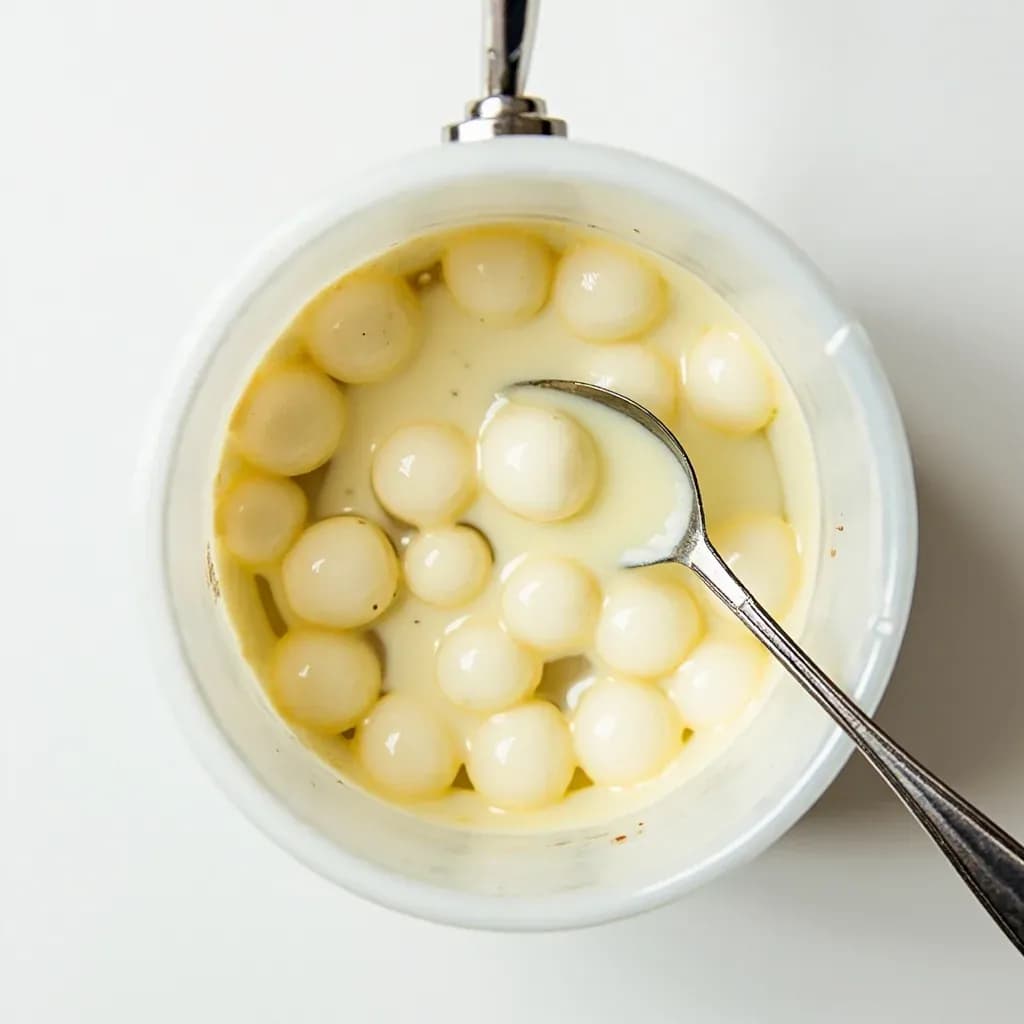
Dropping a calcium-rich liquid into an alginate bath to form liquid-filled spheres.
Reverse spherification submerges a calcium-laden liquid into a sodium-alginate bath, forming a thin gel skin only on the outside so the center stays fully liquid. Unlike basic spherification, the membrane stops thickening once removed, so the spheres hold without gelling solid. It is a modernist technique for juice or yogurt caviar and burst-in-the-mouth ravioli.
Reverse spherification is the modernist technique in which a calcium-fortified flavored liquid is dripped into a bath of sodium alginate and water, where a thin gel membrane forms on contact. Sodium alginate, extracted from brown algae, is a long-chain polysaccharide that cross-links when it meets free calcium ions, creating a delicate skin around each droplet while leaving the inside liquid. Because the calcium (rather than the alginate) is carried by the precious flavored liquid, the unflavored bath can be mixed once and reused across many batches.
The technique was popularized in the early-to-mid 2000s by elBulli and the wider molecular gastronomy movement led by Ferran Adrià and Hervé This, alongside its sibling, direct spherification. Its defining advantage is versatility: it works with dairy products (which already contain calcium), with alcohol-rich liquids that would otherwise disrupt gelling, and with acidic ingredients provided the pH is held above about 3.6. The result is a sphere with a fluid center that bursts cleanly on the bite — a controlled burst of flavor in a self-contained package.
Spheres range from caviar-sized pearls of about 3 mm, made through squeeze bottles and syringes, up to large 'ravioli' 3–4 cm across. They are best served within 30–60 minutes of forming, because the gel reaction continues inward over time and the liquid center will eventually set.
- Difficulty
- Hard
Types & varieties
Calcium-enriched flavored liquid dripped into an alginate bath; liquid stays fluid inside a thin gel membrane.
The calcium-fortified liquid is frozen into cubes or molds, then dropped into the alginate bath; allows spheres of any shape and works with alcohol-rich or heat-sensitive liquids.
Tiny spheres around 3 mm made with a squeeze bottle or syringe, used for cocktail garnishes, sauce bursts, and plating accents.
Spheres 2–4 cm across, served as self-contained liquid centers on a spoon or in a tasting dish.
Takes advantage of milk's natural calcium; can work without added calcium, though fortification improves membrane strength.
How to do it
- 1
Prepare the flavored liquid
Weigh the liquid (juice, dairy, cocktail, etc.). Add calcium lactate or calcium lactate gluconate at 0.5–2% by weight and blend until fully dissolved. Strain if needed. For highly acidic liquids, raise the pH slightly with a little sodium citrate before adding calcium.
- 2
Mix the alginate bath
Weigh cold water. Sprinkle sodium alginate (0.5–1% by weight) over the surface and blend with an immersion blender until smooth. Avoid whipping air into the mixture.
- 3
Rest the alginate bath
Cover and refrigerate the alginate bath for 12–24 hours so trapped air bubbles rise and escape. A bubble-free bath is essential for clean, round spheres.
- 4
Form the spheres
Transfer the calcium-fortified liquid to a squeeze bottle, syringe, or pipette. Hold it a few centimeters above the alginate bath and drip droplets steadily, avoiding splashing. Each droplet forms a sphere on contact.
- 5
Set the membrane
Leave the spheres in the alginate bath for 1–3 minutes, depending on size. Lift one with a slotted spoon and test by gently rolling it — if the membrane holds its shape, it is ready; if it breaks, give it another minute.
- 6
Rinse and reserve
Spoon the spheres out and rinse briefly in a bowl of clean water, or water lightly salted or acidulated to match the flavor, to remove residual surface alginate and the faint 'algae' taste.
- 7
Serve promptly
Plate the spheres within 30–60 minutes. They can be held in their rinse water at room temperature for short service, but membrane gelation continues, so don't hold for more than an hour or two.
How the chemistry behaves
Sodium alginate dissolves in cold water as a viscous, slightly cloudy liquid. When a calcium-bearing droplet enters the bath, the calcium ions migrate outward and the alginate chains cross-link around them, forming a calcium alginate gel skin in seconds. The reaction is diffusion-limited: it begins on the outside and works inward. A 3 mm pearl typically develops a membrane of well under 1 mm in a couple of minutes, leaving a liquid core; a 4 cm 'ravioli' takes much longer and is far more likely to set solid if left in the bath. Three variables control how the reaction behaves in practice: calcium concentration, contact time, and pH.
- Acidity below roughly pH 3.6 converts the alginate to its acid form and prevents gelation — citrus and most vinegars need to be buffered with sodium citrate or partially neutralized.
- High alcohol content disrupts the cross-linking and weakens the membrane; frozen reverse spherification is the usual workaround for spirits and liqueurs.
- Salt competes with calcium for binding sites on the alginate chain, so salty liquids require a slightly higher calcium load.
- Calcium chloride tastes briny and metallic; calcium lactate and calcium lactate gluconate are essentially flavorless and are the standard choices.
- The alginate bath loses strength with each batch as calcium accumulates in it; refresh or replace after roughly 3–5 uses, or strain and top up with fresh alginate.
Common uses
Tips & pitfalls
- Use calcium lactate or calcium lactate gluconate for clean flavor; calcium chloride reads salty and metallic and can throw off the seasoning of the final liquid.
- Hydrate the alginate with an immersion blender and let the bath rest in the fridge overnight — air bubbles cause lumpy, misshapen spheres.
- Adjust calcium to the liquid: too little and the membrane tears when you lift the sphere; too much and the sphere gels solid or turns cloudy.
- Lift spheres from the alginate bath with a slotted spoon and rinse briefly in clean or acidulated water to remove surface alkalinity and any algae taste.
- Do not leave finished spheres in the alginate bath longer than necessary — gelation continues inward and the liquid center will eventually set.
- For acidic liquids (citrus, vinegar-heavy juices), raise the pH above about 3.6 with sodium citrate, or switch to the frozen-reverse method, otherwise the alginate cannot set.
- A squeeze bottle, syringe, or pipette gives the most uniform pearls; ladles produce inconsistent sizes and waste a lot of the flavored liquid.
- Salt and alcohol both inhibit gelation; account for these in the flavored liquid or compensate with a slightly higher calcium load.
Good to know
- Discipline
- Modernist / molecular gastronomy
- Hydrocolloid system
- Calcium ions + sodium alginate (from brown algae)
- Process direction
- Calcium-rich flavored liquid is dripped into a sodium alginate bath (inverse of direct spherification)
- Alginate bath
- 0.5–1% sodium alginate by weight in water, rested 12–24 hours to degas
- Calcium load in flavored liquid
- 0.5–2% calcium lactate or calcium lactate gluconate by weight
- Membrane formation time
- 1–3 minutes, depending on sphere size
- Best served
- Within 30–60 minutes of forming
- Sphere size range
- Caviar-sized (~3 mm pearls) up to large 'ravioli' (3–4 cm)
Related

Confit
Cook slowly submerged in fat for silky tenderness and keeping

Cure
Draw out moisture with salt and time to preserve and concentrate

Pickle
Steep in acidic brine for bright, tangy, crunchy preservation

Ferment
Let friendly microbes transform food into tangy, complex flavor

Marinate
Soak in a seasoned mix to flavor and tenderize before cooking

Brine
Soak in salt water so meat stays juicy and seasoned throughout

Dehydrate
Slowly dry out moisture to concentrate flavor and extend shelf life

Cold-Smoke
Perfume cured food with smoke without cooking it through