Prep & Assembly
Italian Meringue
Whipping egg whites with hot sugar syrup into a glossy, cooked, stable foam.
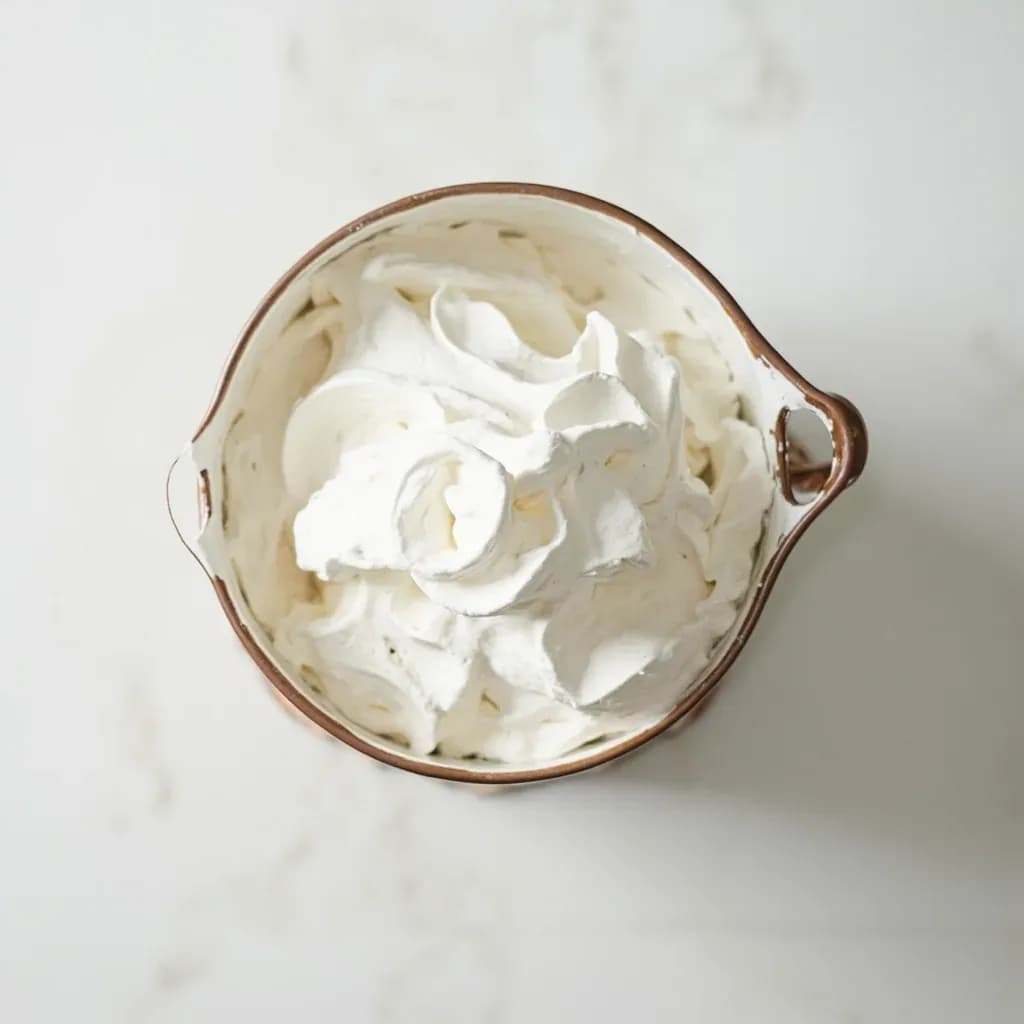
Italian meringue is made by streaming a hot 118 to 121 C sugar syrup into whipping egg whites, which partially cooks them into a dense, glossy, very stable foam. Its stability makes it ideal for buttercream, mousse, and toppings that hold their shape without further baking. The cooked whites also make it safer and longer-lasting than French meringue.
Italian meringue is a fully cooked foam built by streaming hot sugar syrup into whipping egg whites. Unlike French meringue, which is unbaked raw whites and sugar, or Swiss meringue, which is gently warmed over a bain-marie, Italian meringue is made by pouring syrup at soft-ball to firm-ball temperature (115–121°C / 240–250°F) into already-foaming whites. The heat pasteurizes the eggs and dissolves the sugar into the protein network, producing a meringue that is safe to eat as-is and remarkably stable.
What distinguishes it in the kitchen is texture: dense, glossy, marshmallowy, with peaks so firm they can be piped into sculptural shapes and held for days without weeping. The high sugar-to-white ratio (typically 1:2 by weight) and the fact that the sugar arrives already dissolved mean the foam holds more water in suspension and sets with a smooth, almost lacquered surface. This is why Italian meringue is the base of choice for buttercreams, baked Alaska, tart toppings, and glazes that need to keep their snap.
It is also the most technically demanding of the three classical meringues. A candy thermometer, a steady hand, and a stand mixer are practically non-negotiable. Get the variables right, though, and the result is the most forgiving meringue to work with — it can be stored, re-whipped, torched, frozen, and folded into mousses without losing its composure.
- Difficulty
- Hard
Types & varieties
Whipped to soft-to-medium peaks; used folded into mousses, soufflés, semifreddo, and as the base for buttercream.
Whipped to full stiff peaks; piped for tart toppings, baked Alaska insulation, and decorative work.
Soft Italian meringue whipped with softened butter and a pinch of salt until light and silky; the classic celebration-cake frosting.
A looser, warmer version poured hot to coat éclairs, Saint-Honoré, or fruit tarts; sets with a glassy snap.
How to do it
- 1
Set up the equipment
Fit a stand mixer with the whisk attachment and a scrupulously clean, grease-free metal bowl. Have a heavy-bottomed saucepan and a candy thermometer ready. Measure by weight: 120 g egg whites, 240 g sugar, and 60–80 g water for the syrup is a reliable starter batch (1:2 whites-to-sugar, plus enough water to dissolve the sugar).
- 2
Cook the syrup
Combine the sugar and water in the saucepan and bring to a boil over medium heat, brushing down any crystals on the side of the pan with a wet pastry brush. Once boiling, do not stir. Cook to 115–121°C (240–250°F); pull the pan off the heat the moment it reaches your target.
- 3
Begin whipping the whites
When the syrup is around 105°C (220°F), start whipping the egg whites on medium speed with a pinch of cream of tartar. Whip to soft peaks by the time the syrup hits temperature — they should look like foamy shaving cream.
- 4
Stream in the syrup
With the mixer on medium-high, pour the hot syrup in a thin, steady stream against the inside wall of the bowl, not onto the spinning whisk. Aim to finish pouring over roughly 60–90 seconds. Hitting the wires flings syrup onto the bowl wall where it sets hard.
- 5
Whip to cool and stiff
After all the syrup is in, keep the mixer on medium-high for 3–5 minutes. The meringue should turn glossy white, form stiff peaks, and the bottom of the bowl should feel neutral — not warm. A warm meringue slumps once you stop whipping.
- 6
Use or store
Use immediately for buttercreams, folding into mousses, piping, or glazing. For storage, transfer to a clean airtight container, press plastic wrap against the surface to prevent a skin, and refrigerate up to 1 week or freeze up to 2 months. Re-whip briefly if it softens.
Italian, French, and Swiss: choosing the right meringue
The three classical meringues share ingredients but diverge sharply in technique and use. Knowing the trade-offs helps you pick the right one before you start.
- French meringue: raw whites beaten with sugar, piped or shaped, then baked. Lightest, driest texture; classic for cookies, dacquoise, and pavlova bases. Must be baked; not safe to eat raw.
- Swiss meringue: whites and sugar warmed together over a bain-marie to about 60°C (140°F), then whipped. Mildly cooked, very smooth, denser than French. Often used for lemon meringue pie and some buttercreams.
- Italian meringue: syrup cooked to soft-ball, streamed into whipping whites. Fully cooked and most stable of the three. The default for buttercreams, glazes, baked Alaska, and any application where the meringue will not be baked afterward.
Common uses
Tips & pitfalls
- Use a stand mixer — incorporating the syrup while whipping by hand is nearly impossible without losing volume.
- Equipment must be scrupulously grease- and yolk-free; even a trace of fat will keep the whites from whipping.
- Use room-temperature whites (≥ 21°C / 70°F); cold whites whip to noticeably lower volume.
- Cook the syrup to at least 115°C / 240°F — undercooked syrup produces a soft, weepy meringue that collapses within hours. Above 121°C / 250°F, the syrup caramelizes the foam and dulls the gloss.
- Add a tablespoon of glucose, corn syrup, or lemon juice to the syrup to discourage crystallization, and brush down the sides of the pan with a wet pastry brush before and during the boil.
- Continue whipping 3–5 minutes after the last of the syrup hits, until the bowl is cool to the touch. Stopping while the bowl is still warm is the most common reason Italian meringue slumps in the piping bag.
- For torching, use a low flame and pass quickly — the surface sugars scorch easily because the meringue is already cooked.
- If the meringue looks grainy or streaky right after the pour, keep whipping; it usually recovers within a minute as long as the syrup was at temperature.
Good to know
- Type
- Cooked meringue: hot sugar syrup streamed into whipping egg whites
- Egg-to-sugar ratio (classic)
- 1 part egg white to 2 parts sugar by weight
- Syrup cooking temperature
- 115–121°C (240–250°F), soft-ball to firm-ball stage
- Stabilizer (optional)
- Cream of tartar or a few drops of lemon juice, roughly 1/8 tsp per white
- Final meringue temperature
- Around 45°C (113°F); the bowl should feel neutral to the touch
- Food safety
- Egg whites are pasteurized by the hot syrup; safe to use without further baking
- Storage
- Airtight container, refrigerated up to 1 week or frozen up to 2 months
- Origin
- Codified in Italian confectionery tradition (often credited to Piedmont); one of three classical meringues
Also called
Cooked Meringue
Related

Whisk
Beat ingredients smooth and aerated with a looping wire motion

Sift
Pass dry ingredients through mesh to aerate and remove lumps

Strain
Pour through mesh to separate solids from liquid for a smooth result

Filter
Pass liquid through fine material to clarify out the smallest particles

Rice
Press cooked potatoes through small holes for fluffy, lump-free texture

Mash
Crush soft cooked food into a rustic, creamy purée

Grind
Crush food into a coarse to fine texture, from spices to meat

Grate
Shred food into fine bits against a sharp-toothed surface