Prep & Assembly
Sifting
Passing dry ingredients through a fine mesh to aerate them and break up lumps.
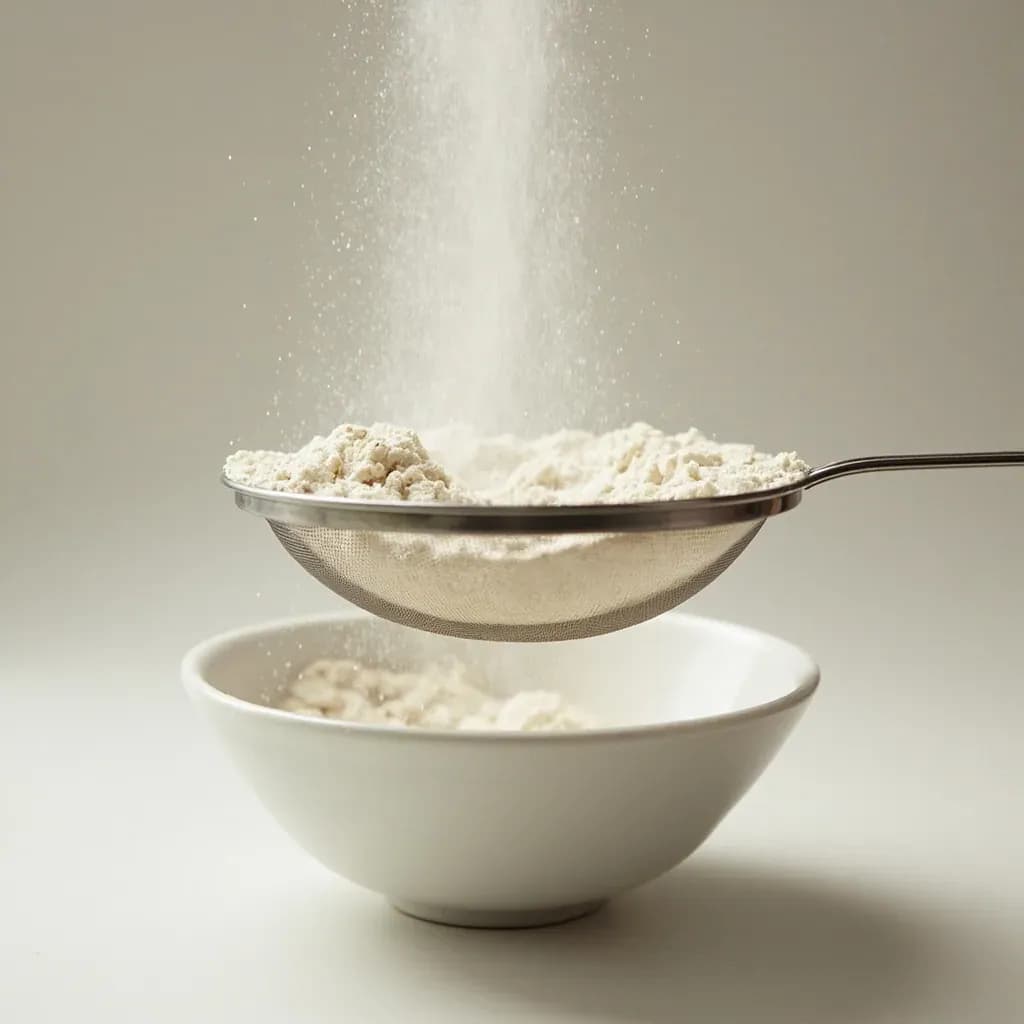
Sifting pushes flour, sugar, or semolina through a fine sieve to aerate it, break up clumps, and blend dry ingredients evenly. The lightened, lump-free result mixes more smoothly into batters and doughs and helps baked goods rise uniformly. Sifting also catches any stray bran, husks, or foreign bits, leaving a cleaner, finer powder.
Sifting is the act of passing a dry ingredient through a fine screen to break up clumps and work in air. In practical terms it does three jobs at once: it disperses stubborn lumps in cocoa or powdered sugar that would otherwise surface in your batter as gritty pockets; it evenly distributes small amounts of leavening and salt through a larger volume of flour; and it puffs the flour with air so that what you measure is measurably lighter and more uniform. A cup of sifted all-purpose flour weighs about 4 ounces (113 g) compared with roughly 5 ounces (140 g) for flour scooped straight from the bag, which is concrete evidence that sifting really does change the ingredient.
That change matters most in bakes where lift and tenderness depend on a well-aerated, lump-free dry mix: genoise, chiffon, angel food, fine layer cakes, and any recipe that leans on whipped egg whites. Cocoa powder, with its habit of compacting into stubborn shards, is the other classic candidate — sift it over the wet ingredients and you avoid the lengthy whisking otherwise needed to break up dry pockets. Powdered sugar clumps under the slightest humidity, and a quick pass through a mesh is the only reliable way to get it to dissolve into a glaze or buttercream without leaving white flecks.
For everyday cookies, muffins, and quick breads, modern pre-sifted all-purpose flour has made sifting largely optional. But it remains the cheapest insurance in baking: a tool, a screen, and thirty seconds that can rescue a recipe from a lumpy, dense result with no risk at all.
- Difficulty
- Easy
Types & varieties
Classic American kitchen tool with a side handle turned by crank; internal blades force ingredients through a fine screen.
Vintage cup-shaped sifter operated by squeezing the side handle; processes a single cup at a time.
The modern home cook's default — a conical or bowl-shaped wire-mesh strainer with no moving parts.
Professional drum sieve with mesh stretched over a hoop; ingredient is rubbed across with a paddle or the back of a spoon for the finest possible result.
Vintage three-screen gravity-fed sifter mounted over a bowl; produces very fine, voluminous flour.
How to do it
- 1
Choose the right tool
Use a fine-mesh strainer for most home baking. Reach for a rotary or squeeze sifter when working through several cups of flour, and pull out a tamis when you need the finest possible result, such as ultra-smooth cocoa or a flawless dusting of powdered sugar over a finished dessert.
- 2
Decide whether to measure first or sift first
Read the recipe's phrasing carefully. '1 cup sifted flour' means sift, then measure by spooning into the cup and leveling. '1 cup flour, sifted' means measure first, then sift into the mixing bowl. The two methods yield different amounts of flour.
- 3
Load the sifter in moderate amounts
Add about 1/2 to 1 cup of the dry ingredient at a time. Overfilling clogs the mesh and forces you to press or pound, which defeats the purpose of gentle aeration and can also pack the flour you do get through.
- 4
Pass the ingredient through the mesh
Turn the crank, squeeze the handle, or tap the side of the strainer so the ingredient falls in a wide, gentle shower into the bowl below. For a strainer, you can also press the back of a dry spoon in small circles to push the ingredient through. Hold the sifter high enough that the flour travels a few inches through the air.
- 5
Inspect what remains
Discard any hard lumps, debris, or bran left in the mesh. If you are working with whole-grain flour and want only the fine portion, set the coarse remainder aside for quick breads, crackers, or pancake batter rather than throwing it away.
- 6
Repeat if needed
Sift a second or third time for delicate cakes, very lumpy cocoa, or dusting the tops of desserts where a flawless finish matters. Two passes is generally enough; three is the practical maximum.
- 7
Combine with other dry ingredients
For recipes that sift dry ingredients together, sift the lightest ingredient first, then add baking powder, baking soda, salt, and spices on top, and sift the entire mixture once more. Finish with a brief hand-whisk to make sure the leaveners and salt are evenly distributed.
Reading the Recipe: 'Sifted' vs. 'Flour, Sifted'
The single most common pitfall with sifting has nothing to do with technique and everything to do with language. Older American recipes, in particular, distinguish between two ways of handling the same cup of flour, and they are not interchangeable.
A recipe that calls for '1 cup sifted flour' wants you to sift first, then measure — you pass the flour through the mesh, spoon it gently into the measuring cup, and level. A recipe that calls for '1 cup flour, sifted' (or '1 cup flour, then sifted') wants the opposite: spoon the flour into the cup, level, then sift it into the mixing bowl. The two methods produce noticeably different amounts of flour in the final batter, and treating them as the same is one of the most common reasons home bakes turn out dry or under-leavened.
In metric recipes and most modern writing, this confusion is avoided by stating weight directly. A reliable kitchen scale, in fact, is the simplest solution: weigh the flour, then sift it for aeration, and you are no longer at the mercy of the recipe's wording.
When Sifting Actually Matters
With pre-sifted all-purpose flour on every grocery shelf, sifting has become a technique more honored in the breach than the observance for many home bakers. Knowing when to bother and when to skip it is part of becoming a fluent baker.
Sift when the bake is delicate, the dry ingredient is lumpy, or the leavening is small relative to the flour. Skip it for sturdy quick breads, drop cookies, and pancakes, where a denser crumb is the goal and the batter is forgiving of small clumps.
- Delicate cakes (genoise, chiffon, angel food, fine layer cakes): sift the flour two or three times
- Cocoa powder in any application: sift to eliminate shards
- Powdered sugar in glazes, icings, or buttercream: sift to avoid white flecks
- Whole-grain flours: sift to remove coarse bran when a finer crumb is desired
- Everyday cookies, muffins, and quick breads: sifting is optional with modern AP flour
- Spice and leavener distribution: sift together with the flour to ensure even spread
Common uses
Tips & pitfalls
- Sift from a height — the wider the arc the flour falls through, the more air it picks up
- Do not press or force hard lumps through the mesh; press them through a separate pass with the back of a spoon or discard them, since forcing packs the rest of the flour
- In humid kitchens, sift powdered sugar immediately before using because it re-clumps within minutes
- Whisk the sifted dry ingredients briefly after sifting to make sure leavening and salt are evenly distributed
- Modern all-purpose flour is pre-sifted at the mill, so for everyday cookies and quick breads the step is optional — do not add an extra sifting out of habit
- If you intend to measure the sifted flour, sift into a separate bowl, not directly over the mixing bowl, since sifted flour settles quickly and the measurement can drift
- When folding sifted dry ingredients into a whipped-egg or creamed-butter base, use a gentle cutting motion — the air you want to preserve is already in the batter, not in the sifted ingredients
- For the lightest crumb in genoise, chiffon, and angel food cakes, sift the flour at least twice
Good to know
- Primary purpose
- Break up lumps and aerate dry ingredients such as flour, cocoa, powdered sugar, and cornstarch
- Typical mesh size
- 40–60 mesh for fine dry goods; coarser for rustic whole-grain work
- Volume effect
- Sifting 1 cup of all-purpose flour increases its volume roughly 5–10%
- Weight difference
- About 4 oz (113 g) per cup for sifted AP flour vs. ~5 oz (140 g) for scooped-and-leveled
- Best for
- Low-protein flours (cake, pastry), cocoa, powdered sugar, and aeration-dependent bakes such as genoise and angel food
- Time required
- 30–60 seconds per cup of flour
- Tool history
- Hand-cranked rotary sifters were patented in the U.S. in the late 19th and early 20th centuries; pre-sifted flour became standard mid-20th century
Also called
Sifting · Sieving
Dishes that rely on it




Related

Whisk
Beat ingredients smooth and aerated with a looping wire motion

Sift
Pass dry ingredients through mesh to aerate and remove lumps

Strain
Pour through mesh to separate solids from liquid for a smooth result

Filter
Pass liquid through fine material to clarify out the smallest particles

Rice
Press cooked potatoes through small holes for fluffy, lump-free texture

Mash
Crush soft cooked food into a rustic, creamy purée

Grind
Crush food into a coarse to fine texture, from spices to meat

Grate
Shred food into fine bits against a sharp-toothed surface