Prep & Assembly
Flour Blending
Mixing different flours to dial in protein, flavor, and performance for a recipe.
Flour blending combines two or more flours, such as bread and pastry flour or wheat with rye or whole grain, to tune the protein content, absorption, and flavor of a dough or batter. Bakers blend to hit a target gluten strength or to add character without losing structure. It lets a cook customize results that a single bagged flour can't deliver.
Flour blending is the practice of combining two or more flours — by weight, never by volume — to engineer a specific protein level, flavor profile, or texture in the finished bake. The protein percentage on a bag of flour (roughly 7% for cake, 8–9% for pastry, 10–12% for all-purpose, 12–14% for bread) determines how much gluten the dough can develop, which in turn controls whether the crumb is tender and cakey or chewy and open. Most flours in the grocery store are designed for a single use, but very few recipes are best served by a single flour straight out of the bag.
A blended flour behaves as a new ingredient: once the flours are sifted and whisked together, the mix carries the weighted average of their proteins along with the combined quirks of each component — the bran absorption of whole wheat, the supple chew of bread flour, the nutty depth of rye. This is why a 50/50 blend of whole wheat and bread flour produces sandwich loaves that rise higher and slice more cleanly than 100% whole wheat, and why a spoon of cake flour dropped into a biscuit recipe yields a noticeably finer, more tender crumb. The trade-off is that the blend inherits the shortest shelf life of its parts, so a blend containing whole grain typically needs to be used or frozen within one to three months rather than the year you might expect from a bag of all-purpose.
Home cooks usually blend to stretch an expensive specialty flour, to make an ancient grain like spelt workable on its own, or to hit a target that an all-purpose bag alone cannot reach. Professional bakers blend for control — nailing the same chew, crust, and crumb from one batch to the next by working backward from a target protein percentage. Either way, the work is the same: weigh, sift, whisk, log the result, and adjust next time.
- Difficulty
- Medium
Types & varieties
Whole wheat combined with bread or all-purpose flour, commonly 30/70 to 50/50, for sandwich loaves and rolls — adds bran flavor without making the crumb too dense.
Bread flour reinforced with vital wheat gluten or high-gluten flour for chewier bagels, pizza, and pan breads.
Cake or pastry flour cut with all-purpose, often 50/50, for biscuits, scones, and shortcakes with a finer, more tender crumb.
00 flour mixed with bread flour or semolina for pizza and focaccia — balances chew with a crisp, well-blistered crust.
Rye flour combined with bread or all-purpose, commonly 20–40% rye, for rye breads, sourdoughs, and crispbread — rye alone will not form a cohesive dough.
Spelt, einkorn, emmer, or khorasan mixed with bread or all-purpose flour for nutty flavor and easier handling than the ancient grain used alone.
Base of brown rice, white rice, or sorghum flour, balanced with starches (tapioca, potato, cornstarch) and a binder (xanthan gum or psyllium husk) — protein and structure must come from the blend, not from gluten.
Almond, hazelnut, or oat flour combined with all-purpose or cake flour, commonly 25–50% nut, for financiers, macarons, and tender cakes.
Sprouted whole wheat or spelt mixed with bread or all-purpose flour — slightly sweeter, more digestible, and more absorbent than standard whole grain.
How to do it
- 1
Define the goal
Decide what you want the blend to do: hit a target protein percentage (roughly 9% for tender, 11% for all-purpose, 12–13% for chewy breads), add whole grain flavor, accommodate a gluten-free diet, or match a regional style such as Italian 00, French T55, or a rye-forward loaf.
- 2
Choose the flours
Pick 2–4 flours whose properties together cover the goal. Read the protein percentage on the bag or look it up by brand; protein determines structure more reliably than the flour's marketing name does.
- 3
Calculate the ratio
Set percentages that add up to 100. Work backward from the target protein: a 12% blend from all-purpose at 10.5% and bread flour at 13% needs roughly 60% bread and 40% all-purpose (50/50 lands near 11.75%, which is usually close enough). Round to clean baker's percentages (25/75, 30/70, 50/50) for easier scaling.
- 4
Measure by weight
Weigh each flour on a kitchen scale to the gram. For a 500 g blend at 30/70, that is 150 g of the first flour and 350 g of the second. Avoid measuring cups — flour compaction skews ratios by 10–20%.
- 5
Sift and whisk together
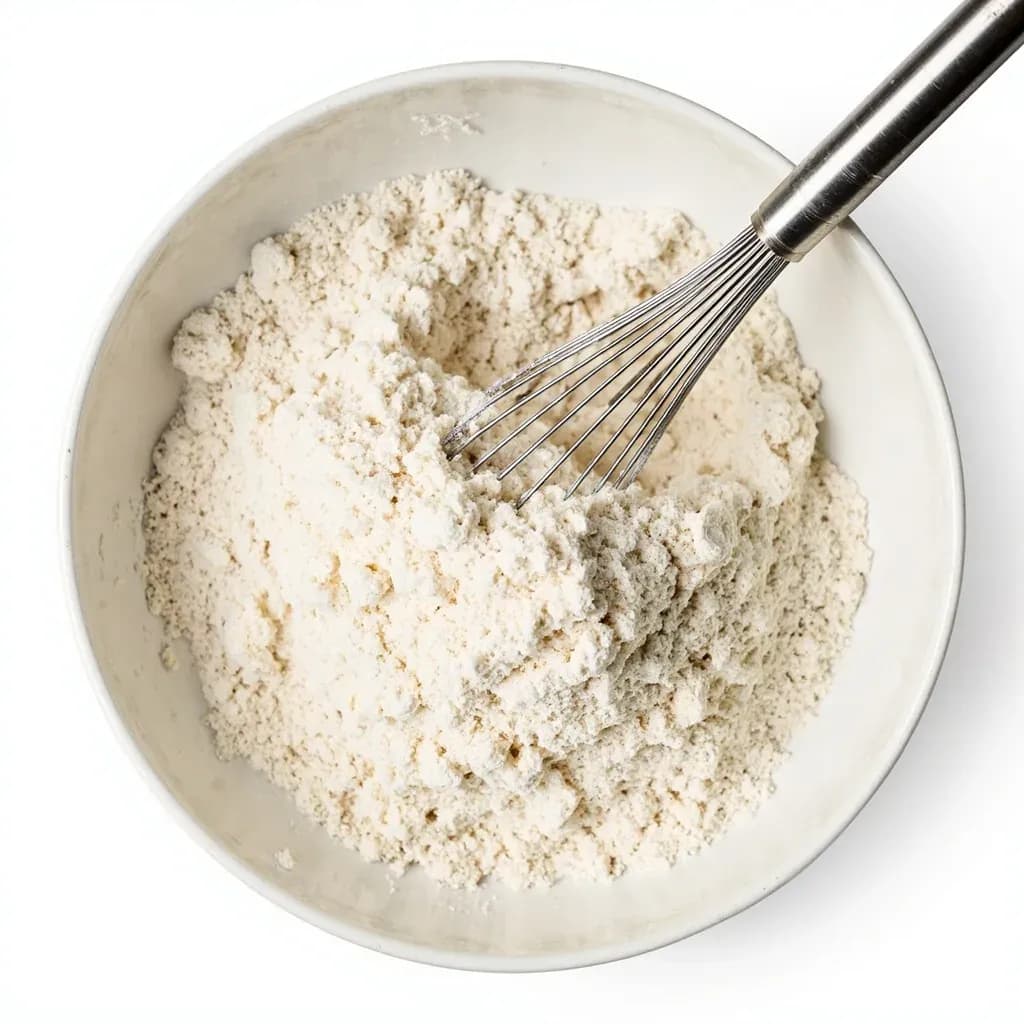
Pass the flours through a fine-mesh sieve into a large bowl, then whisk in wide circles for 20 to 30 seconds, or sift two or three times. This aerates and homogenizes the mix — critical for even hydration and a uniform crumb.
- 6
Adjust for the blend's character
Account for absorption: add 5–15% extra water for whole grain, rye, or nut flours; reduce hydration slightly if you replaced a high-protein flour with a lower-protein one. For gluten-free blends, add the binder now (typically 0.5–1% xanthan gum or 1.5–2% psyllium husk by flour weight) and whisk gently.
- 7
Store or use
Transfer the blend to a labeled airtight container with the date and the percentage of each flour. Use within the shortest flour's shelf life, or freeze in small bags for longer storage. From here, use the blend as a single ingredient in any recipe — and recheck hydration and mixing time on the first bake.
Working backward from a target protein
The most useful skill in flour blending is calculating a weighted average. Because each flour's protein percentage contributes in proportion to its share of the blend, you can pick a target and back-solve the ratio. The general formula is: target protein equals (A × percent A) plus (B × percent B) plus (C × percent C), with all percentages expressed as decimals and adding to 1.00.
- For a 12% blend from all-purpose at 10.5% and bread flour at 13%, the mix works out to roughly 60% bread and 40% all-purpose — a clean 50/50 lands at about 11.75%, close enough for most loaves.
- For an 11% all-purpose-style blend from cake flour at 8% and bread flour at 13%, the mix works out to roughly 60% bread and 40% cake flour — useful when you want AP-like behavior but are working from softer and stronger bags.
- For a 12.5% pizza blend from 00 flour at 11% and bread flour at 13%, the mix works out to roughly 25% bread and 75% 00; round to 30/70 for a slightly chewier, more bread-flour-forward crust.
- Round to clean baker's percentages (25/75, 30/70, 50/50) whenever you can; the small protein drift rarely matters in home baking, and clean numbers make scaling far easier.
Hydration, mix time, and the autolyse
Once the flours are combined, the blend is a new ingredient and the recipe must be re-tuned. Whole grain, rye, and nut flours carry bran, germ, or fat that absorbs water differently from refined white flour, so the same hydration that worked for all-purpose will produce a stiff dough in a whole wheat blend. A short autolyse — letting the blended flour and water rest 20 to 60 minutes before adding salt and yeast — gives the bran time to absorb and the proteins time to hydrate, which both improves extensibility and shortens the final mix.
- Add 5–15% more water (by total flour weight) when whole grain, rye, or nut flour makes up 30% or more of the blend.
- Reduce hydration slightly when swapping a high-protein flour for a lower-protein one in a recipe you have baked before.
- For gluten-free blends, add the binder at the same time as the flour (typically 0.5–1% xanthan gum or 1.5–2% psyllium husk by flour weight) and mix gently — overworking xanthan turns the crumb gummy.
- Expect a blended dough to ferment faster than a refined-flour dough of the same hydration; whole grain carries active enzymes and microbes that accelerate the rise.
- Treat the first bake with any new blend as a test, not a deliverable — note the protein percentages, hydration, mix time, and result, then adjust by 2–3% water at a time on the next batch.
Common uses
Tips & pitfalls
- Always blend by weight, not by cups — a cup of whole wheat can weigh 20–30% more than a cup of all-purpose, and volume measures throw off ratios badly.
- Sift or whisk the flours together for at least 20–30 seconds so the lighter and heavier particles distribute evenly; a quick stir leaves pockets of one flour that bake unevenly.
- When you add whole grain, rye, or nut flours, expect to add 5–15% more liquid (or include an autolyse of 20–60 minutes) — bran and germ absorb water and slow gluten development.
- Treat the blend as a single new flour from that point forward — recheck hydration, mixing time, and oven temperature against the recipe rather than the original flour called for.
- Label the blend with the date and the percentage of each flour; the blend's shelf life equals its shortest component, and whole grain flours go rancid faster than refined ones.
- Test any new blend in a small batch (a single roll, a muffin tin of six) before committing — protein and absorption differences are easy to misjudge by eye.
- Do not over-mix a gluten-free blend containing xanthan gum; aggressive mixing turns the crumb gummy. Whisk gently to combine.
- Swapping in a lower-protein flour usually lets you keep hydration the same; swapping in a higher-protein flour often needs both more water and a longer mix to develop the gluten fully.
- Keep at least one reliable base (bread or all-purpose wheat flour) in the blend unless you are baking gluten-free — pure alternative-grain doughs rarely trap gas well on their own.
- Refresh any blend containing whole grain every 1–3 months; rancid flour smells paint-like or soapy and will ruin a bake before the dough ever sees the oven.
Good to know
- Key parameter
- Protein (gluten-forming) content of each flour, typically 7–15%
- Measure by
- Weight in grams or ounces — never volume in cups
- Typical protein ranges
- Cake flour ~7–9%; pastry ~8–9%; all-purpose ~10–12%; bread ~12–14%; whole wheat ~13–14%; high-gluten ~14–15%
- Equipment
- Kitchen scale, large bowl, fine-mesh sieve or whisk, airtight container
- Hydration note
- Whole grain, rye, and nut flours absorb more liquid; high-protein breads need more water; gluten-free blends need binders such as xanthan gum or psyllium
- Storage
- Cool, dry, airtight; whole grain blends 1–3 months at room temperature, longer frozen; refined blends 6–12 months
- Difficulty
- Beginner to intermediate for home cooks; routine for professional bakers
- Typical batch size
- Home: 200 g – 1 kg; bakery: 10–25 kg
Also called
Flour Mixing · Custom Flour Blend
Dishes that rely on it
Related

Whisk
Beat ingredients smooth and aerated with a looping wire motion

Sift
Pass dry ingredients through mesh to aerate and remove lumps

Strain
Pour through mesh to separate solids from liquid for a smooth result

Filter
Pass liquid through fine material to clarify out the smallest particles

Rice
Press cooked potatoes through small holes for fluffy, lump-free texture

Mash
Crush soft cooked food into a rustic, creamy purée

Grind
Crush food into a coarse to fine texture, from spices to meat

Grate
Shred food into fine bits against a sharp-toothed surface