Prep & Assembly
Macaronage
Folding almond-sugar into meringue to the exact flowing consistency for macarons.
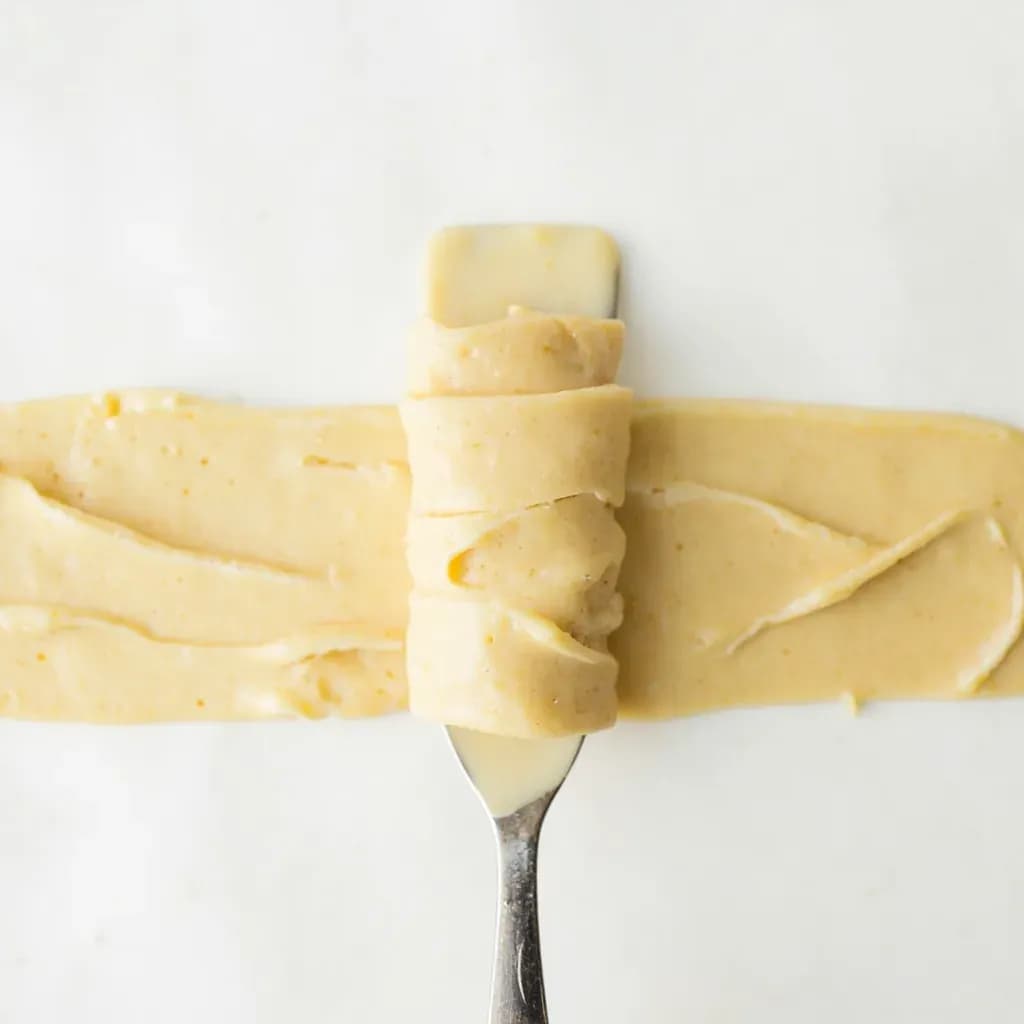
Macaronage is the precise folding of sifted almond flour and icing sugar into meringue until the batter reaches a lava-like ribbon that falls and slowly reabsorbs. Under-folding leaves lumpy, peaked shells while over-folding makes them flat and cracked, so the endpoint is judgment-critical. It is the make-or-break step in French macaron production.
Macaronage is the controlled folding of sifted almond flour and confectioners' sugar into whipped egg-white meringue for macarons. It is not a casual stir but a deliberate deflation: each pass of the spatula knocks air out of the foam while the dry ingredients hydrate, transforming a stiff, glossy meringue into a batter that flows under its own weight. Done correctly, it pipes into clean circles, settles into a mirror finish, and rises into shells with a crisp pied. Done wrong, in either direction, the shells crack, spread, hollow out, or refuse to form a foot at all.
The working window is unusually small — typically one to three minutes of active folding, with only seconds between under- and over-mixed. Humidity, almond-flour brand, meringue stiffness, and bowl temperature all shift where that window sits. Experienced bakers read the batter by its gloss, its flow, and the way a ribbon dropped from the spatula reincorporates into the mass, rather than counting folds. Standard benchmarks are a figure-8 of batter falling from the spatula without breaking, or a ribbon that sinks back into the surface within roughly ten to thirty seconds.
The technique was codified alongside the modern Parisian macaron in twentieth-century French pâtisserie and is unique to this category of work. It is not a general batter-mixing method, and the visual cues for success are specific to meringue-and-almond systems.
- Difficulty
- Hard
Types & varieties
Performed on an uncooked French meringue (whites whipped to peaks with sugar). The starting meringue is drier and stiffer, absorbing the almond-sugar more slowly, so the baker has a longer — but not unlimited — window to reach the ribbon stage.
Performed on a hot Italian meringue made by pouring boiling sugar syrup into whipping whites. The cooked meringue is denser and more stable, so the batter is more forgiving, but excess folding still deflates it past recovery.
Performed on a Swiss meringue (whites and sugar warmed over a bain-marie, then whipped). Stability sits between the French and Italian methods, and the batter typically reaches the ribbon stage a little faster than with a French meringue.
How to do it
- 1
Prepare the dry mix
Sift almond flour and confectioners' sugar together at least once, twice for a noticeably finer crumb, and discard the larger grinds that won't pass the mesh. Set aside in a wide bowl for easy access.
- 2
Whip the meringue
Whip the egg whites (and sugar, depending on the method) to a firm but still glossy peak. The meringue should hold its shape when the whisk is lifted, but the tip should curl over slightly rather than stand at attention like a starch-stiff peak.
- 3
Add the dry ingredients in stages
Tip about one-third of the almond-sugar mix over the meringue. Fold with a flexible spatula using a true folding motion: cut straight down through the center, scrape along the bottom of the bowl, and fold up and over the top. Rotate the bowl a quarter turn after each fold.
- 4
Continue adding and folding
Add the remaining dry mix in two more additions. Between additions, fold only until no dry streaks remain. The batter will still look thick, matte, and slightly lumpy at this point — that is normal.
- 5
Test for the ribbon stage
Lift the spatula and let the batter fall back onto itself. The correct consistency is a slow, thick ribbon that reincorporates into the mass within roughly 10–30 seconds. The surface should now look glossy, and the batter should move like warm lava when the bowl is tapped. The figure-8 test — drawing an 8 with batter falling from the spatula without the stream breaking — is a useful secondary check.
- 6
Finish and transfer
Stop folding the moment the ribbon stage is reached. Tap the bowl firmly on the counter three to five times to release large air bubbles, then immediately transfer the batter to a piping bag and pipe. The batter continues to relax as it sits, so do not leave it on the counter while you tidy up.
Reading the batter
The batter telegraphs its state at every stage, and learning to read those signals is the only reliable way to know when to stop.
- Just after the dry ingredients are incorporated: thick, matte, slightly lumpy, holds a peak on the spatula. This is the under-mixed state.
- Approaching the ribbon stage: the surface turns glossy, the batter starts to slump, and a ribbon dropped from the spatula holds its shape for a moment before sinking.
- At the ribbon stage: batter falls in a slow, thick ribbon that reincorporates within 10–30 seconds. It moves like warm lava or melted ice cream when the bowl is tapped.
- Over-mixed: the batter goes shiny, flat, and almost soup-like. It runs off the spatula in a thin, continuous stream and the ribbon never reincorporates.
- Under-mixed shells crack, peak, hold stiff shapes, and may not develop a foot.
- Over-mixed shells spread into flat puddles, often bake without feet, and frequently turn out hollow.
Why the window is so small
Two things are happening at once, and they work in opposite directions. The almond flour and sugar are absorbing liquid, which makes the batter heavier and more flowable. At the same time, each fold is collapsing the protein film that traps air in the meringue, which makes the batter thinner and runnier. Once the foam structure has collapsed past a certain point, no amount of further folding brings it back — and the same goes for stopping too early, when the meringue is still stiff enough to resist settling into a smooth top.
- Stiff meringue plus heavy dry goods produces a batter that fights the spatula and stays thick.
- Foam collapse from over-folding produces a batter that pours like cream and bakes flat.
- Ambient humidity raises the moisture content of the almond-sugar and slows absorption, often shifting the window.
- Warmer bowls accelerate foam collapse; cooler bowls keep the meringue stiffer for longer.
Common uses
Tips & pitfalls
- Add the sifted dry ingredients in three additions rather than all at once; staged hydration makes the final consistency much easier to read.
- Use a true folding motion — cut down the center, scrape the bottom, fold up and over, and rotate the bowl a quarter turn between folds. Stirring in circles deflates the meringue unevenly.
- Stop at the ribbon stage: batter that falls in a slow ribbon and reincorporates within about 10–30 seconds. A useful shortcut is the figure-8 test — the falling batter should trace a continuous 8 without the stream snapping.
- Under-mixed batter looks like thick frosting and holds stiff peaks. It will produce cracked, peaked shells that don't spread and rarely form a proper foot.
- Over-mixed batter looks shiny, flat, and almost soup-like. It spreads too far on the tray, develops no foot, and tends to bake hollow.
- Work in a non-reactive bowl (plastic or glass). Metal can destabilize the egg-white foam, accelerating collapse and making it harder to hit the ribbon stage.
- Tap the bowl firmly on the counter between folds. The impact releases large air bubbles without adding extra folding strokes.
- Pipe promptly once the ribbon stage is reached. The batter keeps relaxing on the counter, and a 'perfect' mix can quietly become an over-mix by the time it reaches the oven.
- For detailed or large piped shapes, aim for a slightly stiffer ribbon so the design holds. For thin lacy tuiles or large discs that should spread, fold a few strokes more.
Good to know
- Origin
- France; the term is built from macaron plus the suffix -age, denoting a process or technique.
- Also called
- The macaron fold. Correctly mixed batter is often described as at the 'ribbon stage,' 'lava stage,' or 'melted-ice-cream stage.'
- Purpose
- To combine dry ingredients with meringue while partially deflating the foam, yielding a homogeneous, glossy, self-leveling batter.
- Target consistency
- A thick ribbon falling from the spatula that reincorporates into the mass in roughly 10–30 seconds; often checked with a figure-8 drawn in the falling batter.
- Equipment
- A flexible rubber or silicone spatula and a non-reactive bowl (plastic or glass). Metal bowls are avoided once the meringue is whipped.
- Typical time
- 1–3 minutes of active folding, depending on batch size, meringue stiffness, and ambient humidity.
- Difficulty
- Intermediate; widely considered the make-or-break step of macaron making.
- Applied to
- French, Italian, and Swiss meringue bases, each requiring slightly different timing at the folding stage.
Also called
Macaron Folding
Dishes that rely on it
Related

Whisk
Beat ingredients smooth and aerated with a looping wire motion

Sift
Pass dry ingredients through mesh to aerate and remove lumps

Strain
Pour through mesh to separate solids from liquid for a smooth result

Filter
Pass liquid through fine material to clarify out the smallest particles

Rice
Press cooked potatoes through small holes for fluffy, lump-free texture

Mash
Crush soft cooked food into a rustic, creamy purée

Grind
Crush food into a coarse to fine texture, from spices to meat

Grate
Shred food into fine bits against a sharp-toothed surface