Prep & Assembly
Swiss Meringue
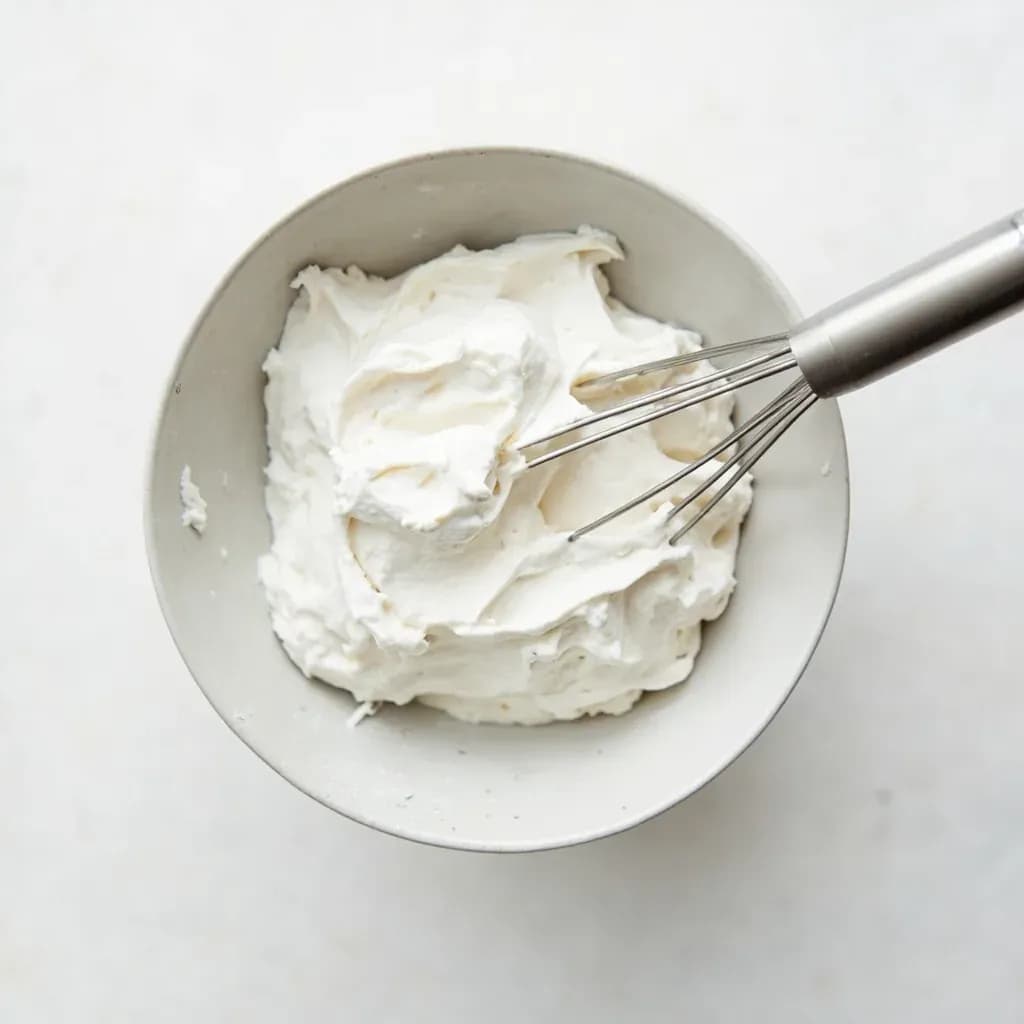
Whipping egg whites and sugar warmed over a bain-marie into a dense, glossy meringue.
Swiss meringue is made by gently heating egg whites and sugar together over simmering water until the sugar dissolves, then whipping the warm mixture to stiff, glossy peaks. The gentle heat produces a stable, silky meringue that is firmer than French meringue and ideal for buttercream, piped decorations, and toppings. It also lightly pasteurizes the whites.
Swiss meringue is the technique of dissolving sugar into egg whites over gentle heat before whipping them into a stable foam. The whites and sugar are whisked together in a heatproof bowl set over barely simmering water until the sugar melts and the mixture warms to about 50–65 °C (120–150 °F); the bowl is then moved to a mixer and beaten until cool. The result is a dense, glossy, marshmallow-soft meringue that holds sculptural peaks and does not weep when piped.
It sits between the other two classical meringues in both stability and effort. Unlike French meringue, where raw sugar is whipped into raw whites, the sugar here is fully dissolved by heat, so the foam will not bead or weep after piping. Unlike Italian meringue, there is no separately boiled sugar syrup or candy-thermometer stage, which makes it more forgiving and doable in a single bowl. That balance — stable enough to pipe, fold, or enrich with butter, yet simple enough for a home kitchen — is why Swiss meringue is the workhorse of pastry shops and the standard base for Swiss buttercream.
- Difficulty
- Medium
Types & varieties
Whipped only to drooping peaks; used as a folding base for soufflés, mousses, and fruit fluff.
Whipped until the bowl is cool and peaks stand straight; the workhorse for piping, buttercream, and pavlovas.
Piped into shells, disks, or nests and baked low (90–110 °C / 200–225 °F) until dry; crisp outside, chewy inside.
The same base whipped to stiff peaks, then enriched with butter (and sometimes yolks) for a silky, pipeable frosting.
How to do it
- 1
Prepare equipment and eggs
Separate eggs cleanly, keeping every trace of yolk out of the whites. Wipe a heatproof bowl (stainless or glass) and whisk with a paper towel moistened with vinegar or lemon juice, then dry — this strips the residual fat that prevents whites from whipping. Fill a saucepan with 2–3 cm of water and bring it to a bare simmer.
- 2
Combine whites and sugar
Weigh 1 part egg whites to 2 parts granulated sugar (e.g. 100 g whites to 200 g sugar) into the bowl. Add an optional pinch of salt or 1/8 tsp cream of tartar per 2 whites for stability. Stir briefly to wet all the sugar; this shortens the time over heat and prevents hot spots.
- 3
Dissolve over a bain-marie
Set the bowl over the simmering water without letting the bottom touch the surface. Whisk gently and continuously for 3–6 minutes until the sugar fully dissolves and the mixture reaches 50–65 °C (120–150 °F). Test by rubbing a small drop between thumb and forefinger: it must feel completely smooth, never gritty.
- 4
Move to the mixer
Lift the bowl off the heat immediately — residual heat will keep cooking the whites and risks scrambling. Attach to a stand mixer fitted with the whisk, or switch to a hand mixer.
- 5
Whip to stiff, glossy peaks
Begin on medium speed for about 1 minute to break up the foam, then increase to high. Whip 5–8 minutes, scraping the bowl down once, until the meringue roughly triples in volume, the peaks stand straight without drooping, and the outside of the bowl feels cool to the touch (around 20 °C / 68 °F).
- 6
Use, pipe, or bake
For buttercream, immediately begin adding softened butter in pieces while whipping on medium. For piping shapes, transfer to a pastry bag and pipe onto parchment. For dried meringues, bake at 90–110 °C (200–225 °F) for 1.5–2 hours until dry and crisp, then turn off the oven and leave the meringues inside to finish drying as it cools.
Swiss vs. French vs. Italian
The three classical meringues are defined by how the sugar is introduced to the whites, and that single variable controls stability, effort, and behavior. French meringue is the simplest: raw sugar is whipped into raw whites, so it relies entirely on air and mechanical agitation; it pipes and bakes well but weeps and collapses when stored. Italian meringue is the most stable: a sugar syrup is boiled to 115–121 °C (soft- to firm-ball stage) and poured into whipping whites, which both cooks the whites slightly and locks in a dense, dry foam that holds for days. Swiss meringue takes the middle road: the sugar is dissolved into the whites over a bain-marie before whipping, so the foam gets most of Italian's stability and dryness without the syrup step. For most piping, buttercreams, and baked shells, Swiss is the pragmatic choice — stable enough to trust, simple enough to do in one bowl.
The two checkpoints by feel
Two physical moments tell you the meringue is on track, and learning to read them by touch is what separates an occasional maker from a confident one. The first is the warm, silky 'sabayon' stage: when the sugar has fully dissolved, the mixture thins into a loose, pale foam that feels hot and slippery, and a drop rubbed between finger and thumb leaves no grit. The second is the cool, marshmallow-firm stage after whipping: the bowl is no longer warm, the foam triples in volume, and a peak lifted on the whisk stands straight with a glossy surface that does not slump. Stop between those two checkpoints and you get a useful but soft foam (good for folding into mousses); overshoot and the meringue becomes dry and difficult to fold; stop too early and the residual sugar will weep out as the meringue cools.
- Sabayon stage: warm, slippery, fully dissolved, ~50–65 °C — the test is finger-and-thumb smoothness, not the thermometer alone.
- Marshmallow stage: cool bowl, rigid glossy peaks, ~20 °C — the test is that the outside of the bowl is comfortable to hold.
- Between the two, the foam is workable but soft; past marshmallow, it stiffens and dries out, which is fine for piping but harsh for folding.
Common uses
Tips & pitfalls
- Use a metal or glass bowl, not plastic: plastic holds a film of grease even after washing, and that fat will deflate the whites.
- Hold the bain-marie at a bare simmer; if the water boils or the bowl touches it, the whites will scramble on the bottom before the sugar dissolves.
- Test for dissolved sugar by feel, not just temperature — rub a drop between thumb and forefinger. Any grit means keep heating and whisking.
- Get the bowl off the heat the instant the sugar is dissolved. Standing warm whites over residual steam is the single most common cause of curdled, rubbery meringue.
- Whip until the bowl is cool to the touch. Stopping while the bowl is still warm lets the foam collapse as the trapped air cools and contracts.
- Add flavorings (vanilla, cocoa, citrus zest, nut pastes) only after the meringue is fully whipped, and fold them in gently at the end — acidic or oily additions will deflate an under-whipped foam.
- In a humid kitchen, a pinch of salt, a few drops of lemon juice, or 1/8 tsp cream of tartar per 2 whites will noticeably improve volume and stability.
- Common mistakes to avoid: gritty meringue (sugar not fully dissolved), scrambled bits (heat too high or bowl left over the water), slumping peaks (under-whipped or stopped while warm), and weeping or beading after piping (under-whipped, under-baked, or made on a humid day — finish with a longer, lower bake or a torch).
Good to know
- Category
- Whipped meringue technique
- Family
- One of three classical meringues (French, Swiss, Italian)
- Standard ratio
- 1 part egg whites to 2 parts sugar by weight (e.g. 100 g whites to 200 g sugar)
- Heating target
- 50–65 °C / 120–150 °F, warm enough to dissolve sugar but not cook the whites
- Whipping endpoint
- Bowl feels cool to the touch, about 20 °C / 68 °F; peaks stand rigid and glossy
- Yield
- Roughly triples in volume; 100 g whites + 200 g sugar yields about 350–400 ml of meringue
- Stability
- More stable than French (no weeping); less stable than Italian (no hot sugar syrup)
- Active time
- About 5–10 min heating + 5–10 min whipping
Also called
Swiss Method Meringue
Related

Whisk
Beat ingredients smooth and aerated with a looping wire motion

Sift
Pass dry ingredients through mesh to aerate and remove lumps

Strain
Pour through mesh to separate solids from liquid for a smooth result

Filter
Pass liquid through fine material to clarify out the smallest particles

Rice
Press cooked potatoes through small holes for fluffy, lump-free texture

Mash
Crush soft cooked food into a rustic, creamy purée

Grind
Crush food into a coarse to fine texture, from spices to meat

Grate
Shred food into fine bits against a sharp-toothed surface