Prep & Assembly
Détrempe (Base Dough Mixing)
Mixing the flour-and-water base dough that encloses the butter block in laminated pastry.
Détrempe is the French term for the base dough of flour, water, salt, and sometimes a little butter that is mixed and rested before laminating. It forms the outer envelope that wraps the butter block in croissant and puff pastry. The dough is mixed just enough to come together, then chilled so it matches the firmness of the butter for clean, even layering.
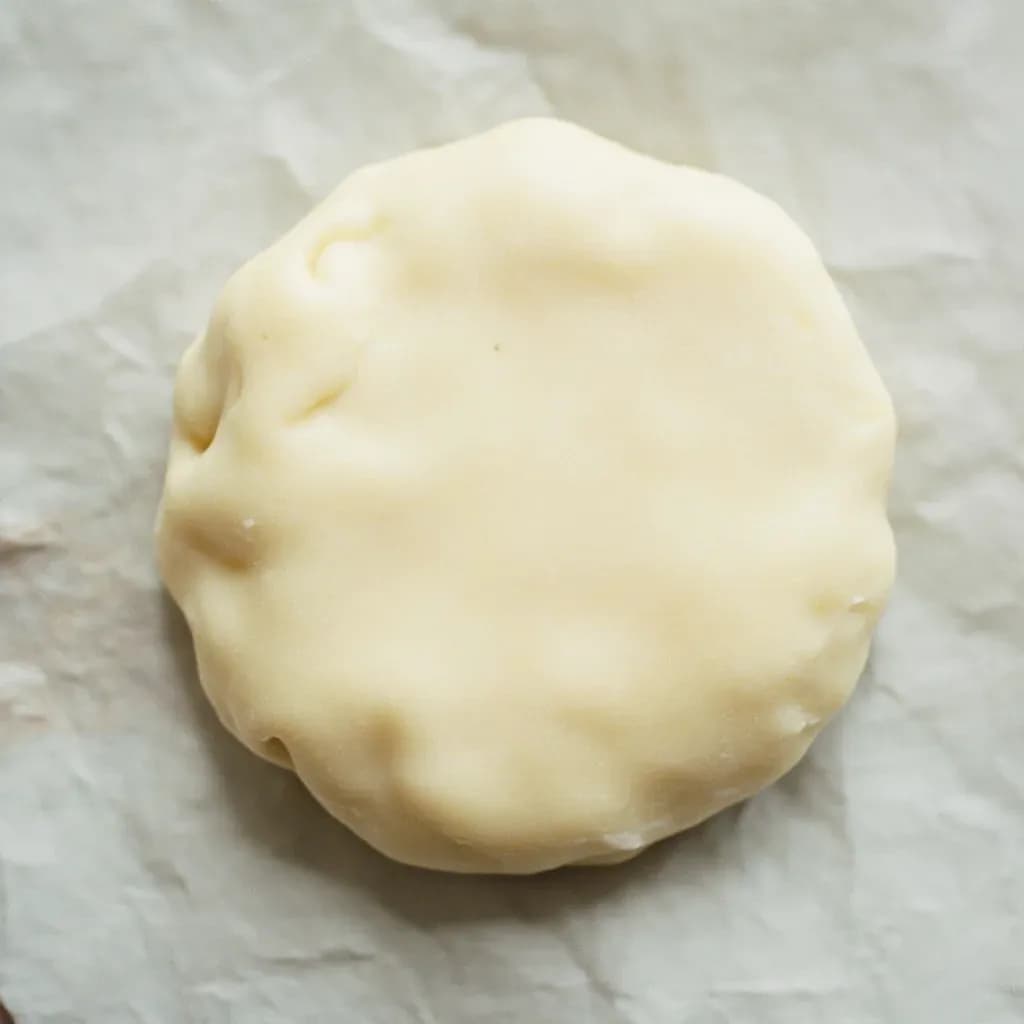
The détrempe is the lean flour-and-water foundation that wraps the butter block in any laminated pastry. The name comes from the French détremper, "to moisten," and its job is deliberately humble: hydrate the flour, gather it into a cohesive mass, and stop. It is not a bread dough and should never be kneaded into a smooth, elastic ball. Instead, the détrempe is a soft, slightly shaggy slab whose minimal gluten development is exactly what allows the dough to be rolled, folded, and stretched into dozens of distinct alternating layers of fat and flour.
What the détrempe contributes to the finished pastry is flavor, structure, and the outer envelope of every flake. The lift and the shattering, honeycomb crumb do not come from gluten — they come from the lamination itself, where steam and melted butter force the layers apart in the oven. Treat the détrempe as a stiff paste rather than a developed dough, and you give those layers room to do their work without resistance.
The single most important variable is temperature. Before the first fold, the détrempe and the beurrage (the shaped butter block) must be matched in firmness — equally cool, equally pliable, firm enough to hold their shape but flexible enough to bend without cracking. A mismatch is the root cause of most lamination failures: butter smearing through the dough, layers disappearing into a homogeneous mass, or the dough tearing at the edges as it is rolled.
- Difficulty
- Medium
Types & varieties
Just flour, water, salt, and sometimes a touch of butter or vinegar; the leanest and stiffest version
Enriched with yeast, milk, sugar, and sometimes egg; softer than puff pastry
Enriched with milk, sugar, egg, and yeast; richer and more tender than croissant dough
Highly enriched with eggs, sugar, milk, and yeast; soft and rich but still a workable dough, not a batter
Bread-flour-based and lean like puff pastry, but yeasted for a long cold ferment
How to do it
- 1
Combine the dry ingredients
Whisk the flour, salt, and any sugar together in a large bowl. For enriched or yeasted styles (croissant, Danish, kouign-amann, brioche feuilletée), bloom the yeast separately in a portion of the warm liquid first, then stir it back into the remaining liquid.
- 2
Add the liquid
Pour in the cold water or milk all at once. Use a bench scraper, wooden spoon, or your hand to bring the dough together just until no dry flour remains. The dough should look rough and shaggy — definitely not smooth.
- 3
Finish incorporating briefly
Press and fold the mass once or twice against the side of the bowl to pick up any remaining flour. Stop as soon as the dough holds together as a single piece. Do not knead.
- 4
Shape the détrempe
Turn the dough out onto an un-floured or very lightly floured surface. Pat and shape it into a rough square or rectangle about 1.5–2 cm (¾ inch) thick. Avoid stretching or smoothing the surface — a slightly uneven slab is correct.
- 5
Wrap and chill
Wrap tightly in plastic wrap, pressing the film directly against the surface to prevent a skin from forming. Refrigerate for at least 1 hour, ideally 2 hours or overnight, to relax the gluten and chill the dough through.
- 6
Match temperature to the butter block
Before lamination, test the détrempe against the beurrage: both should feel equally cool and pliable — firm enough to hold their shape, but flexible enough to bend without cracking. Rest at cool room temperature for 5–10 minutes if too cold, or return to the fridge briefly if too soft.
- 7
Enclose the butter and begin lamination
Roll the détrempe out slightly larger than the butter block, place the beurrage in the center, fold the dough over to fully enclose it, and proceed with the first turn (single, double, or book fold, depending on the recipe).
Why a shaggy dough is the goal
A finished croissant or puff pastry gets its lift from layers, not from a gluten network. The flour is hydrated just enough to form a continuous sheet that can be rolled and folded without tearing, and no more. Active kneading aligns gluten proteins into long elastic strands that fight rolling and snap back during folds, making it nearly impossible to roll thin, even sheets. A short, gentle mix leaves gluten in disorganized clusters — the dough holds together when you need it to, but stays supple and quiet on the bench.
- Mix until no dry flour remains; a few visible streaks and lumps are fine
- Resist the urge to knead "until smooth" — that smoothness is the enemy of lamination
- Hydration is the main lever: drier détrempes are easier to laminate for beginners
- A splash of vinegar or lemon juice tightens gluten and gives a more tender bite
Matching the beurrage before the first fold
Before the first turn, the détrempe and the butter block must feel like the same material. Press a finger into each: both should yield slightly, feel cool to the touch, and bend without cracking or weeping. A short adjustment at this stage saves an entire batch of lamination.
- Détrempe too cold: it cracks and tears when rolled, letting butter squeeze out through the breaks
- Détrempe too warm: it absorbs the butter instead of sealing around it, and the layers blur together
- A 5–10 minute bench rest or a brief return to the fridge will usually fix a mismatch
- Work near a marble slab or chilled sheet pan in a warm kitchen to keep temperatures even
- Wrap the détrempe tightly in plastic so it does not form a skin while it chills
Common uses
Tips & pitfalls
- Mix only until the flour is hydrated — a shaggy, slightly rough mass is exactly right
- Never knead; overworking develops gluten and prevents clean, even lamination
- Chill the détrempe thoroughly so it matches the butter block in firmness and temperature before the first fold
- If the détrempe is too cold, let it rest at cool room temperature 5–10 minutes until pliable but still cool to the touch
- If too warm, return it to the fridge briefly — a soft détrempe will absorb the butter and the layers will disappear
- Work on a cool surface, especially in warm kitchens; a marble slab or chilled sheet pan helps
- Hydration varies by style: puff pastry tends drier (~50%), viennoiserie wetter (55–60%)
- A small amount of salt and a splash of acid (vinegar or lemon juice) tightens gluten and gives a more tender final pastry
Good to know
- French term
- Détrempe, from détremper, "to moisten" — the lean flour-and-liquid base that encloses the butter block
- Typical hydration
- 50–60% of flour weight; leaner (drier) for puff pastry, wetter for viennoiserie
- Target temperature
- 15–17°C / 60–63°F, matched to the beurrage before lamination
- Rest time
- At least 1 hour, ideally 2 hours or overnight, to relax gluten and chill through
- Key principle
- Mix minimally — avoid gluten development so layers roll and fold cleanly
- Paired with
- The beurrage (shaped butter block) that the détrempe encloses
- Final products
- Croissants, puff pastry, Danish, kouign-amann, brioche feuilletée
- Difficulty
- Intermediate — the mixing is simple, but temperature control is critical
Also called
Base Dough
Dishes that rely on it
Related

Whisk
Beat ingredients smooth and aerated with a looping wire motion

Sift
Pass dry ingredients through mesh to aerate and remove lumps

Strain
Pour through mesh to separate solids from liquid for a smooth result

Filter
Pass liquid through fine material to clarify out the smallest particles

Rice
Press cooked potatoes through small holes for fluffy, lump-free texture

Mash
Crush soft cooked food into a rustic, creamy purée

Grind
Crush food into a coarse to fine texture, from spices to meat

Grate
Shred food into fine bits against a sharp-toothed surface