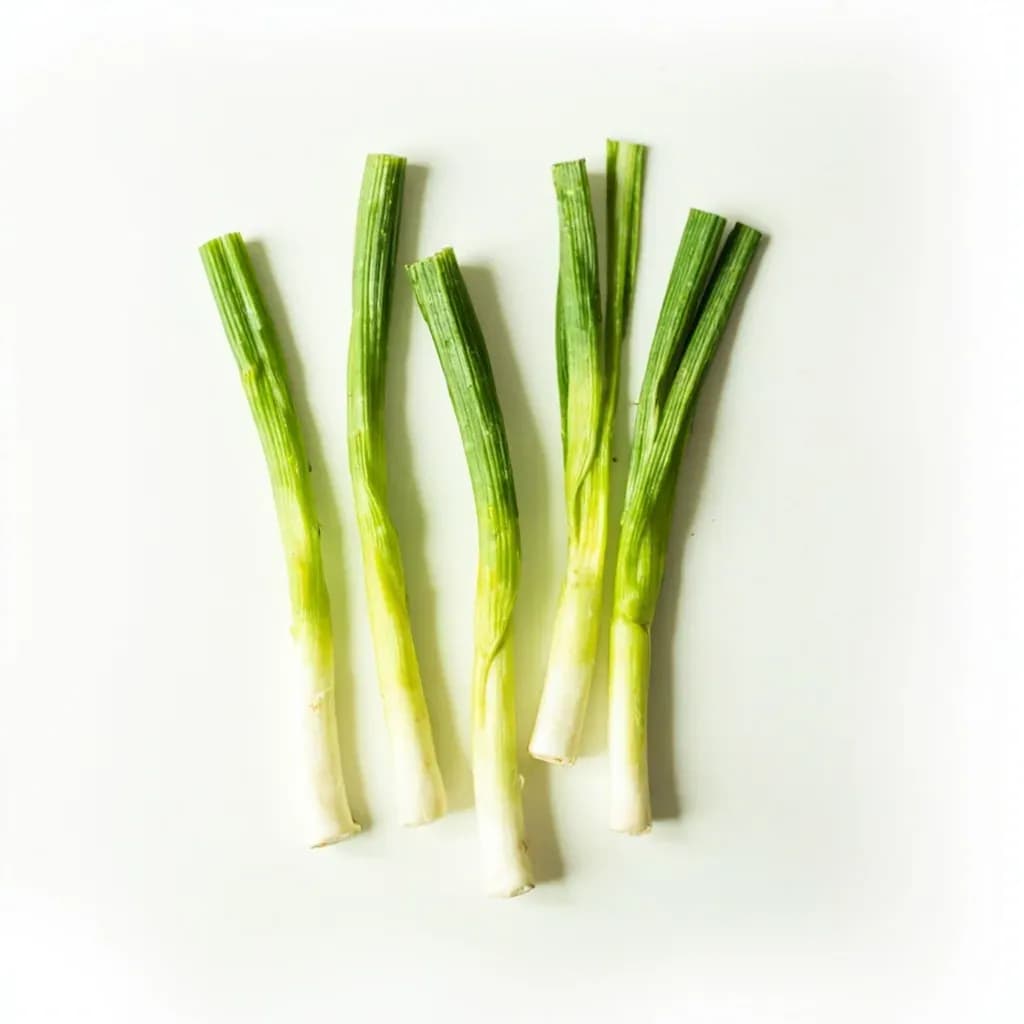
Knife Skills
Diagonal Slicing
Cutting at an angle to expose more surface area for cooking and presentation.
Diagonal slicing cuts food on a slant rather than straight across, used on scallions, plantains, sausages, and vegetables. The angled cut exposes more surface so food browns faster and soaks up sauce, and the elongated oval shape looks more elegant on the plate. It's a staple of Korean and Chinese knife work, where the slant is chosen to match the dish's cooking method.
Diagonal slicing is the practice of cutting across an ingredient at an angle rather than straight down, so each cross-section becomes an oval or ellipse instead of a round disc. The technique is simple in principle — tilt the blade, slice, repeat — but it changes both the cooking and the eating of a dish in meaningful ways. At a roughly 45° angle, a carrot slice exposes about 40% more surface area than the same carrot cut into coins, which means heat penetrates faster, sauce clings better, and browning has more real estate to develop. The same geometry also makes a short ingredient look longer on the plate, giving a stir-fry or braise a more deliberate, restaurant-style read.
The cut is so embedded in East Asian cookery that Chinese, Japanese, and Korean recipes often specify it implicitly when they say "cut into slices" — the default is on the bias unless otherwise noted. French cooking has parallel vocabulary in en biseau and the very thin sifflet. Practically speaking, it is one of the first knife cuts any cook learns, because it costs almost no extra time, requires no special tool, and reliably improves the dish. A 30–45° angle covers most needs; shallower angles stretch the pieces into elegant ovals, while steeper angles produce stockier slices better suited to long braises.
The companion move to know is the roll cut (gǔn dāo kuài), where the ingredient is rotated a quarter turn between each diagonal stroke, producing irregular, faceted chunks with maximum surface area. Together, bias and roll cuts are the visual and physical signature of a Chinese home or restaurant kitchen, and they translate well to almost any cylindrical vegetable, from daikon to zucchini to sausage.
- Difficulty
- Easy
Types & varieties
The default form: a simple angled cross-section, used for scallions, leeks, carrots, and fish fillets.
Ingredient is rotated 90° between each diagonal cut, producing irregular, multi-faceted chunks with maximum surface area; classic for daikon and carrots in braises.
French term for very thin (roughly 1/16 in) diagonal slices, often of carrots, beets, or other root vegetables.
French oblique cut, typically thicker than sifflet; used for shallots, onions, and other aromatics.
Long oval cross-section achieved with a very shallow angle; the classic cut for Chinese scallion and leek sections in stir-fry.
Diagonal version of the standard round disc, used for carrots, cucumbers, sausage, and scallions when a longer slice is desired.
How to do it
- 1
Set up your station
Place a stable cutting board on a flat surface, with a damp towel or non-slip mat underneath to keep it from sliding. Have a sharpened chef's knife or Chinese cleaver ready, and trim and peel the ingredient as needed.
- 2
Position the ingredient
Lay the ingredient — typically a cylindrical vegetable like a carrot, scallion, or leek — flat on the board. Curl your guiding hand into a claw, knuckles forward, fingertips tucked behind the knuckles so the blade rides against the knuckle rather than the fingertip.
- 3
Set the blade angle
Tilt the blade so the tip is raised 30–45° above the board (shallower for longer, more elegant slices; steeper for shorter, stockier ones). Rest the tip on the board as a pivot point; the heel of the knife lifts up and away from you.
- 4
Make the guide slice
Slice through the ingredient in one smooth downward-and-forward stroke. Inspect the resulting oval face — it confirms your angle and target thickness. Adjust the angle or thickness before continuing.
- 5
Continue with consistent slices
Repeat the same stroke, feeding the ingredient back the same thickness each time. Keep the angle locked in; rhythm comes from the guiding hand advancing the blade, not from changing the wrist.
- 6
Roll-cut variation
For a roll cut, after each diagonal slice rotate the ingredient about 90° toward you on the board, then make the next angled slice. The result is irregular, multi-faceted chunks with maximum surface area — ideal for braised daikon or carrots.
- 7
Transfer and use
Slide finished slices into a prep bowl or directly into the pan. For stir-fries, keep slices uniformly thin so they cook in the same window; for braises, slightly thicker bias or roll-cut pieces hold their shape better.
Why the angle changes the dish
The diagonal is fundamentally a surface-area decision. Heat enters food through its outer faces, and flavor leaves food the same way, so a slice with more exposed face cooks faster, browns more, and absorbs more sauce per bite. In a braise, a coin-cut carrot tends to stay pale and waterlogged; the same carrot on the bias, cut at roughly 1/4 inch, takes on color and glaze far more readily. In a stir-fry, where the cooking window is measured in seconds, this is the difference between vegetables that still have snap and vegetables that have gone limp.
- More exposed cross-section per piece means faster, more even heat penetration.
- Longer, flatter faces give sauce and oil something to cling to.
- A 1-inch carrot becomes a 1.5- to 2-inch oval on the plate, reading as more refined than a coin.
- Thinner diagonal slices shorten the cooking window, which protects texture in quick, high-heat methods.
When to use it (and when not to)
Reach for the bias cut whenever the cooking method is fast, the ingredient is short, or the presentation matters. It is the default in stir-fries, flash-blanched greens, quick sautés, and garnishes. For long, slow braises, the roll-cut variation is usually better because the irregular shapes hold their structure while still presenting plenty of surface. Skip the diagonal when you need rounds for a uniform visual effect (a composed salad, a pickle jar where even thickness matters for brine penetration), or when the ingredient is already flat, like a fish fillet that just needs a clean cross-cut.
Common uses
Tips & pitfalls
- Lock in the angle visually: make the first slice, look at the oval, and reproduce that exact tilt for the rest of the batch — most inconsistent bias cuts come from a wandering wrist, not a dull knife.
- Use a properly sharp blade; a dull knife crushes cell walls on aromatics like scallion and leaks juice, leaving ragged edges and a watery cutting board.
- Curl the guiding hand into a true claw with the knuckles forward; this is what protects your fingertips and gives you a consistent thickness to feed the blade.
- Make one smooth, forward-and-down stroke per slice — sawing tears vegetables, frays herbs, and turns clean diagonals into ragged shards.
- Match slice thickness to cooking time: paper-thin diagonals for a flash stir-fry, 1/4-inch diagonals for a quick sauté, and 1/2-inch or roll-cut pieces for a long braise.
- For roll cuts on long cylindrical vegetables like daikon or carrots, rotate a quarter turn after every slice; the irregular faces are the point, so don't try to make them match.
- Cut on a dampened wooden board or place a damp towel under the board; a slipping board is the most common cause of an angled cut going wrong.
- If the angle keeps drifting, try keeping the tip of the knife on the board as a fixed pivot and lifting the heel — the geometry is easier to repeat than holding a free-floating tilt.
Good to know
- Also known as
- Bias cut, oblique cut, angle cut; French: en biseau (thicker) and en sifflet (very thin)
- Typical angle
- 30–45° from the work surface; shallower angles produce longer, more elegant pieces
- Primary traditions
- Chinese, Japanese, and Korean cooking; parallel French vocabulary exists
- Knife typically used
- 8–10 in chef's knife, Chinese cleaver, santoku, or nakiri depending on ingredient
- Effect on cooking
- Increases exposed surface area, accelerating heat transfer and sauce absorption
- Effect on appearance
- Elongates round ingredients and reads as more refined on the plate
- Difficulty
- Beginner-friendly once a consistent angle is established
- Time per cut
- Seconds once a rhythm is established
- Common pairing technique
- Often combined with a 90° rotation between cuts to produce the roll cut (gǔn dāo kuài)
Also called
Diagonal Slicing (Eosseolgi) · Slant Slicing · Bias Slicing
Dishes that rely on it
Related

Chop
Cut into rough, irregular pieces — the everyday workhorse cut

Dice
Cut into uniform cubes for even cooking and a tidy look

Mince
Cut as fine as possible so flavor melts evenly into the dish

Slice
Cut into even, flat pieces for consistent cooking and presentation

Julienne
Cut into thin matchsticks for fast cooking and elegant garnish

Brunoise
Cut into tiny, precise cubes — the finest dice in the kitchen

Chiffonade
Roll and slice leafy greens into delicate ribbons

Batonnet
Cut into tidy sticks, thicker than julienne — think classic fries