Prep & Assembly
Foraging
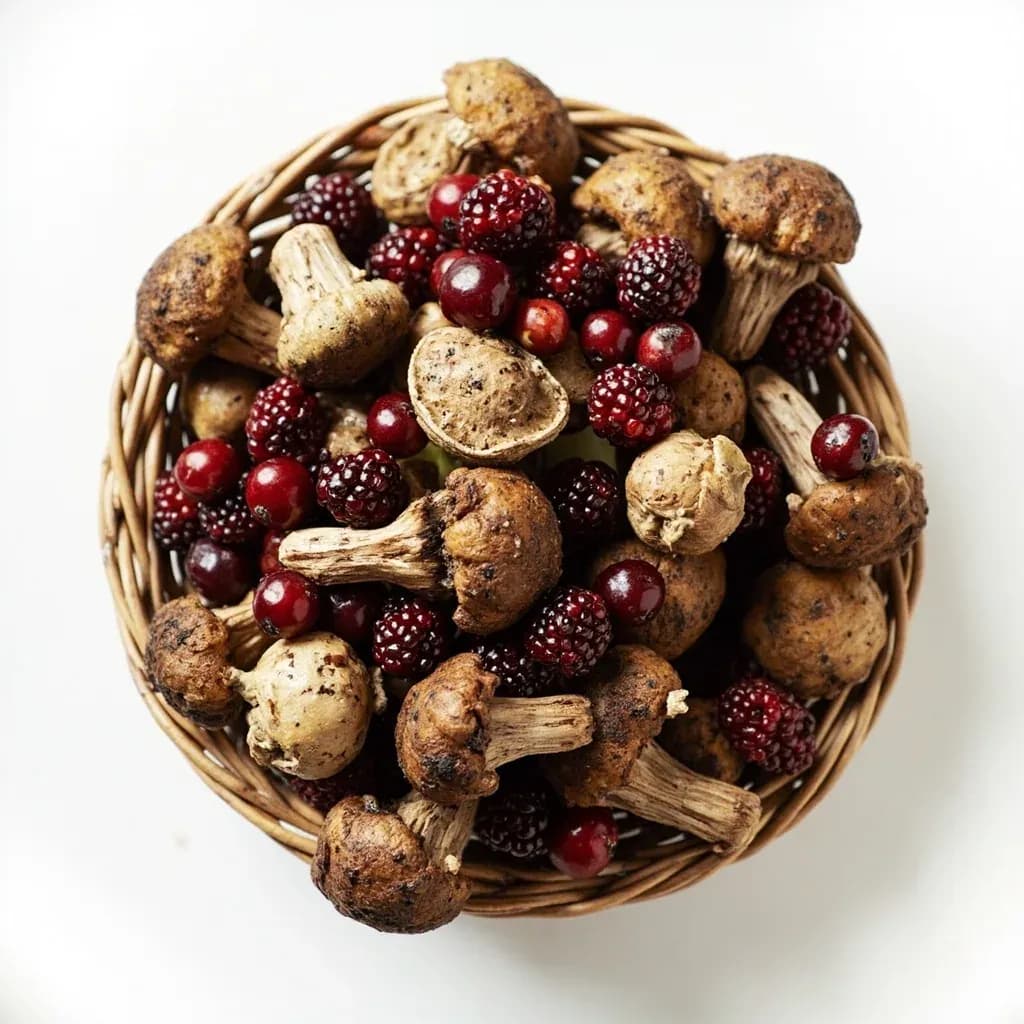
Gathering wild edibles like mushrooms, berries, and herbs from nature.
Foraging is the gathering of wild edible plants, mushrooms, and fruits from forests, fields, and coastlines for the kitchen. It connects cooks to seasonal, local ingredients that cannot be bought, from chanterelles to wild berries and olives. Accurate identification is essential because many wild mushrooms and plants have poisonous look-alikes, so foragers learn to confirm every find.
Foraging is the practice of identifying and gathering wild, uncultivated food directly from its native habitat — woodlands, meadows, coastlines, and even urban edges. For cooks, it offers something agriculture cannot replicate: a calendar of fleeting, intensely flavored ingredients tied to a specific place, soil, and week of the year. A single skillet of chanterelles delivers the apricot-and-pepper aroma of an oak forest after rain; a jar of pickled fiddleheads or a chiffonade of raw ramps carries a season you can only taste for two or three weeks.
As a cooking technique, foraging behaves differently from shopping. Success depends less on knife skill than on ecological literacy, legal awareness, and a willingness to be patient. Misidentification of mushrooms can be fatal, certain wild greens must be cooked before eating, and many species are protected by law. Treat each harvest as a collaboration with a landscape: you read the weather, the canopy, the last frost date, and the substrate, and in return the land provides ingredients that have no cultivated equivalent. The discipline that grew from Euell Gibbons's mid-century revival and now anchors tasting menus at restaurants like Noma and Blue Hill is, at its core, a way of paying closer attention to where food actually comes from.
- Difficulty
- Medium
Types & varieties
Morels (Morchella spp.), chanterelles (Cantharellus cibarius and relatives), porcini/cep (Boletus edulis), black trumpets (Craterellus), hen-of-the-woods/maitake (Grifola frondosa), lobster mushroom (Hypomyces lactifluorum), chicken-of-the-woods (Laetiporus), hedgehog mushroom, cauliflower mushroom.
Wild blackberries, dewberries, raspberries, blueberries, huckleberries, elderberries, mulberries, juneberries/serviceberries, wild strawberries, cloudberries (Nordic), rose hips, crabapples, wild plums.
Ramps/wild leek (Allium tricoccum), fiddleheads (ostrich and cinnamon ferns), stinging nettle, dandelion greens, wood sorrel, watercress, miner lettuce, lambsquarters, chickweed, purslane, sea bean, sow thistle, garlic mustard.
Wild garlic and onion grass, sweet cicely, chervil, epazote (southwest U.S. and Mexico), California bay, sage (high desert and mountain regions), wild fennel, yarrow.
Black walnuts, shagbark and shellbark hickories, butternuts, beechnuts, hazelnuts, edible pine nuts from piñon and sugar pine; acorns (require leaching of tannins before use).
Dulse, kelp/kombu (Laminaria), nori/laver (Porphyra), sea lettuce, samphire/glasswort, rockweed (Fucus), bladderwrack.
Elderflower, linden/basswood flower, rose petals and hips, juniper cones, fresh pine tips, spruce tips.
How to do it
- 1
Build a foundation of identification knowledge
Before harvesting anything, study regional field guides, attend an expert-led class, or join a mycological or native-plant society. Learn the diagnostic features of target species and, equally important, their toxic lookalikes. For mushrooms, study cap shape, gill or pore structure, stem and base, flesh color when cut, and spore print color.
- 2
Research the law for your area
Confirm whether foraging is permitted on the land you intend to visit. National parks and many state parks prohibit it outright. Some public forests allow personal-use harvest with limits. Private land requires the owner's permission. In Scandinavia and parts of the Baltic, 'Everyman's Rights' grant broad access; in much of the U.S. and U.K., rules are restrictive and local.
- 3
Scout habitat and time the season
Each species has specific habitat requirements: morels favor disturbed ground, old apple orchards, and post-burn forests; chanterelles associate with oaks, conifers, and mossy slopes in mid- to late-summer; ramps need shaded hardwood coves in spring; fiddleheads grow along stream banks. Learn the local calendar — many species fruit for only two to four weeks.
- 4
Pack the right equipment
Bring a woven basket for mushrooms and greens (allows airflow and spore drop), a rigid container or shallow tray for berries, a small sharp knife or scissors, a hand lens, paper bags to separate species, regional field guides, a GPS or downloaded offline map, a notebook, water, sturdy footwear, and tick and insect protection. Avoid plastic bags, which crush and sweat the harvest.
- 5
Harvest sustainably
Cut mushrooms at the base, leaving the mycelium network in the soil. Pick leafy greens above the growth point so the plant regrows. For stressed ramp populations, take only one leaf per plant and never the entire clump. The informal 'one in ten' rule — leaving the majority of what you find — protects future flushes.
- 6
Identify and clean in the field
Confirm identification on the spot. Brush forest debris from mushrooms rather than washing them; waterlogged mushrooms spoil quickly and lose flavor. Inspect greens for insect damage and remove tough or fibrous stems. Discard anything questionable without hesitation: doubt is not edible.
- 7
Transport and cool promptly
Keep the harvest shaded and cool on the way home. Mushrooms benefit from airflow; berries and delicate greens should be kept cool and not crushed. Refrigerate or process within a few hours for best quality.
- 8
Process and store correctly
Sauté, pickle, or freeze mushrooms within a day of harvest; tougher species like porcini and chanterelles dry well on screens or in a dehydrator at low temperature. Wash wild greens and, where required, blanch briefly to neutralize irritants (stinging nettle) or toxins (raw fiddleheads, which can cause gastrointestinal illness — blanch or steam for 2–3 minutes before storage). Berries are best frozen on a parchment-lined tray before bagging, or cooked down into preserves.
- 9
Record and revisit
Keep a hunting diary noting GPS coordinates, habitat, weather, last rain date, and timing of any productive patch. Revisit these spots in subsequent years — many species return to the same locations when the same conditions recur, a pattern experienced foragers rely on for decades.
Identification & Safety
Identification is the single non-negotiable skill in foraging, and it applies across every category, not just mushrooms. For fungi, the diagnostic features are cap shape and texture, the gill or pore surface underneath, the stem and any ring or volva at the base, the color of the flesh when cut, and the spore print. A spore print — made by setting a cap gill-down on paper for 30 minutes to a few hours — narrows the field dramatically and is essential for any unfamiliar species. For plants, key in on leaf arrangement (alternate vs. opposite), leaf shape and margin, stem cross-section, and the presence of milky sap or distinctive odors. Cross-reference every find with at least two regional sources, photograph it in habitat before you pick, and never eat a wild species on the strength of an app or a single source. The old forager's maxim applies: when in doubt, throw it out.
- Always photograph the cap, gills or pores, stem, base, and surrounding habitat before harvesting.
- Take a spore print for any unknown mushroom; color rules out entire genera.
- Try a small portion of any new species and wait 24–48 hours before larger amounts — even edible mushrooms can cause individual intolerance, and morels are toxic raw.
- Several species must be cooked before eating: morels, raw fiddleheads (blanch 2–3 minutes), and stinging nettle (heat destroys the stinging compounds of histamine, acetylcholine, and moroidin).
Sustainability & Ethics
Foraging is renewable only when it is restrained. The guiding principle is to leave a patch as healthy as you found it, ideally healthier. That means cutting mushrooms at the base rather than pulling them up, which protects the underground mycelium that produces next year's flush. It means picking leafy greens above the growth point so the plant regrows, and taking at most one leaf per ramp in any stressed population — the species has been overharvested to commercial scarcity in parts of Quebec and the Appalachians. Spread your effort across multiple sites rather than hammering a single productive patch. The informal 'one in ten' rule — leaving the majority of what you find — is a good default. Ethical foragers also disperse trampling by walking on durable surfaces, avoid disturbing duff and saplings, and never share the location of a rare species publicly.
- Cut mushrooms at the base; never pull, which damages the mycelium.
- Take at most one ramp leaf per plant where populations are stressed; never the whole clump.
- Leave young plants and reproductive structures (flowers, unripe fruit) to ensure future generations.
- Walk on durable surfaces to limit soil compaction and habitat damage.
Seasonal Calendar at a Glance
Successful foragers think in phenology — the timing of biological events — rather than calendar dates. The triggers that bring mushrooms up are warm rain on cool ground, often after a thunderstorm in late spring or autumn. Greens track soil temperature and day length. Berries ripen on a tight window of two to three weeks. Build a local calendar by keeping notes year over year: GPS, habitat, recent weather, and last rain date.
- Spring: ramps, fiddleheads, stinging nettle, morels, wild garlic, miner lettuce, watercress, pine and spruce tips, seaweed (late winter into spring), elderflower (late spring to early summer).
- Summer: wild strawberries, raspberries, mulberries, juneberries, chanterelles (mid- to late), sweet cicely, lambsquarters, purslane, sea bean, epazote.
- Autumn: blackberries, elderberries, rose hips, porcini, black trumpets, hen-of-the-woods, chicken-of-the-woods, hedgehog mushroom, hickories, black walnuts, hazelnuts, juniper cones.
- Winter: evergreen aromatics (younger pine and spruce), certain seaweeds at low tide, preserved and frozen stores from peak seasons.
Common uses
Tips & pitfalls
- Never eat a wild plant or mushroom you cannot identify with 100% certainty; many edible species have toxic or fatal lookalikes (false morels vs. true morels, death cap vs. paddy straw mushroom).
- Take a spore print and photograph the cap, gills or pores, stem, base, and habitat of any unknown mushroom; cross-reference with at least two regional field guides and ideally a local expert before eating.
- Try a small portion of any new species and wait 24–48 hours before consuming larger quantities — even edible mushrooms can trigger individual intolerance, and morels are toxic raw.
- Carry a woven basket or paper bags; plastic bags trap moisture, accelerate spoilage, and (for mushrooms) prevent spore release that sustains next year's flush.
- Learn local laws before going: national parks and many state parks prohibit foraging, and several species (ramps, ginseng, goldenseal, certain orchids) are protected by heavy fines for illegal harvest.
- Avoid areas likely contaminated: roadsides, railroad rights-of-way, sprayed agricultural fields, lawns treated with chemicals, and downstream of industrial or mining operations.
- Practice leave-no-trace ethics: cut mushrooms at the base rather than pulling, take at most one leaf per ramp in stressed populations, and spread harvesting across multiple patches so each can recover.
- Join a local mycological society, native-plant club, or guided foray — hands-on mentorship is the fastest and safest way to build real identification skill.
Good to know
- Origin
- The original method of human food acquisition, predating agriculture by hundreds of thousands of years and still practiced today by indigenous and rural communities worldwide.
- Modern revival
- Brought to American popular attention by Euell Gibbons in Stalking the Wild Asparagus (1962); reintroduced to fine dining in the 2000s by chefs such as René Redzepi (Noma, Copenhagen) and Dan Barber (Blue Hill), who built menus around seasonal wild ingredients.
- Peak season
- Spring brings ramps, fiddleheads, morels, and nettles; summer and autumn deliver chanterelles, porcini, hen-of-the-woods, and most berries and nuts. Seaweeds are best at low tide from late winter through spring.
- Difficulty
- High. Demands rigorous identification skills, ecological knowledge, and legal awareness. Misidentification of mushrooms can be fatal; some wild greens require blanching or wilting before eating.
- Core equipment
- Woven basket for mushrooms and greens, rigid containers for berries, small sharp knife or scissors, hand lens, paper bags to separate species, regional field guides, GPS or offline map, notebook, tick protection.
- Yield
- Highly variable. Experienced mushroom hunters may collect 5–20 lb in a productive day; berry pickers commonly gather 2–6 quarts per hour in good patches.
- Legal status
- Inconsistent globally. 'Everyman's Rights' in Finland, Sweden, and Norway permit foraging on most public and private land; U.S. National Forests and state lands vary by jurisdiction; National Parks prohibit it; ramps, ginseng, goldenseal, and certain orchids are protected with bag limits or seasons.
- Contamination risk
- Avoid foraging within roughly 100 ft of busy roads, on or downstream of sprayed agricultural land, near industrial sites, and in watersheds with known pollution.
Also called
Mushroom Foraging · Berry Picking · Olive Harvesting · Wild Harvesting
Dishes that rely on it
Related

Whisk
Beat ingredients smooth and aerated with a looping wire motion

Sift
Pass dry ingredients through mesh to aerate and remove lumps

Strain
Pour through mesh to separate solids from liquid for a smooth result

Filter
Pass liquid through fine material to clarify out the smallest particles

Rice
Press cooked potatoes through small holes for fluffy, lump-free texture

Mash
Crush soft cooked food into a rustic, creamy purée

Grind
Crush food into a coarse to fine texture, from spices to meat

Grate
Shred food into fine bits against a sharp-toothed surface