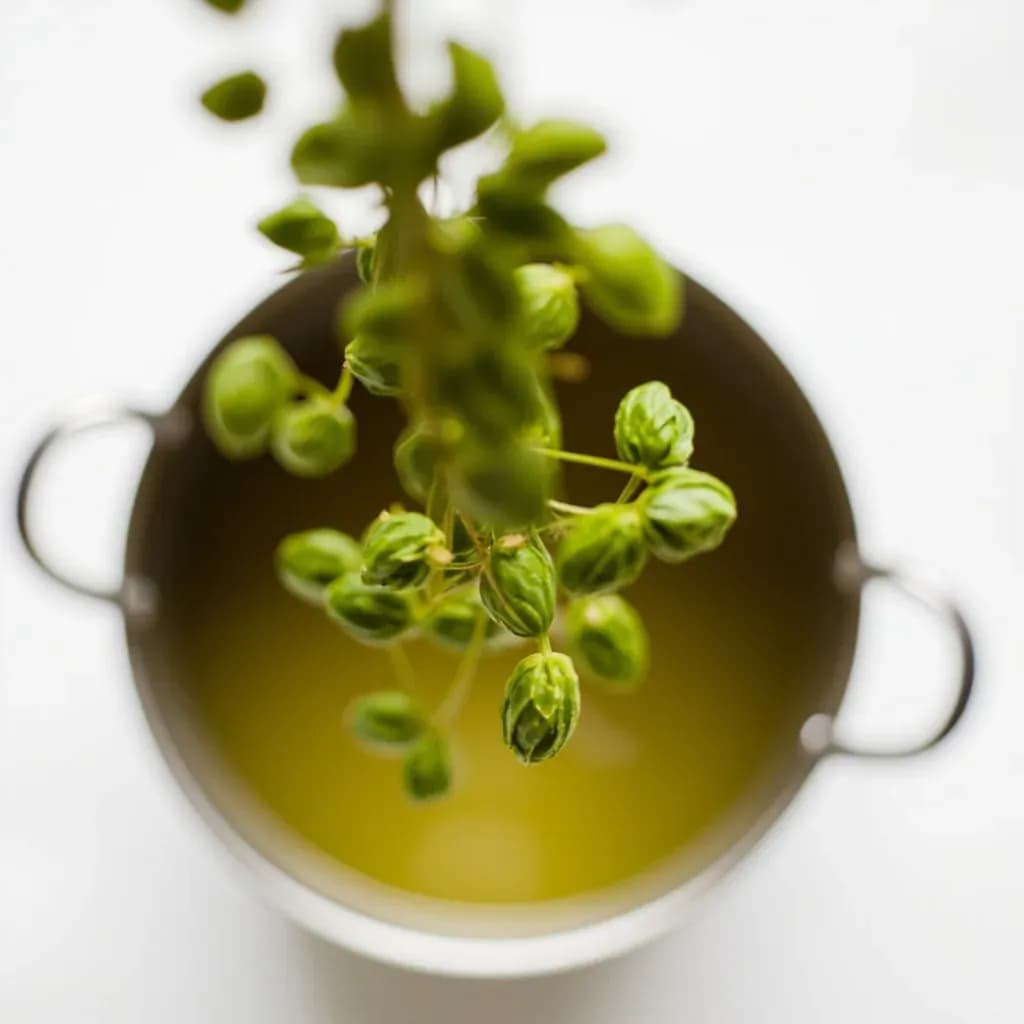
Transform & Preserve
Bittering Hop Addition
Adding hops early in the wort boil to isomerize alpha acids and build a beer's bitterness.
Bittering hop additions go into the boiling wort early, typically at the start of a 60-minute boil, so heat isomerizes their alpha acids into the soluble compounds that give beer its bitterness. The longer the boil, the more bitterness is extracted but the more aroma is driven off, which is why aroma hops are added late instead. It is a core step in brewing that balances the malt's sweetness.
Bittering hop addition is the deliberate addition of hops at the start of the wort boil to extract bitterness from a beer. The technique relies on a piece of chemistry that most other cooking has no equivalent of: alpha acids — the bitter compounds stored in hop lupulin glands — are water-insoluble at room temperature but, when boiled for roughly 60 to 90 minutes, thermally isomerize into iso-alpha acids, which dissolve into the wort and survive into the finished beer. Once that conversion is essentially complete, the hop's original aromatic oils have largely boiled off, which is exactly the point: bittering additions contribute structural bitterness with almost no flavor or aroma, freeing the brewer to layer in character later.
This separation of tasks — bittering early, flavoring and aroma late — is the organizing principle of modern hopped beer. A brewer who piled all the hops in at the start would get a bitter but aromatically flat beer; a brewer who skipped the early addition and used only late hops would get a fragrant beer that finished cloyingly sweet. Bittering hops balance residual malt sugars across everything from crisp pilsners to imperial stouts, and they are measured in IBUs (International Bitterness Units), where one IBU equals roughly one milligram of iso-alpha acid per liter of beer.
In practice, bittering additions are a numbers game. Brewers pick a high-alpha hop variety (10–18% alpha acids by weight), plug batch volume, target IBU, wort gravity, and boil time into a utilization formula such as Tinseth's, and weigh out the result. Only about a quarter to a third of the alpha acids actually convert under typical conditions, which is why bittering hops are dosed by calculated chemistry rather than by feel.
- Difficulty
- Medium
Types & varieties
German clean bittering hop, ~12–15% alpha; smooth bitterness with mild aroma contribution.
American high-alpha hop, ~15% alpha; very clean, neutral bitterness — a go-to for IPAs.
American super-high-alpha hop, ~15–18% alpha; assertive, economical bitterness.
American dual-purpose high-alpha hops, ~14–16% alpha; pungent, slightly resinous.
American bittering hop, ~12–14% alpha; black currant undertones.
American high-alpha hop, ~12–14% alpha; herbal, slightly green bitterness.
American high-alpha hop, ~14–16% alpha; clean and smooth.
American high-alpha hop, ~14–17% alpha; clean with a faint floral edge.
American dual-purpose, ~10–12% alpha; clean with faint floral notes.
Often used as a dual-purpose bittering hop, ~12–14% alpha; pine and grapefruit character.
How to do it
- 1
Set the target IBU
Decide the bitterness you want for the style — for example, 35–45 IBU for an American Pale Ale, 60–80 for an American IPA. This is the number the rest of the calculation is trying to hit.
- 2
Choose a high-alpha bittering variety
Pick a clean, high-alpha hop such as Magnum, Warrior, Apollo, or CTZ. Read the alpha acid percentage on the package; if only a range is given, assume the lower end to avoid under-bittering.
- 3
Calculate the addition weight
Plug alpha acid %, target IBU, boil gravity, boil time, and batch volume into an IBU formula — Tinseth is the most widely used. The output is the weight of hops to add.
- 4
Weigh the hops
Measure the calculated weight on a brewer's scale. Pellet hops are easier to weigh, store, and submerge; whole leaf hops behave similarly but float more readily.
- 5
Wait for the hot break
Bring the wort to a boil and hold it 5–10 minutes until a steady hot break (coagulated protein foam) forms. Adding hops before this risks a boilover.
- 6
Add the bittering hops
Drop the measured hops into the rolling boil and start a timer — the 60-minute bittering clock begins at this addition. Stir briefly so the hops wet out and sink.
- 7
Maintain a vigorous boil
Keep the boil rolling (typically 8–15% evaporation per hour, depending on the setup) for 60–90 minutes. Dropping to a simmer reduces utilization and lengthens the time to full isomerization.
- 8
Schedule later additions
With 15 minutes or less remaining, schedule flavor and aroma hop additions. Pull the kettle off the heat at flameout and begin cooling as usual.
- 9
Verify and dial in
Measure finished beer IBU (or send a sample to a lab) and compare to target. Adjust hop weight or boil time on the next batch until the recipe lands where you want it.
Why high-alpha hops exist
Breeding programs over the last half-century have pushed alpha acid content from single digits into the mid-to-high teens specifically to serve bittering additions. A 15% alpha hop delivers roughly twice the bitterness per gram of a 7% noble hop, which means a brewer can hit a target IBU with a smaller, less aromatic addition — leaving the kettle clearer and the polyphenol load lower. This is why varieties such as Warrior, Apollo, and Bravo exist almost exclusively for this single task.
Utilization and the math behind the dose
Utilization is the fraction of alpha acids that actually convert into iso-alpha acids. It is not 100%, and it is not constant. Boil time, boil vigor, gravity, and pH all move the needle. Tinseth's utilization formula captures the gravity and time effects in a single expression, which is why it is the most widely used tool for sizing a bittering charge. Brewing software does the arithmetic, but understanding the inputs is what lets a brewer adjust when a recipe lands short or harsh.
Bittering vs. flavor vs. aroma additions
The late kettle additions and dry hops that get most of the consumer attention contribute very little to measured IBU because their alpha acids never see enough heat to isomerize fully. This is by design: iso-alpha acids contribute bitterness without flavor, while the essential oils preserved in late additions contribute flavor and aroma without much bitterness. A balanced recipe divides the hop schedule accordingly — bittering up front, character at the back.
Common uses
Tips & pitfalls
- Choose neutral high-alpha hops for clean bittering: reserve pungent or aromatic varieties for late additions where their oils are preserved; using them for bittering wastes aroma and adds harshness.
- Store hops cold, sealed, and oxygen-free — alpha acids oxidize over time into harsh, cheesy compounds, so aged hops deliver less bitterness than the label suggests and can taint the beer.
- Calculate, don't guess: use Tinseth, Rager, or Daniels formulas to size the addition. Weighing by intuition alone is the single most common cause of under- or over-bittered batches.
- Keep the boil vigorous — a gentle simmer lowers utilization and lengthens isomerization. The utilization formulas assume a hard rolling boil.
- Add hops after the hot break forms; dropping them in too early invites boilovers and pulls protein into the kettle that later shows up as haze.
- Adjust for high-gravity worts: utilization drops as wort gravity climbs, so bump bittering charges for barleywines, imperial stouts, and double IPAs or the beer will taste sweet.
- Don't boil past 90 minutes — beyond that point, iso-alpha acid degradation and oxidation start to offset any further conversion, and measured IBU can actually fall.
- Don't substitute low-alpha aroma or noble hops for bittering; they would need to be dosed at multiples of the weight, raising vegetal 'green' flavors and polyphenol load without delivering clean bitterness.
Good to know
- Definition
- Adding hops at the start of the wort boil (typically 60–90 minutes before flameout) so their alpha acids isomerize into iso-alpha acids, the bitter compounds in beer.
- Primary chemistry
- Alpha acids (humulone, cohumulone, adhumulone) isomerize thermally to iso-alpha acids; the reaction is essentially complete after about 60–90 minutes of boiling.
- Typical utilization
- Roughly 25–30% of alpha acids convert in a 60-minute boil at standard wort gravity (~1.050), per formulas such as Tinseth.
- Utilization drivers
- Boil time, boil vigor, wort gravity (higher gravity lowers utilization), wort pH (lower pH raises it), and hop age/condition.
- Measured as
- Contributes to IBU (International Bitterness Units); 1 IBU ≈ 1 mg of iso-alpha acid per liter of beer.
- Typical dose
- 0.5–1.5 oz (14–42 g) per 5 gallons (19 L) for most ales; high-gravity or aggressively bittered styles use significantly more.
- Variety profile
- Modern bittering hops run 10–18% alpha acids by weight — far higher than traditional or aroma varieties — and are chosen for clean, neutral bitterness.
- Effective boil window
- Roughly 75–90 minutes; longer boils show diminishing returns as iso-alpha acids degrade and oxidize, which can actually lower measured IBU.
Also called
Bittering Hops · Hop Boil Addition
Related

Confit
Cook slowly submerged in fat for silky tenderness and keeping

Cure
Draw out moisture with salt and time to preserve and concentrate

Pickle
Steep in acidic brine for bright, tangy, crunchy preservation

Ferment
Let friendly microbes transform food into tangy, complex flavor

Marinate
Soak in a seasoned mix to flavor and tenderize before cooking

Brine
Soak in salt water so meat stays juicy and seasoned throughout

Dehydrate
Slowly dry out moisture to concentrate flavor and extend shelf life

Cold-Smoke
Perfume cured food with smoke without cooking it through