Transform & Preserve
Boiling the Wort
Vigorously boiling sweet wort to sterilize it, extract hop bitterness, and set beer flavor.
Boiling the wort is a core brewing step where the sugary liquid drawn from malted grain is boiled hard for roughly an hour. The boil sterilizes the wort, isomerizes hop alpha acids for bitterness, drives off unwanted volatiles, and coagulates proteins so the beer clears. Hop additions are timed during the boil, with early ones for bitterness and late ones for aroma.
Boiling the wort is the vigorous, prolonged rolling boil that turns sweet, sugar-rich liquid drained from a mash into the sterile, bitter, flavored foundation of beer. In a single step it sterilizes the liquid, isomerizes hop alpha acids into bitterness, strips volatile off-flavors like dimethyl sulfide (DMS), coagulates proteins into a hot break, and concentrates the wort to its target original gravity. The boil is also where color deepens through Maillard browning and where hop oils are either locked in or boiled away, depending on timing.
Two non-obvious variables drive nearly every decision a brewer makes at the kettle: vigor and time. Boil vigor — a true rolling boil, not a simmer — is what physically pushes DMS out of the kettle as a gas and carries hop compounds into solution. Timing is what splits the hop charge into the distinct sensory roles of bittering, flavor, and aroma. Get both right and the kettle does the rest of the work for you; get either wrong and no amount of yeast or aging rescues the beer.
The practice is also one of the oldest kitchen techniques still in continuous use. Sumerian and Mesopotamian beer recipes from c. 3500–1800 BCE describe boiled-grain beverages, and the integration of hops into the boil replaced the older gruit herb blends across most of Europe between the 9th and 13th centuries. Modern brewing has refined — but not replaced — that ancient kettle.
- Difficulty
- Medium
Types & varieties
The workhorse for most ales and lagers; balances bitterness extraction, hop flavor, and DMS purge.
Used for very high-gravity beers (imperial stouts, barleywines) and pilsner-malt bills; stronger Maillard color and more reliable DMS stripping.
Traditional choice for all-pilsner-malt beers to drive off the excess DMS pale malts can produce.
Single kettle with timed bittering, flavor, and aroma additions; the most common modern ale schedule.
After flame-out, hops rest in 70–85 °C / 158–185 °F wort for 10–30 minutes for soft, juicy aroma without added bitterness.
Bittering hops added to the kettle before the boil starts; yields a smoother, less harsh perceived bitterness.
Same hop variety added in equal small doses every few minutes throughout the boil for layered, integrated hop flavor.
Traditional lager/bock technique: a portion of wort is pulled, boiled separately, and returned; deepens malt complexity and color.
Concentrated malt extract boiled in a smaller volume, then topped up in the fermenter; shorter, less intense boil.
Drastically shortened or omitted boil; relies on kettle hops and pasteurized extract. Practiced in some 19th-century American and British breweries, though rarely with consistent results.
How to do it
- 1
Sanitize and assemble equipment
Clean and sanitize the kettle, burner, hop bags, spoons, chiller, and fermenter. Anything added to the kettle cold (late hops, finings, water for top-up) can carry contamination that survives the boil — sanitation at this stage is cheap insurance.
- 2
Transfer the sweet wort
Drain or ladle the mash into the boil kettle. Leave the grain bed behind; suspended starch haze and fine particulates scorch on the kettle bottom and add astringency that no amount of boiling will smooth out.
- 3
Bring to a vigorous boil
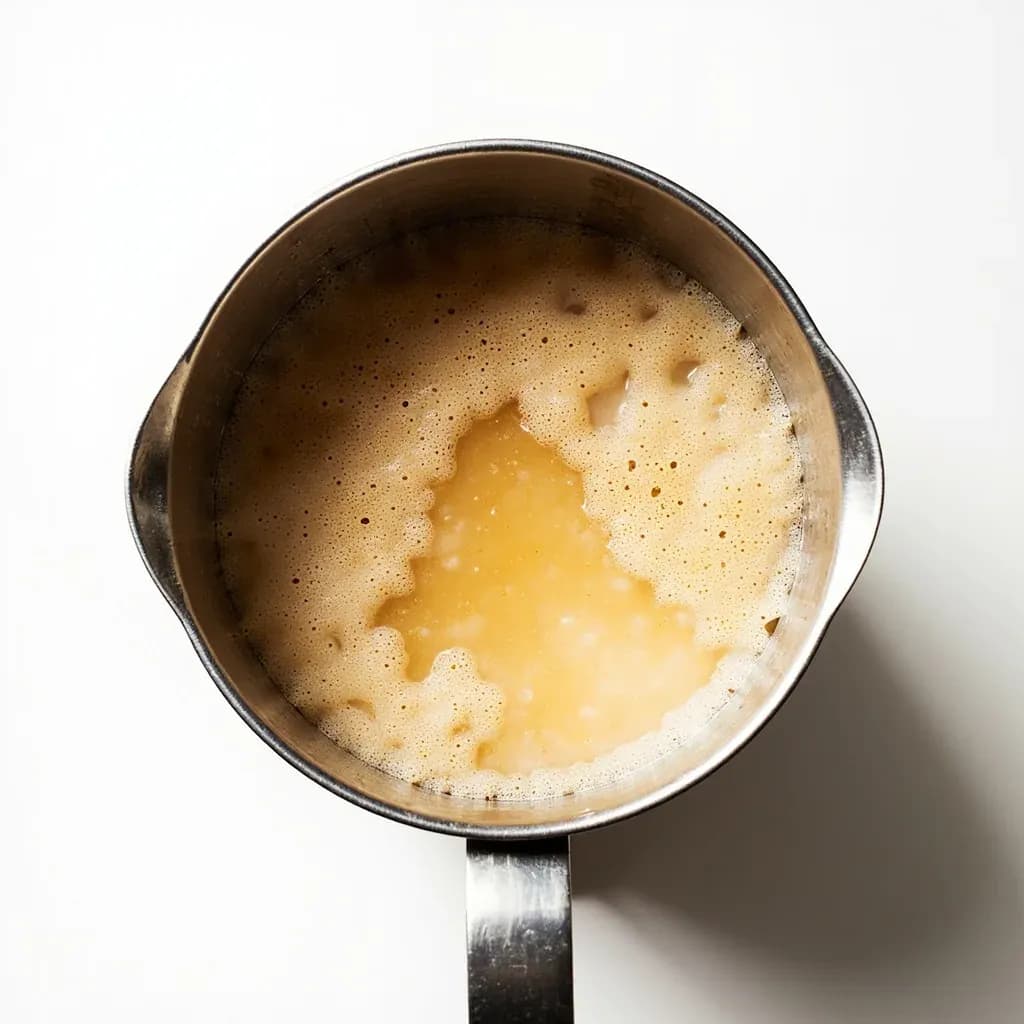
Crank the burner to full and bring the wort up through the hot-break range (~80–95 °C / 176–203 °F). Establish a true rolling boil — constant, broken-surface bubbling across the whole kettle — and hold it for the full scheduled time. A simmer is not enough.
- 4
Add bittering hops
At the start of the rolling boil (the 60-minute mark), add the bittering hop charge. High-alpha, low-oil varieties go in now to maximize iso-alpha-acid conversion.
- 5
Manage the boil
Watch the kettle edges for foam climb in the first 10–15 minutes as proteins coagulate. Reduce heat briefly if it threatens to boil over, then return to full power. Maintain the target evaporation rate (typically 10–12% per hour at homebrew scale).
- 6
Add kettle clarifiers and flavor hops
At about 15 minutes remaining, add Irish moss or a whirlfloc tablet to bind proteins for a cleaner break. At 15–30 minutes remaining (per recipe), add the flavor-hop charge — dual-purpose varieties that will still leave some essential oil behind.
- 7
Add aroma hops
At 5–10 minutes remaining, add the aroma hop charge. These hops contribute flavor and aroma with very little additional bitterness.
- 8
Flame-out and whirlpool hop stand
Cut the heat. Add 0-minute aroma hops and stir briefly to set a gentle whirlpool. Cover and let the hops stand in the hot wort for 10–30 minutes at roughly 70–85 °C / 158–185 °F to extract soft, juicy aroma without driving it off.
- 9
Cool rapidly to pitching temperature
Move the kettle off the burner and chill the wort as fast as practical — under 21 °C / 70 °F for ales, under 10 °C / 50 °F for lagers. Use an immersion or counterflow chiller. Quick cooling limits DMS reabsorption and infection risk in the vulnerable window between boil and pitched yeast.
- 10
Transfer, aerate, and pitch yeast
Move the chilled wort to the fermenter, splashing to pick up oxygen (oxygen is desirable only at this exact moment). Pitch yeast immediately, seal, and begin fermentation.
Why vigor matters more than temperature
Two kettles can read 100 °C and produce very different beers. A simmer barely moves vapor off the surface, so DMS lingers, hop alpha acids dissolve slowly, and proteins refuse to coagulate into a clean hot break. A rolling boil, by contrast, physically strips volatiles, churns hop pellets into the liquid, and drives Maillard reactions forward. Many perceived 'boil problems' are actually problems the boil cannot fix — thin pre-boil wort, low calcium, missed mash conversion, or a pH stuck above 5.4 — and pushing the burner harder will not correct them. Treat the boil as a place to finish chemistry that the mash started, not as a place to rescue flaws.
- A rolling boil is defined by constant, broken surface movement — bubbles erupting across the whole kettle, not just at the edges.
- Boil vigor is the single biggest factor in DMS removal; even 90 minutes at a simmer leaves more DMS than 60 minutes at a full rolling boil.
Hop timing and the bittering–flavor–aroma split
Every minute a hop spends in boiling wort costs it aroma and gains it bitterness. Alpha acids need roughly 5+ minutes at boiling temperatures to isomerize into iso-alpha acids, the compounds that read as bitterness. Essential oils responsible for citrus, pine, and tropical character boil off in a fraction of that time. The standard schedule — bittering hops at 60 min, flavor hops at 15–30 min, aroma hops at 0–5 min or in a whirlpool — is a working compromise that lets a single kettle produce a balanced, layered hop character.
- Bittering charge: high-alpha hops at 60 min for maximum iso-alpha conversion.
- Flavor charge: dual-purpose hops at 15–30 min keep enough oil to read as flavor without the harsh edge of full utilization.
- Aroma charge: low-alpha, high-oil hops at 0 min or in a 10–30 min whirlpool stand at 70–85 °C for aroma with negligible added bitterness.
Color, concentration, and Maillard
Although Maillard reactions accelerate well above 150 °C — temperatures the kettle never reaches — they proceed measurably during a long, vigorous boil through amino-sugar interactions and caramelization of free sugars. Pale pilsner worts deepen several SRM/Lovibond over a 90-min boil; high-gravity barleyworts can darken dramatically. The boil also concentrates the wort by evaporation, which is the brewer's main tool for hitting the target original gravity before fermentation.
- Pre-boil volume × pre-boil gravity should approximately equal post-boil volume × post-boil gravity; measure both to track efficiency.
- Longer boils deepen color in all-malt worts; recipe writers account for this when targeting a specific SRM.
Common uses
Tips & pitfalls
- Use a kettle at least 30% larger than your intended batch volume — a vigorous boil can climb and boil over in seconds, especially in the first 15 minutes.
- Aim for a real rolling boil, not a simmer; DMS removal and hop utilization both depend on vigorous vapor movement at the surface.
- Add bittering hops at 60 min, flavor hops at 15–30 min, aroma hops at 0–5 min or in a whirlpool stand — timing is the whole game for hop character.
- Keep pre-boil gravity under ~1.080; very high-gravity boils extract less bitterness and scorch more easily.
- Add Irish moss or whirlfloc at 15 min for a cleaner hot break and better downstream clarity — adding it too early wastes its binding capacity.
- Watch the kettle edges, not the center, for boil-over; a spray bottle of water or a thin film of oil on the rim controls foam without diluting the wort.
- Calibrate your boil-off rate by measuring pre- and post-boil volumes; home systems vary wildly and recipe numbers often assume a specific kettle.
- Cool the wort as fast as possible after flame-out — slow cooling is a major source of DMS rebound and contamination.
- Don't stir vigorously during hop additions; let the hops sit so their oils do not oxidize and turn grassy.
- Track kettle pH if you can; a steady drop to ~5.0–5.2 by the end of the boil is healthy and supports a clean hot break.
- Account for hop absorption — a heavy leaf-hop load can hold back 0.5–1 L of liquid per 100 g, throwing off your gravity numbers.
- Use stainless steel or copper-enameled kettles only; aluminum and galvanized steel can leach metals into an acidic boil.
Good to know
- Typical duration
- 60–90 minutes of rolling boil (90 min is the common homebrew default; some lagers and very high-gravity beers run 120 min).
- Boil temperature
- ~100 °C / 212 °F at sea level (lower at altitude); vigor matters more than the thermometer reading.
- Evaporation rate
- 8–15% per hour; homebrew systems usually target ~10–12%/hr, professional kettles 4–8% depending on stack and kettle geometry.
- Hop utilization
- Roughly 25–30% of alpha acids convert to iso-alpha acids in a 60-min boil; utilization rises with longer boils and lower wort gravity, and falls with higher wort gravity.
- Hot break
- Proteins coagulate between ~80–95 °C / 176–203 °F; a vigorous boil encourages a clean break and brighter finished beer.
- DMS removal
- S-methylmethionine breaks down to DMS during the boil; ~60+ min of vigorous boil is needed to purge it, especially in pilsner-malt worts.
- Pre-boil gravity window
- Most recipes target 1.040–1.055 for an efficient boil; boils above ~1.080 extract less bitterness and scorch more readily.
- Equipment
- Stainless or copper-enameled kettle sized 30–50% larger than batch volume; homebrew burners of 55,000+ BTU are recommended for 5-gallon batches.
- Ancient origin
- Boiled-grain beverages appear in Sumerian and Mesopotamian recipes c. 3500–1800 BCE; hops became standard in European brewing from the 9th–13th centuries.
Also called
Wort Boil · The Boil
Dishes that rely on it
Related

Confit
Cook slowly submerged in fat for silky tenderness and keeping

Cure
Draw out moisture with salt and time to preserve and concentrate

Pickle
Steep in acidic brine for bright, tangy, crunchy preservation

Ferment
Let friendly microbes transform food into tangy, complex flavor

Marinate
Soak in a seasoned mix to flavor and tenderize before cooking

Brine
Soak in salt water so meat stays juicy and seasoned throughout

Dehydrate
Slowly dry out moisture to concentrate flavor and extend shelf life

Cold-Smoke
Perfume cured food with smoke without cooking it through