Transform & Preserve
First Wort Hopping
Adding hops to the wort before the boil during lautering to give beer a smoother, rounder bitterness.
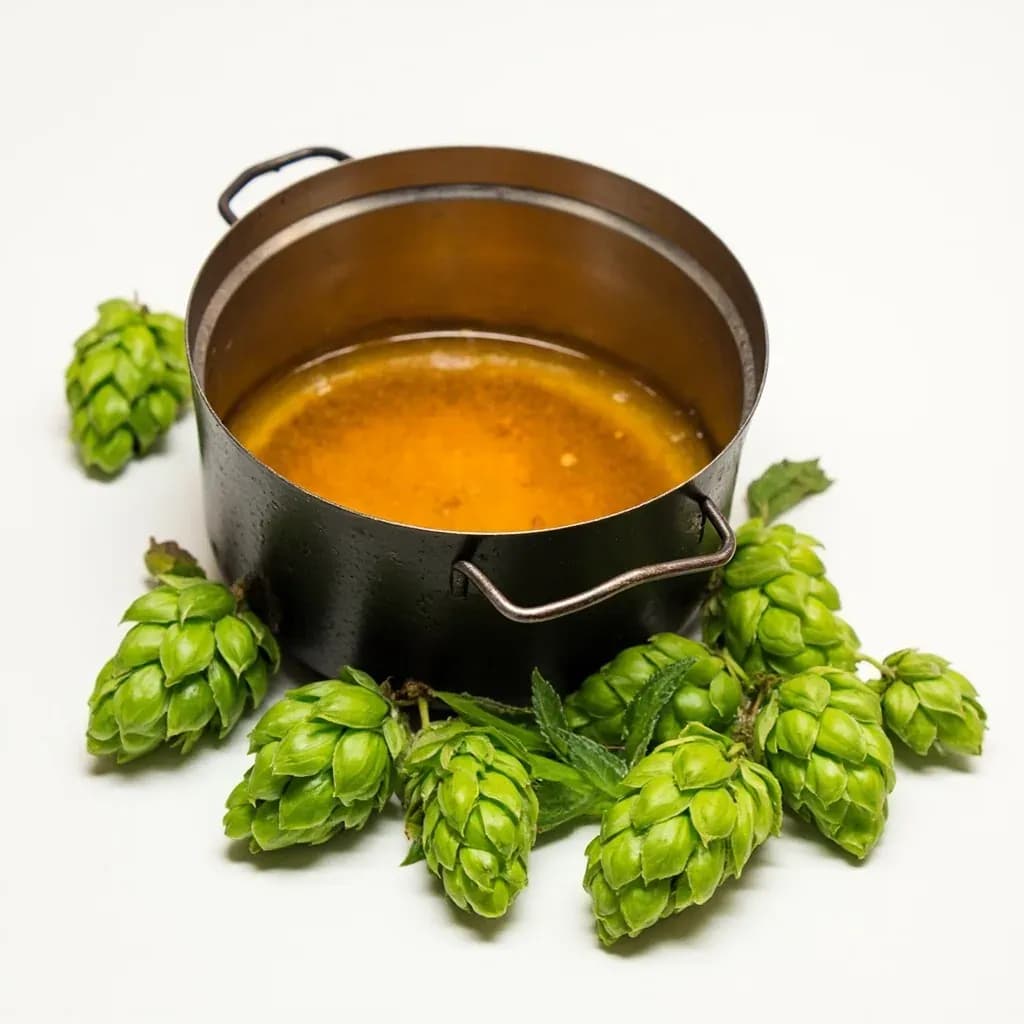
First wort hopping adds hops to the collecting wort during the lauter, before the boil begins, so they steep at a lower temperature for longer. This produces a smoother, more refined hop bitterness and enhanced aroma compared with adding hops only during the boil. It is a traditional German brewing technique used especially for pilsners and pale lagers.
First Wort Hopping (FWH) is a brew-day technique in which the bittering hop charge goes into the kettle not at the start of the boil but earlier, while the kettle is still filling with sweet wort from the lauter tun. The hops sit in wort that climbs slowly from mash temperature (around 168 °F / 76 °C) up to a rolling boil, so the alpha acids isomerize gradually rather than being flash-heated at full kettle temperature. The effect is a cleaner, softer bitterness in the finished beer, even when the calculated IBU stays roughly the same.
What the slow ramp does is gentle the work the hops perform on the wort. Polyphenols and the harsher bittering fractions extract more gradually, which reads in the glass as a rounder, more refined bitterness that lingers less on the palate. FWH is widely credited in modern American craft brewing to figures like Randy Mosher, Ken Grossman of Sierra Nevada, and Jamil Zainasheff, though the practice has older roots in German Ersthopfung, the small pre-boil hop charge still used in some German pilsner breweries.
The technique is best understood as a timing variation on conventional kettle bittering rather than a separate hop product. Because the isomerization is gentler, most brewing software (BeerSmith, Brewfather, and similar tools) treats FWH with slightly lower utilization than a 60-minute addition, which is why brewers often see IBU targets drop marginally when they move part of their bittering charge to first wort. The net sensory effect, however, is a smoother bitter backbone, one that shows up most clearly in lagers and pilsners but has migrated into American craft IPAs and DIPAs where brewers want a clean platform beneath heavy late and dry hop additions.
- Difficulty
- Hard
Types & varieties
A small charge of noble hops added to the kettle as first wort runs from the lauter tun; classic in German pilsners, helles, and other delicate lagers.
All bittering hops added at first wort for a markedly smoother bitterness profile; used in many American craft lagers, pilsners, and some hop-forward ales.
A portion of the bittering charge added at first wort, the remainder at the 60-minute mark; balances FWH character with conventional utilization and easier IBU calculation.
How to do it
- 1
Prepare the kettle
Sanitize the boil kettle and position it under the lauter tun outlet so it can collect wort as lautering begins.
- 2
Weigh the FWH hop charge
Measure the hops intended for first wort hopping, typically 10–20% of total bittering hops, though some brewers use the entire bittering charge.
- 3
Add hops at first runnings
As soon as wort begins to flow from the lauter tun into the kettle, sprinkle the FWH hops into the kettle so they begin steeping in the hot wort.
- 4
Continue lautering
Let wort continue to run into the kettle while the temperature climbs gradually from mash temperature (~168 °F / 76 °C) toward boiling.
- 5
Bring to a boil
Fire the burner and bring the kettle to a rolling boil; the FWH hops have now been steeped through the entire pre-boil ramp.
- 6
Run the boil as usual
Add the remaining hop additions (60-min, 30-min, 15-min, whirlpool, dry hop) according to the recipe; the FWH charge counts as having had full boil-time exposure.
- 7
Cool and ferment
Proceed with the standard whirlpool, chill, and fermentation steps; evaluate perceived bitterness in the finished beer and adjust the FWH percentage in future batches.
Why the Slow Ramp Matters
The refining effect of FWH comes almost entirely from timing, not from the hop variety itself. When hops hit wort that is already at a rolling boil, the alpha acids isomerize quickly and the hot wort pulls harsher polyphenol fractions into solution in a narrow window. When hops steep through the climb from mash temperature to boil, two things change:
- Alpha acids isomerize across a wider temperature band, producing a perceived bitterness that is less sharp and more sustained through the sip.
- Polyphenols and tannin-like compounds leach out gradually, muting the harsh, 'green' bite often associated with long kettle boils.
- Low-cohumulone noble hops (Hallertau, Tettnang, Saaz) show this effect most clearly, because their gentler character is no longer being flattened by aggressive boiling.
- On hard, alkaline water, FWH can offset the perception of mineral-driven harshness and produce a noticeably cleaner finish.
Common uses
Tips & pitfalls
- Use FWH only with hops you would otherwise boil for the full duration; reserving aroma hops for FWH wastes their volatile flavor and aroma compounds.
- Add the FWH charge as soon as wort begins to cover the kettle bottom so the hops steep through the entire temperature ramp rather than being dropped into already-boiling wort.
- Account for FWH hops in your IBU calculations; most brewing software has a dedicated FWH utilization setting that is typically slightly lower than the 60-minute utilization.
- Do not confuse FWH with mash hopping; FWH goes into the kettle during lautering, not directly into the mash tun, and the two techniques behave differently.
- Stir or recirculate wort over the FWH hops to keep them from scorching on the kettle bottom as the wort heats toward a boil.
- FWH works best with a vigorous boil and a good hot break; weak or sluggish boils blunt its refining effect on bitterness.
- If your recipe already calls for a large 60-minute addition, try moving 10–20% of that addition to FWH rather than adding extra hops to the recipe.
Good to know
- Also known as
- FWH, Ersthopfung (German)
- When hops are added
- To the kettle during lautering, before the wort reaches a boil
- Typical share of bittering charge
- Roughly 10–20% of total bittering hops; some brewers use the entire bittering charge
- Primary sensory effect
- Smoother, rounder, more refined bitterness with less harsh, lingering bite
- Mechanism
- Gradual heating from mash temps (~168 °F / 76 °C) up to boil allows more complete alpha-acid isomerization and gentler polyphenol extraction
- Effect on IBU
- Often results in slightly lower perceived bitterness at equal utilization; FWH hops still contribute to total IBU
- Common hop types used
- Low-cohumulone bittering hops, especially noble varieties (Hallertau, Tettnang, Saaz) in lagers and pilsners
- Differs from
- Mash hopping (hops added to the mash tun) and standard kettle bittering (added at hot break)
- Skill level
- Beginner-friendly; no special equipment beyond a standard batch setup
Also called
FWH
Related

Confit
Cook slowly submerged in fat for silky tenderness and keeping

Cure
Draw out moisture with salt and time to preserve and concentrate

Pickle
Steep in acidic brine for bright, tangy, crunchy preservation

Ferment
Let friendly microbes transform food into tangy, complex flavor

Marinate
Soak in a seasoned mix to flavor and tenderize before cooking

Brine
Soak in salt water so meat stays juicy and seasoned throughout

Dehydrate
Slowly dry out moisture to concentrate flavor and extend shelf life

Cold-Smoke
Perfume cured food with smoke without cooking it through