Transform & Preserve
Lautering
Separating clear sweet wort from spent grain in brewing by rinsing the grain bed with hot water.
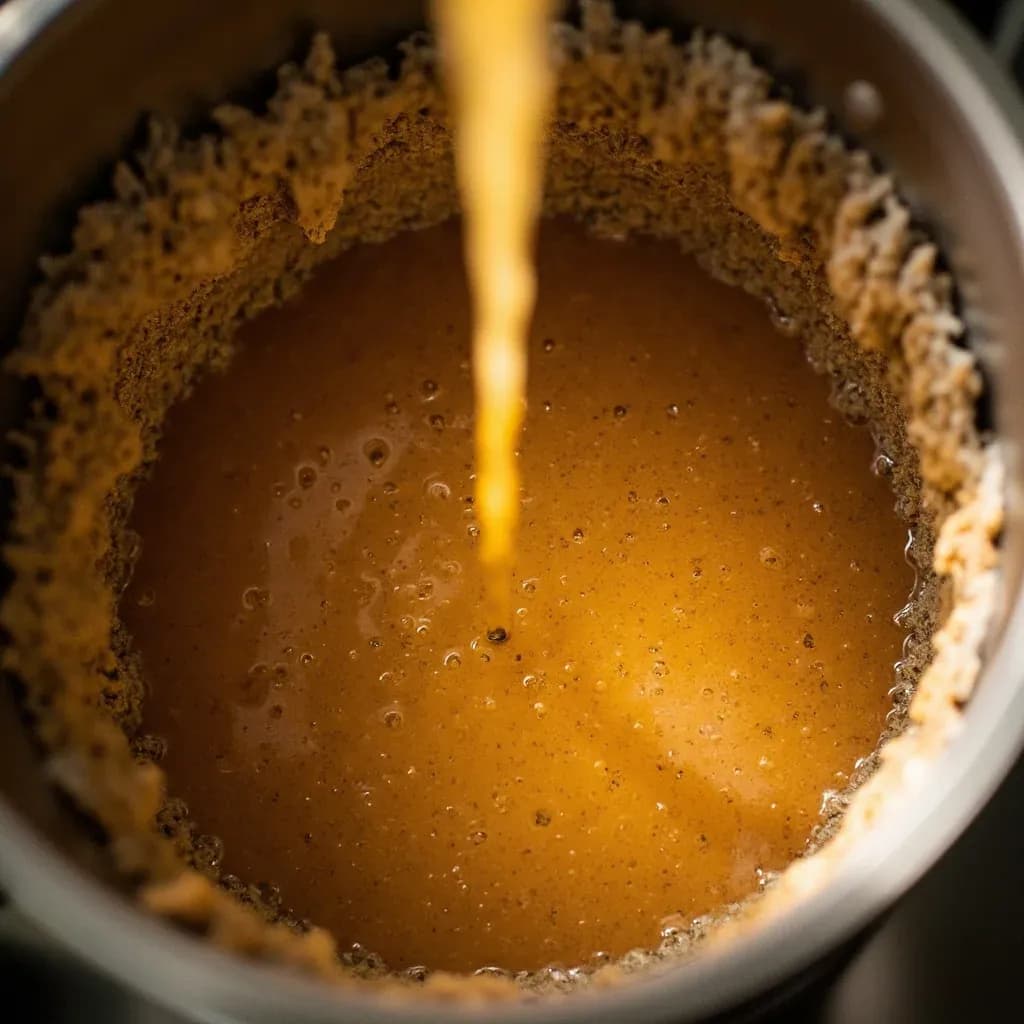
Lautering is the brewing step that separates the sugary liquid wort from the spent grain husks after mashing. The grain bed itself acts as a filter, and the cloudy first runnings are recirculated (vorlauf) until the wort runs clear before sparging rinses out the remaining sugars. Careful lautering maximizes sugar extraction and keeps the wort free of grain particles.
Lautering is the separation stage in all-grain brewing that turns a starchy, sweet porridge — the mash — into the clear liquid wort that will be boiled and fermented. The grain bed itself acts as the filter: cracked malt husks stack into a loose mat through which wort drains by gravity, leaving the spent grain behind. Done well, lautering is quiet, slow, and almost meditative, a controlled extraction that balances yield against clarity, and clarity against the risk of pulling bitter, husk-derived tannins into the kettle.
The work has two distinct phases. Vorlauf (recirculation) clears the cloudy first runnings of fine grain particles by returning them to the top of the bed until the runoff runs bright. Sparging then rinses the remaining sugars out of the grain with hot water held in a narrow temperature window — too hot extracts harsh polyphenols, too cold leaves fermentable extract trapped in the bed. The payoff is a measured volume of wort at a known gravity, ready for the boil. The same logic applies anywhere malt starch is being washed: beer, malt whisky, grain neutral spirit, and any kitchen-scale project that uses a grain bed to clarify a starchy or herbal liquid.
- Difficulty
- Hard
Types & varieties
Continuous, slow addition of hot sparge water from the top while wort drains from the bottom. Maximum sugar extraction; standard in pro breweries.
Drain the first runnings completely, add all sparge water at once, rest briefly, then drain again. Faster and more forgiving for homebrewers; slightly less efficient.
Mash with the entire brewing water volume and skip the sparge entirely. Lower efficiency but the cleanest wort and the simplest setup.
Traditional Central European method where the next batch's mash water is poured directly over the previous lauter tub's grain bed as it finishes draining.
On systems with poor filtration, brewers sometimes pull only the clear first runnings and treat the dilute sparge runoff as a separate small beer — a parti-gyle-style split.
How to do it
- 1
Mash out (if step mashing)
Raise the mash to 168 °F (75.6 °C) and rest 10 minutes to halt enzymatic activity and thin the wort. Skip on a single-infusion mash that already sits at mashing-out temperature.
- 2
Set the bed
With the outlet valve closed, make sure the grain bed is level. Loosen any compacted top crust with a long spoon; do not stir the lower two-thirds of the bed.
- 3
Vorlauf (recirculate)
Open the outlet and let wort run slowly into a pot or back into the tun. Return the cloudy first runnings to the top of the bed. Continue until the runoff is noticeably clear — usually 1–2 gallons (4–8 L) recirculated over 10–20 minutes.
- 4
Begin runoff
Once the wort is clear, redirect flow to the boil kettle. Maintain a slow, steady drain — about 1 quart per pound of grain per minute at peak.
- 5
Start sparging
As soon as the liquid level above the grain drops to about 1 inch, begin adding 168–170 °F sparge water gently and continuously (fly) or in measured batches (batch). Keep 1–2 inches of water above the grain at all times.
- 6
Monitor gravity and pH
Sample runoff every 15 minutes with a hydrometer or refractometer and a pH strip. Stop when pre-boil volume is reached, when gravity falls below ~1.010, or when pH rises above 6.0.
- 7
Close the valve and clean up
Shut the outlet the moment the target is met. Remove the spent grain promptly — once it dries it hardens quickly and becomes very difficult to scoop out of the tun.
When the bed stalls
A stuck lauter is almost always one of three things: a compacted bed, channeling from pouring too hard, or fines clogging the false bottom. The remedy is the same — stop adding water, let the bed rest five to ten minutes, then stir only the top one to two inches (the protective filter layer) with a long spoon, and re-vorlauf gently. If the mash is doughy from wheat or oats, prevention beats cure: mix in 5–10 percent rice hulls at mash-in to keep the bed open. The grain bed is the only filter, so bed integrity — a level surface, even particle size, no compaction — matters more than pump pressure or fancy hardware.
- Flow under ~0.25 qt/lb/min — likely a compacted bed; rest and break the surface crust only.
- Runoff suddenly cloudy mid-sparge — channeling; pour sparge water onto a ladle or sprinkler, never a solid stream.
- Runoff starts slow then runs fine — the bed was set a touch tight; add rice hulls to the next grain bill.
- Runoff smells sharp or astringent — pH is climbing above 6.0; stop sparging and accept the lower yield.
- If you overshoot pre-boil volume, top up with cold water rather than re-sparging the bed.
Common uses
Tips & pitfalls
- Always vorlauf until the wort runs noticeably clear — the first 1–2 quarts are cloudy with grain fines and should be returned to the tun, not sent to the kettle.
- Pour sparge water onto a ladle, watering can, or spray ring to avoid punching holes in the grain bed.
- If flow stalls, stir the top 1–2 inches only, never the full bed; the deeper layer is the protective filter that keeps fines off the false bottom.
- Add 5–10 percent rice hulls to the grain bill for wheat- or oat-heavy beers to keep the bed loose and prevent a stuck mash.
- Monitor runoff pH with test strips; if it climbs above 6.0, stop sparging immediately to avoid husk tannin extraction and astringency in the finished beer.
- Heat sparge water in a separate hot liquor tank so the temperature stays stable through the 45–90 minute runoff.
- Under-modified malts (pilsner, raw wheat) benefit from a protein rest in the mash before lautering, which clarifies the wort and improves runoff.
- If you overshoot pre-boil volume, top up with cold water rather than re-sparging the bed — a second sparge will pull harsh tannins.
Good to know
- Process
- Two-stage separation: vorlauf (recirculation) clears the cloudy first runnings, then sparging (rinsing the grain bed with hot water) extracts the rest of the sugars.
- Sparge water temperature
- 168–170 °F (75.6–76.7 °C). Above 170 °F risks tannin and silica extraction; below 150 °F leaves fermentables behind.
- pH window
- Mash held at 5.2–5.5; sparge runoff kept below pH 6.0 to avoid astringent polyphenols from the husks.
- Runoff rate
- Roughly 1 qt (≈1 L) per pound of grain per minute during vorlauf; slowed to about 0.5 qt/lb/min during sparge.
- Water level above the bed
- Maintain 1–2 inches (2.5–5 cm) of water on top of the grain during fly sparging to prevent channeling and air ingress.
- Equipment
- A lauter tun with a false bottom, slotted manifold, or perforated plate; a brew-in-a-bag (BIAB) grain bag is a simplified single-vessel variant.
- Time
- Vorlauf 10–20 minutes; sparge runoff 45–90 minutes depending on grain bill and batch size.
- End signal
- Stop when pre-boil volume is reached, or when runoff gravity falls below ~1.010, or pH climbs above 6.0 — whichever comes first.
Also called
Vorlauf (Recirculation) · Vorlauf · Sparging
Related

Confit
Cook slowly submerged in fat for silky tenderness and keeping

Cure
Draw out moisture with salt and time to preserve and concentrate

Pickle
Steep in acidic brine for bright, tangy, crunchy preservation

Ferment
Let friendly microbes transform food into tangy, complex flavor

Marinate
Soak in a seasoned mix to flavor and tenderize before cooking

Brine
Soak in salt water so meat stays juicy and seasoned throughout

Dehydrate
Slowly dry out moisture to concentrate flavor and extend shelf life

Cold-Smoke
Perfume cured food with smoke without cooking it through