Transform & Preserve
Sparging
Rinsing the grain bed with hot water to extract fermentable sugars.
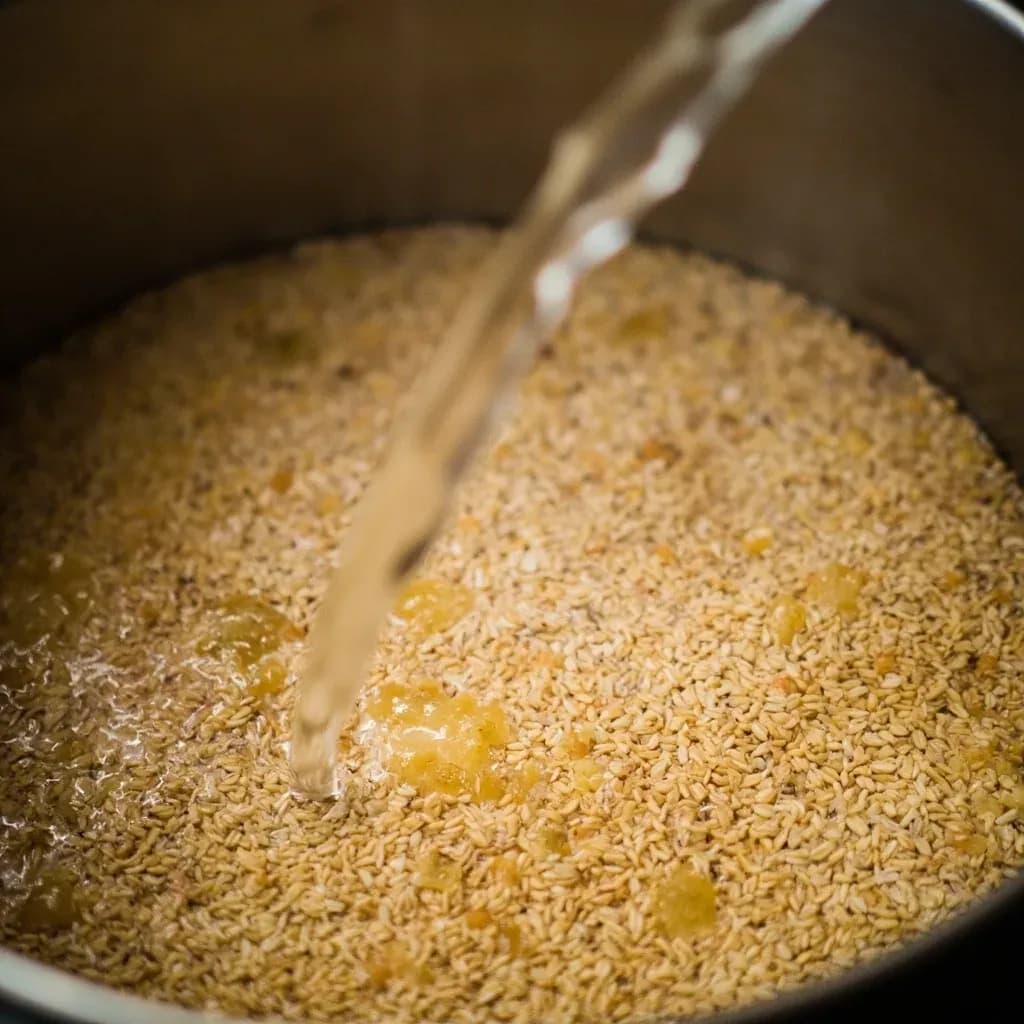
Sparging rinses the spent grain bed during brewing with hot water to wash out the remaining fermentable sugars after the initial mash. Fly sparging trickles water slowly over the bed for high efficiency, while batch sparging drains and refills in stages for speed. Proper water temperature and pH keep extraction high without pulling harsh tannins from the husks.
Sparging is the rinsing step that follows the mash in all-grain brewing, in which hot water is slowly passed through the grain bed to wash out the fermentable sugars the mash liquor left behind. It is the second half of lautering — the first half being the initial runoff — and it is the single biggest lever a brewer has for hitting a target pre-boil volume and gravity. Done well, sparging pushes mash efficiency into the upper 80s or low 90s percent; done carelessly, it either strands sugars in the grain bed or pulls harsh tannins out of the husks and into the kettle.
The technique is governed by a narrow temperature window of about 168–170°F (76–77°C). Below roughly 160°F, sugar diffusion slows and the runoff runs thin, quietly costing efficiency. Above about 170°F, the husks begin yielding tannins and the finished beer turns astringent. Within that window, the goal is to keep the grain bed evenly wet, undisturbed, and draining at a rate the brewer can match on top with fresh hot water. How that flow is managed — in distinct batches, as a continuous shower, or not at all — defines the three main styles of sparging.
Sparging matters beyond efficiency: it shapes kettle volume, pre-boil gravity, hop utilization, and the clarity of the finished beer, because the grain bed itself acts as a filter. A calm, well-settled bed delivers clearer wort to the boil. The word also turns up in a couple of unrelated contexts — spraying kegs or bottles with water to displace residual CO2, and very loosely in manual pour-over coffee — but in a brewing reference, sparging means the grain-bed rinse.
- Difficulty
- Hard
Types & varieties
Drain the mash, add a measured volume of hot water, rest 10–15 minutes, and drain; repeat once or twice. Forgiving and the most common method in homebrewing.
Slowly sprinkle hot water on top of the grain bed at the same rate wort drains from the bottom, keeping the bed just covered. Highest potential efficiency but the most technique-sensitive.
Mash with the full water volume up front and simply drain. Simplest method, lower efficiency, and a denser, smaller-volume wort that affects hop utilization.
How to do it
- 1
Heat sparge water
Bring the sparge water (held in a hot liquor tank or kettle) up to 168–170°F (76–77°C). Plan for roughly 0.5–1.0 qt per lb of grain beyond what was used for the mash.
- 2
Vorlauf (recirculate)
Slowly drain wort from the mash tun into a pitcher or pot and pour it gently back on top of the grain bed. Repeat until the runoff is relatively clear and free of grain particles, then begin full collection.
- 3
Begin the first sparge pass (batch method)
Drain the mash until the grain bed is just exposed. Slowly pour the first batch of hot sparge water over the bed, taking care not to disturb it, until the grain is covered by roughly an inch of water.
- 4
Rest and drain
Let the grain bed settle for 10–15 minutes so the sugars can diffuse out of the grain particles, then drain slowly back into the kettle.
- 5
Repeat sparge passes as needed
Add a second (and rarely third) batch of hot water following the same rest-and-drain routine until you reach your target pre-boil volume or the runoff gravity falls to the cutoff.
- 6
For fly sparging instead
After vorlauf, set a sparge arm or rotating sprinkler above the grain. Open the outflow valve to a slow, steady trickle and add hot water at the same rate so the bed stays just submerged; collect continuously until target volume or gravity cutoff.
- 7
Confirm kettle volume and gravity
Measure pre-boil volume with a kettle mark or graduated vessel and pre-boil gravity with a hydrometer or refractometer. Top up with water or extend the boil to hit targets before cooling and pitching yeast.
Why the 170°F ceiling matters
The upper limit is not arbitrary. Above roughly 170°F the husk polyphenols become noticeably water-soluble, and they carry through the boil into the finished beer as astringency and a dry, puckering finish. The lower limit matters for a different reason: the diffusion of sugars out of cracked endosperm particles slows sharply as the wort cools, so under-temperature sparging strands extractable sugar in the grain and quietly tanks efficiency. Hitting 168–170°F keeps the bed hot enough for sugar to diffuse quickly out of the grain while staying below the threshold where the husks start leaching tannin.
Reading the runoff
The wort coming off the grain bed tells you almost everything you need to know. Use sight, timing, and a gravity sample to decide when to stop.
- Early runoff should be milky; recirculate it (vorlauf) until it runs clear before opening the valve to the kettle.
- Mid-runoff should pour steadily and look like pale apple juice; if it slows to a drip, the bed has likely compacted or pulled a vacuum.
- Late runoff thins out and the gravity drops. Below about 1.010 (2.5°P), every additional gallon costs more in tannin and time than it returns in fermentable sugar.
- A sudden change in color or aroma toward the end — sharper, grainier, slightly husky — is a second cue to stop even if you have not hit the volume target.
Common uses
Tips & pitfalls
- Keep sparge water between 168–170°F; hotter water extracts harsh tannins from the husks, cooler water leaves extractable sugars behind.
- Vorlauf first — recirculate the first quart or two of runoff through the grain bed until it runs clear before opening the valve fully.
- Match inflow to outflow: water added on top should be roughly equal to wort leaving the bottom, so the grain bed stays just covered.
- Do not stir the grain bed once sparging begins; disturbing it stirs up particulates and causes channeling.
- Stop collection when runoff gravity falls below ~1.010; the last dilute runnings are not worth the tannin and time cost.
- Use a gentle, even sprinkle — a sparge arm or rotating sprinkler head prevents water from cutting channels through the bed.
- If the bed pulls a vacuum and wort flow stalls, gently break the suction with a sanitized spoon or paddle; do not stir aggressively.
- Measure pre-boil volume and gravity after sparging so you can adjust with water or a longer boil before pitching yeast.
Good to know
- Purpose
- Rinse residual sugars from the grain bed after mashing
- Position in the brew day
- Follows mashing and vorlauf; precedes the boil
- Sparge water temperature
- 168–170°F (76–77°C)
- Lower temperature limit
- Below ~160°F slows extraction and may leave sugars behind
- Upper temperature limit
- Above ~170°F extracts harsh tannins from grain husks
- Runoff gravity cutoff
- Stop collecting when wort drops below ~1.010 (≈2.5°P)
- Mash efficiency by method
- Batch sparge 85–90%; fly sparge 88–93%; no-sparge 75–82%
- Total water-to-grain ratio
- Roughly 1.25–1.5 qt of combined mash and sparge water per lb of grain
Also called
Fly Sparging · Batch Sparging · lautering rinse
Related

Confit
Cook slowly submerged in fat for silky tenderness and keeping

Cure
Draw out moisture with salt and time to preserve and concentrate

Pickle
Steep in acidic brine for bright, tangy, crunchy preservation

Ferment
Let friendly microbes transform food into tangy, complex flavor

Marinate
Soak in a seasoned mix to flavor and tenderize before cooking

Brine
Soak in salt water so meat stays juicy and seasoned throughout

Dehydrate
Slowly dry out moisture to concentrate flavor and extend shelf life

Cold-Smoke
Perfume cured food with smoke without cooking it through