Prep & Assembly
Mashing
Crushing cooked or soft foods into a smooth or chunky pulp with a tool or by hand.
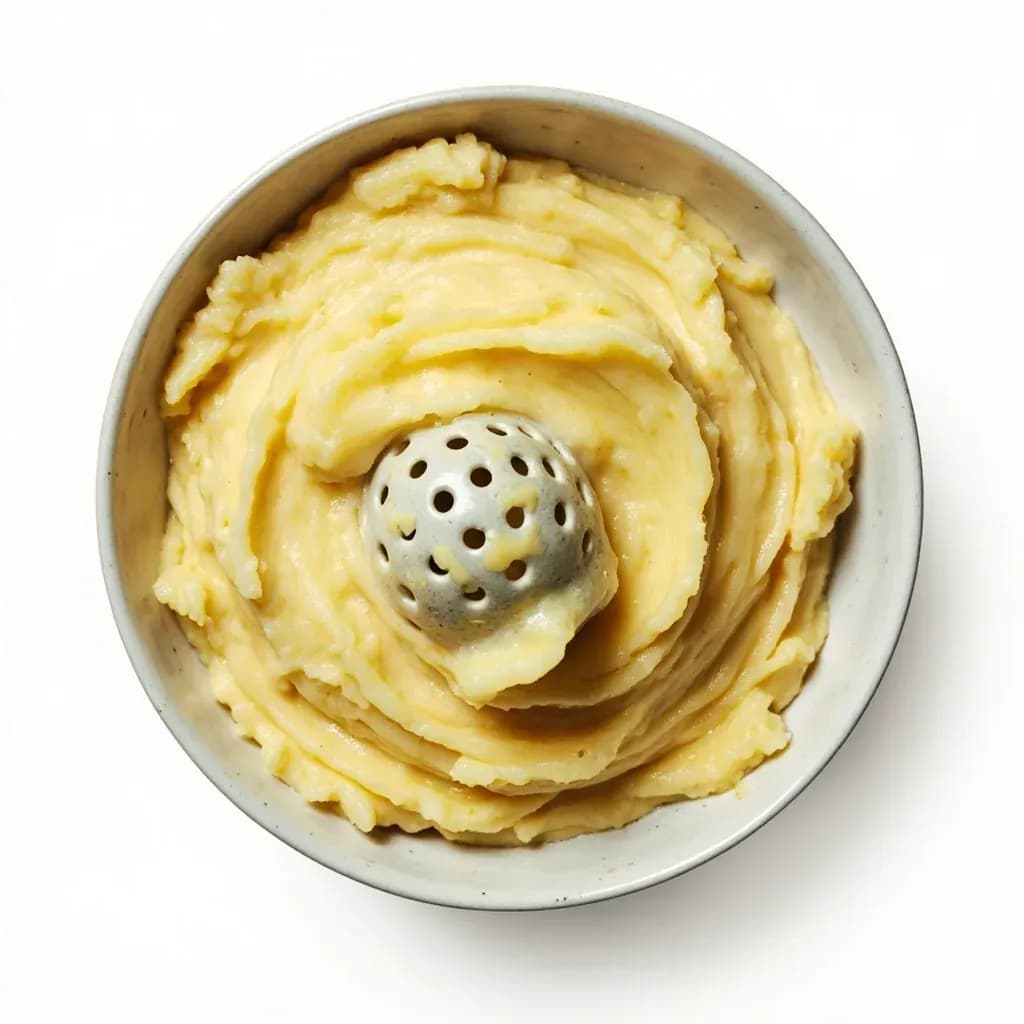
Mashing presses and crushes soft foods such as potatoes, plantains, taro, beans, or cooked greens into a coarse to smooth pulp using a masher, fork, or pestle. It is used for purées, bhartas, and dough bases across many cuisines. Working warm food and controlling how much you crush it sets the final texture, from rustic to silky.
Mashing is the mechanical reduction of already-soft food to a pulp by pressing, crushing, or forcing it with a tool — distinct from puréeing (which usually implies a fully smooth, often blended result), ricing (which pushes food through a perforated disc for an even finer texture), and whisking or whipping (which incorporates air for lightness). What sets mashing apart is the texture it targets: something between intact pieces and a fully homogenized purée, and the way it accomplishes it, through a downward, shearing press rather than a spinning blade. That distinction matters, because the texture of a finished dish often hinges on it. A properly mashed potato should taste of potato, not glue; a properly mashed avocado should be creamy but not pasty.
The technique's behavior is governed by the cellular structure of the food. A potato cell is a thin pectin wall around a starch granule; press too hard, work too long, or whip with a beater, and those granules rupture, releasing free starch that binds the mash into a viscous, cement-like mass. The same principle applies, more gently, to legumes (pectin from their skins shears into a gluey paste) and winter squash (whose cells break down faster than the cook expects). Understanding this is the difference between creamy mashed potatoes and the sad, wallpaper-paste version most home cooks have suffered through at least once.
Mashing is also one of the oldest kitchen tasks in the world — prehistoric cooks crushed cooked tubers and grains into porridges long before they had written recipes. The toolset has evolved from stone mortars to wire-loop mashers, ricers, food mills, and stand mixers, but the underlying idea has not changed: take something that is already tender and break it up to a texture that suits the dish.
- Difficulty
- Easy
Types & varieties
Hand tool, chunkiest result; good for guacamole, soft cheeses, and small batches of potatoes
Classic mashing tool; medium texture, fast, easy to overwork if pressed too hard
Forces food through small holes for the lightest, fluffiest texture with minimal cell damage; the restaurant standard for premium mashed potatoes
Hand-cranked auger with a perforated disc; simultaneously mashes and strains out skins and seeds; ideal for tomatoes, applesauce, and skin-on potatoes
Fast and hands-free but high risk of overworking potatoes into glue; use the lowest speed and stop early
Produces a very smooth purée; easy to over-process and release starch, especially in potatoes
Smoothest result in seconds; pulse briefly and never let it run continuously on potatoes or beans
Small-batch, flavor-forward results; traditional for spice pastes, garlic, and small quantities of beans or avocado
Used for banana mash, soft cooked plums, or seeding tomatoes
How to do it
- 1
Cook the food until tender
Simmer, steam, roast, or boil the food until a knife, skewer, or fork slides in with no resistance. Undercooked food will not yield a smooth mash and forces overworking later. Cut food into evenly sized pieces before cooking so everything softens at the same rate.
- 2
Drain and dry off the heat
Drain thoroughly (reserving a little cooking liquid for adjustment) and return the food to the empty pot. Place over low heat or off the heat for 1–2 minutes to evaporate surface moisture. Excess water is the most common cause of a watery, bland purée.
- 3
Warm the fat and liquid additions
In a separate small saucepan, bring milk, cream, broth, or butter just to a simmer. Hot liquid blends in smoothly; cold liquid chills the starch and makes the mash gluey.
- 4
Add fat first
Drop butter, olive oil, or cream cheese into the hot food and let it melt for 30 seconds. Fat coats the starch granules and gives a silky, rich mouthfeel before any liquid goes in.
- 5
Mash with the right tool
Use a folding, pressing motion rather than aggressive stirring. For potatoes, press straight down with a ricer or zigzag masher; for avocado, drag a fork through in short strokes; for beans, pulse briefly in a food processor rather than running it continuously.
- 6
Add liquid gradually
Pour in warm liquid a little at a time, mashing between additions, until you reach the desired consistency. You can always add more; you cannot take it out.
- 7
Stop at the right texture
Once the mash is mostly uniform with the texture you want, stop. The difference between creamy and gluey is often just 10–15 extra seconds of work.
- 8
Season and finish
Fold in salt, pepper, herbs, garlic, cheese, or acid to taste. Taste on a plain spoon — a properly seasoned mash should taste slightly over-seasoned on its own, because it is served alongside other food.
- 9
Serve or hold
Serve immediately for best texture. To hold for up to 30 minutes, transfer to a heatproof bowl, set over simmering water, dot with butter, and cover. Stir once before serving.
Choosing the right potato for the right mash
Variety matters as much as technique. A high-starch russet breaks down into a fluffy, almost powdery mash that is also the most fragile — it punishes overwork and turns gluey the moment you look at it sideways. Yukon Gold, with its moderate starch and buttery yellow flesh, gives a naturally creamy mash that forgives a little extra effort. Waxy red potatoes and fingerlings hold their shape, making them the right choice for a chunky, smashed-style mash where you want defined pieces. As a rule, the lower the starch content, the creamier and more forgiving the mash will be.
- Russet: high starch, fluffy, fragile — best for a ricer or very gentle hand work
- Yukon Gold: medium starch, naturally buttery, the most forgiving all-purpose choice
- Red Bliss or fingerling: low starch, waxy, holds shape — best for smashed or chunky mash
- Mix two varieties (half russet, half Yukon) for a balance of fluff and creaminess
Mashing around the world
Nearly every cuisine has a signature mash, and the local name usually tells you something about the technique or the additions.
- Champ (Ireland): mashed potatoes folded with chopped scallions, butter, and warm milk
- Colcannon (Ireland): mashed potatoes mixed with cabbage or kale and sometimes butter
- Rösti (Switzerland): par-cooked potatoes grated or chopped, then pan-fried to a crisp crust
- Puréed celeriac or parsnip (France): root vegetable mash, often finished with cream and nutmeg
- Aligot (France): potato mash stretched with melted Tomme cheese until elastic and stringy
- Smashed potatoes (American gastropub): boiled skin-on potatoes crushed with the bottom of a glass or a fork, then crisped in a hot pan with oil
Mashing vs. related techniques
A few adjacent verbs get used interchangeably, but they produce noticeably different results.
- Puréeing: aims for a completely smooth result, often with a blender or food processor; mashing accepts some texture
- Ricing: forces food through small holes for an even finer, lighter texture with less cell damage than mashing
- Whisking or whipping: incorporates air for a fluffy, voluminous result (think whipped potatoes) — opposite of the dense, gluey result of over-mashing
- Grinding: breaks down harder or drier foods (grains, spices, meat) that mashing cannot handle
- Smashing: a casual, high-texture cousin — cooked potatoes crushed with a glass or a fork, deliberately uneven
Common uses
Tips & pitfalls
- Salt the cooking water generously; seasoning from the inside matters more than surface salt sprinkled on at the end.
- Drain cooked food thoroughly and return it to the hot pot for 1–2 minutes off the heat — excess moisture is the most common cause of a watery mash.
- Warm milk, cream, or broth before adding; cold liquid cools the food and prevents fat from emulsifying smoothly.
- Add fat (butter, olive oil, cream) first and let it melt into the hot food before adding any liquid.
- For the smoothest, fluffiest potatoes, use a ricer — it shears cells without crushing them the way a beater or food processor does.
- Choose potato variety to match the result you want: Yukon Gold for creamy, russet for fluffy, red or fingerling for chunky.
- Stop mashing the moment you reach the texture you want; every extra stroke risks a gluey result.
- Season at the end with salt and an acid (buttermilk, sour cream, lemon juice, or vinegar) to brighten the flavor of an otherwise starchy dish.
- If using a stand mixer or hand beater on potatoes, stay on the lowest speed and stop the moment the mash is smooth — high-speed agitation ruptures starch granules faster than any other tool and turns the mash to glue.
- Hold finished mash covered over a bain-marie or in a low oven with a little cream on top to prevent a skin from forming.
Good to know
- Technique type
- Mechanical size-reduction; soft foods pressed or crushed to a pulp
- Difficulty
- Easy; minimal skill required, but easy to overwork
- Active time
- 3–8 minutes once the food is cooked
- Food state required
- Cooked and fork-tender, or naturally soft (ripe avocado, banana)
- Texture range
- Rustically chunky to completely smooth, depending on tool and effort
- Primary tools
- Fork, potato masher, ricer, food mill, stand mixer paddle, immersion blender, food processor, mortar and pestle
- Key scientific pitfall
- Overworking releases starch (potatoes) or shears pectin (legumes, squash), causing gluey or gummy texture
- Best for
- Starchy roots, legumes, ripe fruits, cooked vegetables, soft cheeses
- Origin
- Prehistoric; one of the oldest cooking methods, used for millennia to make porridges, purées, and pottages
Also called
Mash · Aixafar · Bharta · Smashing · Crushing
Dishes that rely on it
Related

Whisk
Beat ingredients smooth and aerated with a looping wire motion

Sift
Pass dry ingredients through mesh to aerate and remove lumps

Strain
Pour through mesh to separate solids from liquid for a smooth result

Filter
Pass liquid through fine material to clarify out the smallest particles

Rice
Press cooked potatoes through small holes for fluffy, lump-free texture

Mash
Crush soft cooked food into a rustic, creamy purée

Grind
Crush food into a coarse to fine texture, from spices to meat

Grate
Shred food into fine bits against a sharp-toothed surface