Transform & Preserve
Emulsifying
Forcing fat and water-based liquids into a smooth, stable blend that won't separate.
Emulsifying combines two normally unmixable liquids, typically oil and a water-based liquid, into a uniform suspension by vigorous agitation and often an emulsifier like egg yolk, mustard, or starch. It is how vinaigrettes, mayonnaise, aioli, and silky pasta sauces (mantecatura) achieve their creamy, cohesive texture. Adding the fat slowly while whisking constantly is key, because pouring too fast overwhelms the emulsifier and causes the mixture to break.
Emulsifying is the mechanical work of forcing two liquids that naturally repel each other — typically a fat and a water-based liquid — into a single, uniform mixture. In the kitchen this almost always means breaking oil into microscopic droplets and suspending them throughout a continuous water or acid phase, helped along by an emulsifier (a surfactant) that lowers surface tension and keeps the droplets from re-fusing. Without this technique, a vinaigrette pools, butter slides off a sauce, and hollandaise would simply be a pot of warm butter next to a pot of warm vinegar.
It is the unifying method behind an enormous family of sauces and dressings, from the raw simplicity of a mustard vinaigrette to the carefully cooked emulsion of a béarnaise spooned over grilled steak. The two variables that determine success are temperature — everything must be roughly room temperature to allow the emulsifier to do its job — and patience, meaning oil must be added slowly at the start until a 'mother emulsion' forms, after which the rest can stream in. Get those right and you can produce glossy, stable sauces that hold their shape on the plate; get them wrong and you end up with a greasy puddle.
Beyond sauces, emulsification is the technique that gives body to chilled soups, binds composed salads, and underlies modern foams and espumas. It is one of the few kitchen techniques where a small dose of food science — knowing that a broken sauce can almost always be rescued by re-dispersing it into a fresh yolk — separates confident cooks from frustrated ones.
- Difficulty
- Medium
Types & varieties
Holds only while agitated; separates on standing. Classic vinaigrette is the model.
Held together by a true emulsifier such as lecithin in egg yolk. Mayonnaise, hollandaise, béarnaise.
Oil droplets dispersed in a continuous water/acid phase. Mayonnaise, hollandaise, milk, cream.
Water droplets dispersed in a continuous fat phase. Butter and margarine are the classic culinary examples.
Egg yolk used as emulsifier but cooked gently over a bain-marie. Hollandaise, béarnaise, sabayon.
No heat applied; depends on fresh eggs or mustard for stability. Mayonnaise, aioli, mustard vinaigrette.
How to do it
- 1
Prepare and temper
Set out eggs, oil, and any dairy 30–60 minutes ahead so everything is at room temperature (around 20 °C / 68 °F). Cold ingredients are the single most common cause of a broken emulsion.
- 2
Build the base
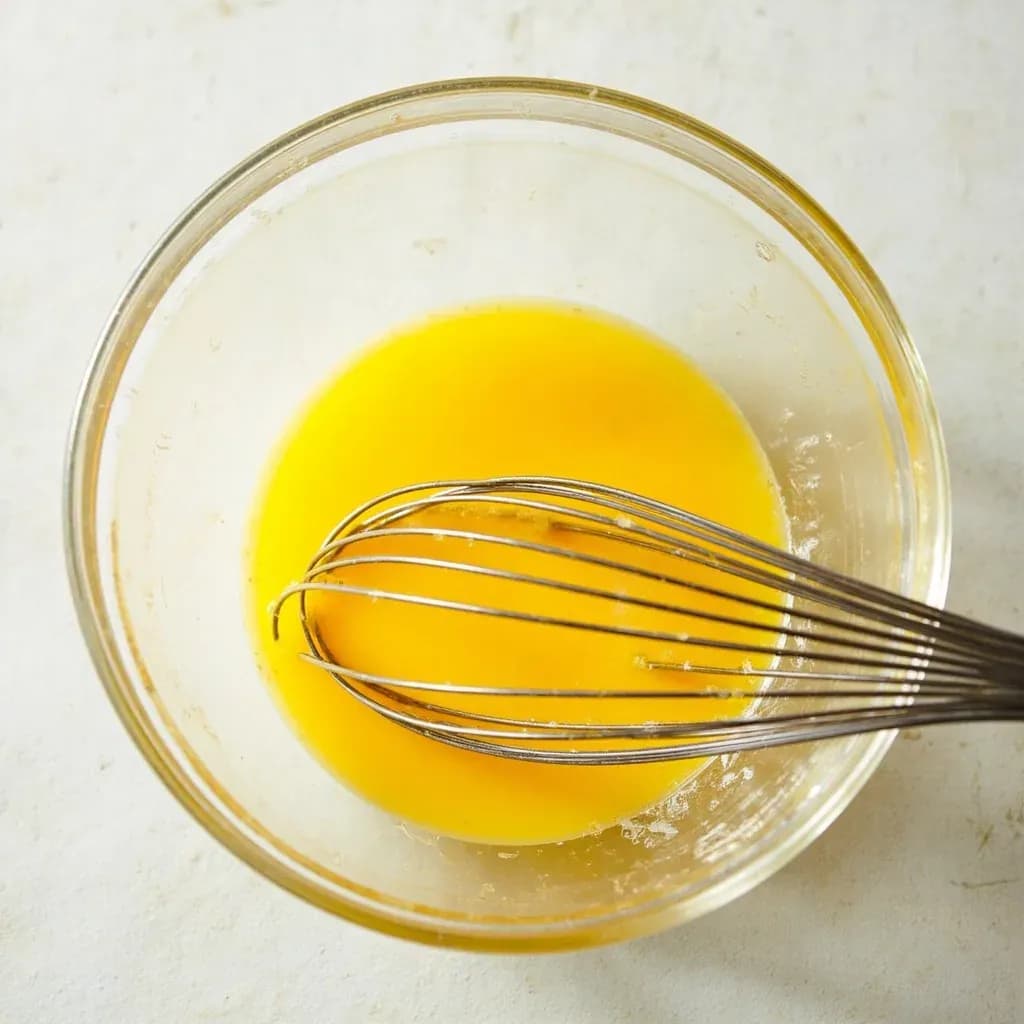
In a bowl, blender jug, or food processor combine 1 large egg yolk (or 1 whole egg for a thinner result), 1 tsp Dijon mustard, and 1 tbsp lemon juice or vinegar. Whisk or pulse until smooth.
- 3
Start the mother emulsion
With the whisk or machine running, add oil literally a drop at a time for the first 2–3 tablespoons. Wait until each drop is fully incorporated and the mixture looks thick and glossy before adding the next — this is the 'mother emulsion' that everything else builds on.
- 4
Stream in the remaining oil
Once the base is the texture of heavy cream, switch to a slow, thin, steady stream of oil. With a hand whisk this means drizzling; with a blender or processor, pour a continuous thin stream through the feed tube. Total oil for one yolk is about 200–250 ml.
- 5
Adjust seasoning and consistency
Season with salt, pepper, and more acid to taste. If too thick, whisk in a teaspoon of warm water; if too thin, beat in a little more oil.
- 6
Rescue a broken emulsion
If the mixture looks greasy or separated, stop adding oil. Clean the bowl, add a fresh yolk and a teaspoon of the acid, then drip the broken sauce into it while whisking — it almost always comes back.
- 7
Use or store
Use immediately, or cover and refrigerate up to 3 days (mayonnaise) or 1–2 hours (hollandaise, béarnaise). Bring cold mayonnaise back to room temperature and re-whisk before serving so the texture loosens.
The science in plain terms
Oil and water don't mix because their molecules have different polarities — the surface tension at the boundary between them acts like an invisible skin that pulls the droplets back together the moment mechanical agitation stops. An emulsifier is a molecule with one end that likes water and one end that likes fat; it sits at the boundary, lowers that surface tension, and physically keeps the droplets apart. Egg-yolk lecithin, mustard mucilage, garlic's allium mucilage, and the proteins in cream all do this job. The reason temperature matters is that cold fat is more viscous and the yolk proteins are less mobile, so the emulsifier can't reach the oil-water boundary quickly enough. The reason patience matters is that if you dump oil in too fast, the droplets are larger than the available emulsifier can coat, and they snap back together — the sauce 'breaks'.
How to tell a good emulsion
A well-built emulsion has three visible tells.
- It is glossy and homogeneous, with no oily sheen pooling on the surface.
- When you lift the whisk or spoon, the sauce falls in a thick ribbon that briefly holds its shape on the surface before sinking in.
- It does not weep oil on the plate even after sitting for several minutes at room temperature.
A short history
Emulsified sauces have medieval European roots — aioli and ajo blanco in Spain, sauces thickened with bread or almond in early French and Italian cookery. Mayonnaise as we know it is generally traced to 18th-century France, often linked to the 1756 capture of Mahón in Menorca, though similar sauces existed earlier under other names. Hollandaise emerged as a refinement of those butter-and-egg techniques and was codified as one of the five French mother sauces by Escoffier in the early 20th century.
Common uses
Tips & pitfalls
- Bring eggs, oil, and any dairy to room temperature before starting — cold fat is the #1 reason a mayo or hollandaise breaks.
- Add oil drop by drop at the start; once a tablespoon or two has built the 'mother emulsion' and thickened, the oil can stream in steadily.
- Whisk constantly and in the same direction; with a blender or food processor, run it the entire time the oil is pouring so no unmixed oil can pool.
- Use a deep, narrow bowl or a tall blender cup so the whisk or blade contacts the whole volume — wide, shallow bowls let the oil pool and break the emulsion.
- For mayonnaise, reach for a neutral oil (sunflower, canola, grapeseed) or a light olive oil; strongly flavoured extra-virgin olive oil can dominate the sauce and, in some cases, inhibit the emulsion.
- If the sauce breaks, don't throw it out: start a fresh yolk in a clean bowl with a teaspoon of acid, then drip the broken sauce into it a teaspoon at a time — it almost always recovers.
- Add acid (lemon, vinegar) at the start with the yolk and mustard; it flavours and helps stabilize, but adding it at the end can thin or break a finished emulsion.
- For hollandaise and béarnaise, keep the heat gentle (around 65 °C / 150 °F) — above 70 °C the yolk proteins curdle and the sauce breaks into scrambled eggs and butter.
Good to know
- Definition
- Mechanical dispersion of one liquid (usually oil) into microscopic droplets within another (water, vinegar, citrus juice) so they remain mixed instead of separating.
- Two stability classes
- Temporary emulsions (plain vinaigrette) separate within minutes; permanent/stable emulsions (mayonnaise, hollandaise) are held by an emulsifier such as egg-yolk lecithin or mustard mucilage.
- Phase identity
- Mayonnaise and hollandaise are oil-in-water emulsions despite being mostly fat — the water/acid phase is continuous and the oil is dispersed within it.
- Common emulsifiers
- Egg yolk (lecithin), whole egg, mustard, honey, garlic, tomato paste, puréed cooked potato or vegetables, and dairy proteins (cream, butter).
- Temperature rule
- All ingredients should be at roughly 20 °C / 68 °F. Cold yolks and cold oil are the most common cause of a broken emulsion.
- Oil addition
- Add oil drop by drop at first to build a 'mother emulsion'; once it has thickened to the texture of heavy cream, the oil can stream in steadily.
- Standard ratio
- Roughly 1 large egg yolk emulsifies 200–250 ml (about 1 cup) of oil plus 1 tbsp of acid; whole egg gives a thinner result.
- Mother sauce
- Hollandaise is one of the five French mother sauces and the only one built entirely on an emulsion.
Also called
Émulsionner · Mantecatura · Monter une Vinaigrette · Emulsionar
Dishes that rely on it
Related

Confit
Cook slowly submerged in fat for silky tenderness and keeping

Cure
Draw out moisture with salt and time to preserve and concentrate

Pickle
Steep in acidic brine for bright, tangy, crunchy preservation

Ferment
Let friendly microbes transform food into tangy, complex flavor

Marinate
Soak in a seasoned mix to flavor and tenderize before cooking

Brine
Soak in salt water so meat stays juicy and seasoned throughout

Dehydrate
Slowly dry out moisture to concentrate flavor and extend shelf life

Cold-Smoke
Perfume cured food with smoke without cooking it through