Prep & Assembly
Pounding Spice Paste (Mortar & Pestle)
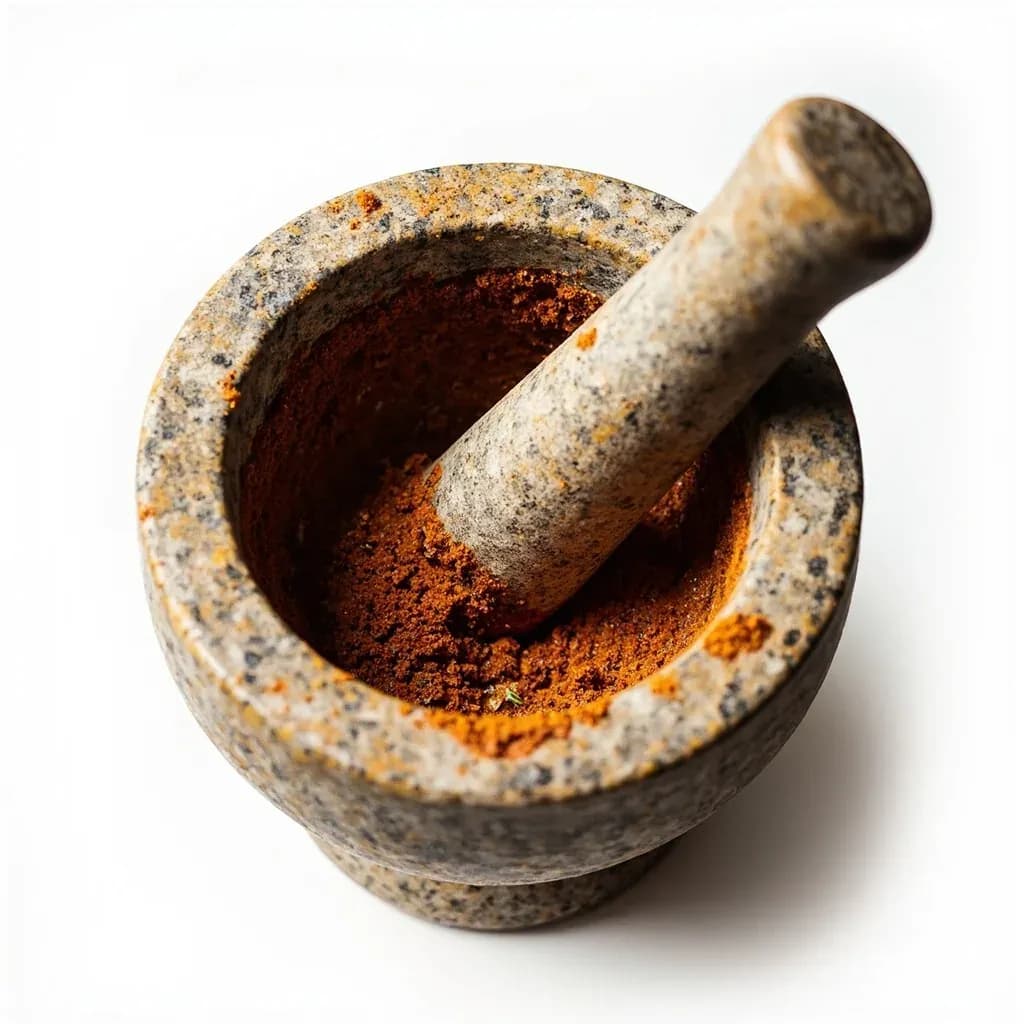
Crushing aromatics in a mortar and pestle into a fragrant paste that releases more flavor than blending.
Pounding spice paste uses a mortar and pestle to crush garlic, chilies, ginger, lemongrass, and spices into a smooth aromatic base. The bruising and grinding rupture cell walls more thoroughly than a blade, releasing oils and a deeper, rounder flavor that powers countless dishes. It is fundamental to Southeast Asian kroeung and rempah, Italian pesto, and Spanish picada alike.
Crushing aromatics in a mortar and pestle is a manual prep technique that turns whole spices, fresh herbs, garlic, chilies, and shallots into a fragrant, cohesive paste through repeated pressure and slow grinding. Unlike a blade, the pestle shears plant cell walls under load with almost no heat from friction and almost no air being mixed in. That matters because the volatile oils that give garlic its pungency, chilies their fruity heat, and lemongrass its citrus-floral lift are easily lost to oxidation and evaporation, and pounding preserves them in a way that blending, however convenient, cannot match.
A spice paste is built in stages: hard dry seeds and dried chilies go in first and are powdered, then fibrous aromatics like ginger, galangal, and lemongrass are shredded, then softer items like garlic and fresh chilies are crushed with a pinch of salt that doubles as an abrasive grit. Liquid — water, vinegar, or oil — is added last, a teaspoon at a time, to bring the mass to the texture the dish calls for. The result is coarser, more vividly colored, and noticeably more aromatic than its machine-processed counterpart, and the small extra effort pays off in any dish where the paste is the flavor backbone.
- Difficulty
- Medium
Types & varieties
Initial crushing of hard, dry items — peppercorns, coriander, cumin, cardamom, dried chilies — before any wet ingredient is added
Fresh aromatics with a splash of water, oil, or vinegar to form a slurry; the classic Indonesian and Malaysian bumbu and Thai paste method
Oil drizzled in gradually while pounding to build a thicker, spoonable texture; used in pestos, sofregit-style bases, and Moroccan chermoula
Deliberately textured with visible flecks of chili, garlic, and herb; common in Sichuan-style chili pastes and Thai nam prik
Mexican variant in a volcanic basalt mortar, traditionally seasoned with rice and garlic before first use; used for guacamole, moles, adobos, and salsas
How to do it
- 1
Prepare the ingredients
Peel and roughly chop garlic, shallots, ginger, galangal, lemongrass (tender inner part only, sliced crosswise), and fresh chilies into roughly ½ cm pieces. Keep whole spices, dried chilies, shrimp paste, candlenuts, and salt measured out separately in the order they will go in.
- 2
Grind the dry spices first
Add whole dry spices — peppercorns, coriander, cumin, cardamom, cloves — to the empty mortar. Press the pestle down and rotate firmly in small circles until you hear and feel the seeds crack, then continue 30–60 seconds until a coarse powder forms. Add dried chilies (toasted first if the recipe calls for it) and pound to a rough flake.
- 3
Add fibrous aromatics
Drop in lemongrass, galangal, ginger, and fresh turmeric if using. Use firm downward strikes combined with a grinding rotation; these items are tough and need the mechanical pressure more than abrasion. Stop when the fibers are shredded and the mass looks like damp sawdust.
- 4
Add soft aromatics with salt
Add garlic, shallots, and fresh chilies along with the coarse salt. The salt crystals tear cell walls and stop the pestle from skating on the slick surface. Pound with a slightly lighter pressure, in steady circles, until a chunky paste forms.
- 5
Add paste ingredients and nuts
If the recipe calls for shrimp paste (terasi or balacan) or candlenuts or macadamias, add them now. Pound to incorporate; these add body, salt, and emulsifying fats that thicken the paste.
- 6
Bind with liquid if needed
Add liquid a teaspoon at a time — water, vinegar, fish sauce, or oil — pounding continuously between additions, until the paste reaches the texture the recipe calls for: spreadable, scoopable, or thickly spoonable. For a pesto or chermoula, drizzle oil in a slow stream while pounding to emulsify.
- 7
Rest and scrape down
Stop pounding and let the paste sit 5 minutes so the essential oils can redistribute through the matrix. Scrape the sides and base with a spoon, fold the outer paste into the center, then give it 10–15 final grinding strokes to even the texture. Transfer to a bowl and rinse the mortar before residues harden.
Pounding vs. blending: what actually changes
A blade and a pestle both break plant tissue, but they do it in fundamentally different ways, and the differences show up in the finished paste. Reach for the mortar when flavor, aroma, and color are the priority; reach for the machine only when volume or speed is the priority.
- Heat: blade friction warms the bowl, especially on long runs, and cooked aromatics taste flatter; the pestle generates almost no heat.
- Air: a spinning blade whips oxygen into the mixture, oxidizing phenols and dulling the color of herbs and chilies; the pestle displaces air outward rather than folding it in.
- Texture: a blade homogenizes, producing a smooth, uniform purée; a pestle leaves a coarser, more variable grind that holds its structure in a finished dish.
- Flavor release: pounding shears cell walls and lets essential oils pool on the surface, so the paste smells stronger from the moment it is made.
- Batch size: a mortar is built for small aromatic charges, generally under about 100 g; for anything larger, a processor is faster and the trade-off in flavor is smaller.
Seasoning and caring for a stone mortar
New stone mortars, especially volcanic basalt molcajetes, have microscopic pores that can shed grit and absorb flavors on the first few uses. A short seasoning ritual fills those pores, neutralizes mineral taste, and gives the surface a smoother, more abrasive feel for grinding.
- Grind a handful of plain white rice in a dry mortar until the powder turns grey-white, then discard. Repeat with fresh rice until the powder comes out white.
- Follow with a paste of garlic and coarse salt; grind for two minutes, then discard and rinse with water only.
- Never wash porous stone with dish soap; the soap taints the pores and will flavor future batches. Rinse with hot water and scrub with a stiff brush.
- Air-dry the mortar upside down so water drains fully and the inside stays odor-free.
- Reserve a separate mortar for pungent items like garlic or shrimp paste if you also make sweet spice or nut pastes.
Common uses
Tips & pitfalls
- Start with the hardest, driest ingredients — whole seeds, peppercorns, dried chilies — and powder them before adding anything soft or wet.
- Cut garlic, shallots, and ginger into rough chunks before pounding; large pieces bruise the surface but never break down in the center.
- Sprinkle coarse salt at roughly 5–10% of the weight of the garlic and fresh chilies — the crystals act as an abrasive grit and stop the pestle from skating on slick surfaces.
- Combine a firm downward strike with a slow, grinding rotation; pure pounding without rotation leaves the center of the mortar untouched.
- Keep the pestle angled and work in a circular path from the outside in, then scrape the sides down toward the center with a spoon every 30–45 seconds.
- Add liquid sparingly, a teaspoon at a time, only after the solids are already broken down; liquid added early turns the mix into a slipping slurry that refuses to grind.
- Do not overload the mortar; work in two or three batches for anything more than roughly half full, or the ingredients will simply ride up the sides.
- Let the paste rest 5–10 minutes after pounding so the released essential oils can redistribute through the matrix and the flavor evens out.
Good to know
- Tool type
- Manual grinding and crushing technique using a heavy bowl-shaped mortar and a club-shaped pestle
- Origin
- Prehistoric; stone mortars are among humanity's oldest food-prep tools, with examples from Egyptian, Greek, Roman, Mesoamerican, and South/Southeast Asian archaeological sites
- Common mortar materials
- Granite, marble, volcanic basalt (molcajete), soapstone, heavy hardwood, brass-lined bronze, and glazed ceramic
- Typical batch time
- 3–10 minutes for a small handful (roughly 30–80 g) of aromatics
- Yield
- About 60–70% of starting weight once fibrous liquids are expressed; varies with ingredient moisture
- Storage
- Up to 1 week refrigerated in a sealed jar under a thin oil film; up to 3 months frozen in ice-cube trays
- Key flavor effect
- Shears cell walls under pressure with minimal heat or air, preserving volatile aromatic oils and limiting oxidation and browning
Also called
Pounding · Mortar and Pestle · Making Spice Paste · Rempah · Kroeung · Picada
Dishes that rely on it
Related

Whisk
Beat ingredients smooth and aerated with a looping wire motion

Sift
Pass dry ingredients through mesh to aerate and remove lumps

Strain
Pour through mesh to separate solids from liquid for a smooth result

Filter
Pass liquid through fine material to clarify out the smallest particles

Rice
Press cooked potatoes through small holes for fluffy, lump-free texture

Mash
Crush soft cooked food into a rustic, creamy purée

Grind
Crush food into a coarse to fine texture, from spices to meat

Grate
Shred food into fine bits against a sharp-toothed surface