Heat & Fire
Building an Aromatic Base
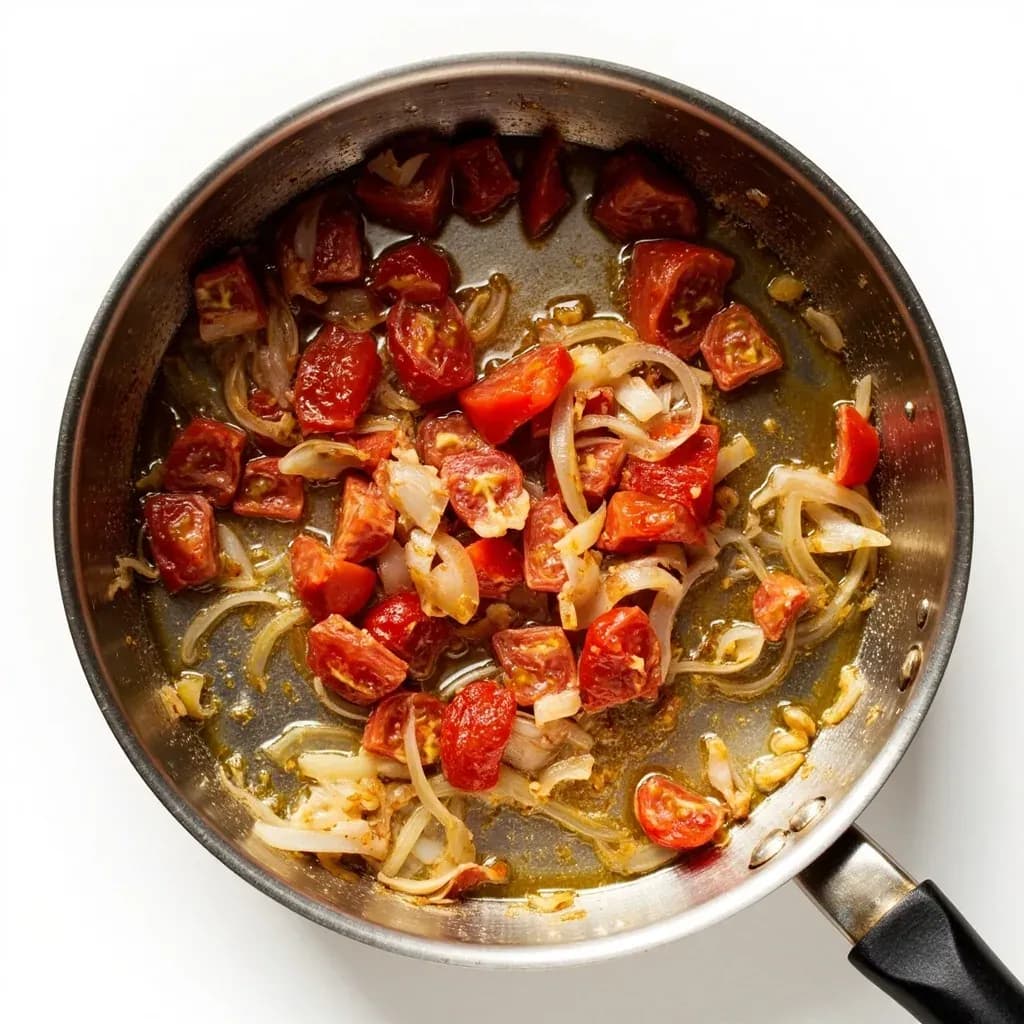
Gently frying aromatics like onion, garlic, and tomato in fat to lay a deep flavor foundation.
Building an aromatic base cooks foundational vegetables and spices in fat to release and meld their flavors before other ingredients go in. It takes many forms: French mirepoix, a garlic-onion-tomato sofrito, or the high-heat aromatic frying of Chinese bao xiang. This step builds the savory backbone that defines stews, sauces, and braises. Patience here lets sugars caramelize and harshness cook off.
An aromatic base is the foundational flavor layer of nearly every long-cooked savory dish. It is built by gently cooking chopped onion, carrot, celery, garlic, and other aromatics in a little fat before any liquid is added, coaxing sweetness and depth out of vegetables that would taste harsh or raw if dropped straight into a broth or sauce. The technique is less about a single recipe than about a principle: low, even heat, enough fat to conduct that heat, uniform cuts so everything softens at the same rate, and patience. Get those four things right and the rest of the cook — the braise, the stew, the soup, the pilaf — assembles itself on top of a foundation that already tastes finished.
What the base actually does is two things at once. It extracts water-soluble sugars and flavor compounds from the vegetables and dissolves fat-soluble ones into the cooking fat, producing a mixture that carries both. As the aromatics soften they also release moisture, which cools the pan and prevents scorching, then slowly reduces back into a glossy, concentrated layer. That layer — and the browned bits, or fond, clinging to the pan — is what gives a finished dish the impression of having been cooked for hours even when the protein went in ten minutes ago.
Across cuisines the base wears different names and uses slightly different ingredients, but the underlying skill is identical. Mirepoix in France, soffritto in Italy, sofrito in Spain and Latin America, the Cajun holy trinity, and the Portuguese refogado all share the same gentle sweating principle. The South Asian tadka is a related but distinct technique: whole or ground spices are bloomed in hot ghee or oil, usually at higher temperatures and typically as a finishing step poured over a dish rather than a built foundation. Once a cook understands these principles, swapping the vegetables, fat, and final seasonings becomes a matter of geography rather than a new technique.
- Difficulty
- Medium
Types & varieties
The French onion, carrot, and celery base in a 2:1:1 ratio; the opening of stocks, soups, braises, and mother sauces.
Onion, celery root or parsnip, leek, and sometimes mushroom, with no carrot; used for pale stocks, veloutés, and cream sauces where orange color is unwanted.
The Italian cooked form of battuto, traditionally onion, carrot, and celery finely diced and gently sweated in olive oil, often with pancetta.
Spanish and Latin American slow-cooked base of onion, garlic, and bell pepper or tomato in olive oil; Caribbean versions add cilantro, culantro, recao, and annatto.
The Cajun and Creole base of onion, celery, and green bell pepper in roughly equal parts; foundation of gumbo, jambalaya, and étouffée.
Portuguese and Brazilian sauté of onion and garlic in olive oil, often with tomato, bay leaf, and cilantro.
South Asian technique of blooming whole or ground spices briefly in hot ghee or oil, usually as a finishing step poured over a dish.
Ginger and scallion gently fried in neutral oil; foundation for steamed fish, congee, and many Cantonese braises.
Onion and garlic sautéed in lard or oil, often with serrano or jalapeño, with tomato added once the onion is translucent to form a guisado-style start.
How to do it
- 1
Choose the fat
Match the fat to the cuisine: olive oil for Mediterranean bases, butter or a butter–oil blend for French mother sauces, ghee for South Asian, lard or bacon fat for Cajun and Mexican, neutral oil for delicate Asian bases. Use enough to coat the bottom of the pan about 2–3 mm deep — the vegetables should sit in fat, not on a dry surface.
- 2
Heat the pan and fat
Place a heavy-bottomed pan over medium heat (medium-low for butter) and warm the fat until it shimmers and just begins to ripple. A piece of onion should sizzle gently on contact, not snap or sit silent.
- 3
Add the long-cooking aromatics
Add onion, carrot, celery, leek, fennel, or bell pepper in an even layer. Stir to coat in fat, season with a pinch of salt, and spread back into an even layer. The salt draws out moisture and gently drops the pan temperature.
- 4
Sweat gently
Cook, stirring occasionally, for 6–10 minutes until the vegetables soften, turn translucent, and release their moisture. Lower the heat if the edges begin to color too quickly; add a splash of water if the pan dries out before softening is complete.
- 5
Optional: develop color
For deeper sweetness and a more rounded base, continue cooking 10–20 minutes, stirring more frequently, until the vegetables turn pale gold. The base should smell sweet, not sharp or burnt.
- 6
Add garlic, ginger, chilies, and dried spices
Stir in minced garlic, ginger, fresh chilies, and any dried ground or whole spices. Cook 30–90 seconds, just until fragrant — these burn fast and should not be left unattended.
- 7
Add tomato or paste if using
Stir in diced fresh tomato, tomato paste, or both. Cook 2–5 minutes, stirring and pressing, until the tomato deepens in color and loses its raw edge. Tomato paste should turn from bright red to brick-red.
- 8
Deglaze
Pour in wine, stock, or water (about 1/4 to 1/2 cup) and scrape the bottom of the pan with a wooden spoon to dissolve the fond. Let the liquid reduce by about half so the base is no longer watery before adding the main cooking liquid.
- 9
Proceed with the recipe
Add the remaining liquid, main ingredient, and any long-cooking herbs and spices. The base is now ready to support braises, stews, soups, sauces, grains, or beans.
Why uniform cuts matter more than size
The single most common failure of an aromatic base is uneven cooking — some pieces scorched while others are still raw. The cause is almost always inconsistent cutting. A brunoise of carrot next to a ragged half-inch chop of onion will release water at different rates, brown at different rates, and finish at different times. The fix is not a specific knife skill but a habit: settle on one size per dish and apply it across every aromatic. For refined sauces and veloutés, a small, even dice (around 5 mm) is traditional; for rustic braises and long stocks, a larger 1.5–2 cm dice is fine. What matters is that every piece in the pan is the same.
- Brunoise (about 3–5 mm) for cream sauces, veloutés, and refined braises.
- Macédoine (1–1.5 cm) for soups, stews, and most everyday cooking.
- Large rough chop (3–4 cm) for stocks that will be strained out.
Layering aromatics by cooking time
Not all aromatics belong in the pan at the same moment. Sturdy, high-moisture vegetables — onion, carrot, celery, leek, fennel, bell pepper — need several minutes to soften and sweeten. Concentrated aromatics — garlic, ginger, fresh chilies, dried ground spices — burn in under a minute once the fat is hot. The base is built in layers: the long-cooking vegetables go in first and sweat until translucent, the delicate aromatics go in for the last 30–90 seconds, and tomato or paste is cooked down in between. Skipping this order is the most common cause of bitter, sharp-tasting bases.
- First wave: onion, carrot, celery, leek, fennel, bell pepper, dried bay, thyme stems.
- Second wave: dried ground spices, dried chilies, tomato paste, minced pancetta.
- Final wave: garlic, ginger, fresh chilies, fresh tomato — added in the last 1–2 minutes.
Common uses
Tips & pitfalls
- Dice uniformly: mismatched pieces leave some raw and some scorched in the same pan.
- Salt the aromatics early. A pinch of salt draws out moisture, gently cools the pan, and seasons the base from the inside out.
- Mind the order of addition. Onion, carrot, celery, leek, and fennel need more time than garlic, ginger, and fresh chilies; add the quick-cookers in the last 1–2 minutes to avoid burning.
- Keep heat moderate. Aromatics should glisten and soften, not sizzle aggressively; high heat scorches sugars and turns the base bitter.
- Use enough fat. Fat conducts heat and carries fat-soluble flavor compounds; a dry pan steams rather than sautés.
- Do not crowd the pan. If vegetables pile up and release too much liquid, they will steam and turn gray; work in batches or use a wider pan.
- Toast tomato paste into the base. Cooking 1–2 tablespoons of paste until it turns brick-red adds umami and a deeper backbone to braises and chilis.
- Do not throw away the fond. The browned bits clinging to the pan are concentrated flavor; deglaze with wine, stock, or even water before moving on.
Good to know
- Also known as
- Mirepoix (French), soffritto (Italian), sofrito (Spanish and Latin American), holy trinity (Cajun and Creole), refogado (Portuguese and Brazilian), battuto (Italian, the raw cut), tadka or chaunk (South Asian).
- Core purpose
- To coax sweetness and depth from vegetables and aromatics through gentle, even cooking in fat before liquids or main ingredients are introduced.
- Typical fat choices
- Olive oil, butter, ghee, neutral oil, lard, bacon or pancetta fat, schmaltz, coconut oil — chosen to complement the cuisine.
- Heat level
- Low to medium; the pan should sizzle gently, never so hot that aromatics brown before softening through.
- Typical cook time
- 5–10 minutes for a quick sweat of soft aromatics; 20–40 minutes for a deeper, lightly caramelized base.
- French mirepoix ratio
- 2 parts onion to 1 part carrot to 1 part celery, by weight.
- Cajun holy trinity ratio
- Roughly equal parts onion, celery, and green bell pepper, by volume.
- Skill level
- Beginner; the first technique taught before sautéing, braising, sauce-making, and stewing.
Also called
Aromatic Base (Garlic-Onion-Tomato) · Frying Aromatics (爆香) · Making Mirepoix · Frying Aromatics · Sofrito
Dishes that rely on it
Related

Sear
Blast the surface hot for a deep-browned, savory crust

Sauté
Cook quickly in a little fat over lively heat, tossing as you go

Stir-Fry
Toss bite-sized pieces over roaring heat for fast, smoky cooking

Pan-Fry
Crisp food in a shallow layer of hot fat, turning once or twice

Deep-Fry
Submerge in hot oil for an all-over crackling crust

Roast
Cook uncovered in dry oven heat for browned edges and tender centers

Bake
Cook with steady, surrounding oven heat — the soul of bread and pastry

Broil
Hit food from directly above with fierce overhead heat