Water & Steam
Etouffee / Smothering
Slow-cooking food, often covered, in a small amount of liquid and aromatics until tender and richly sauced.
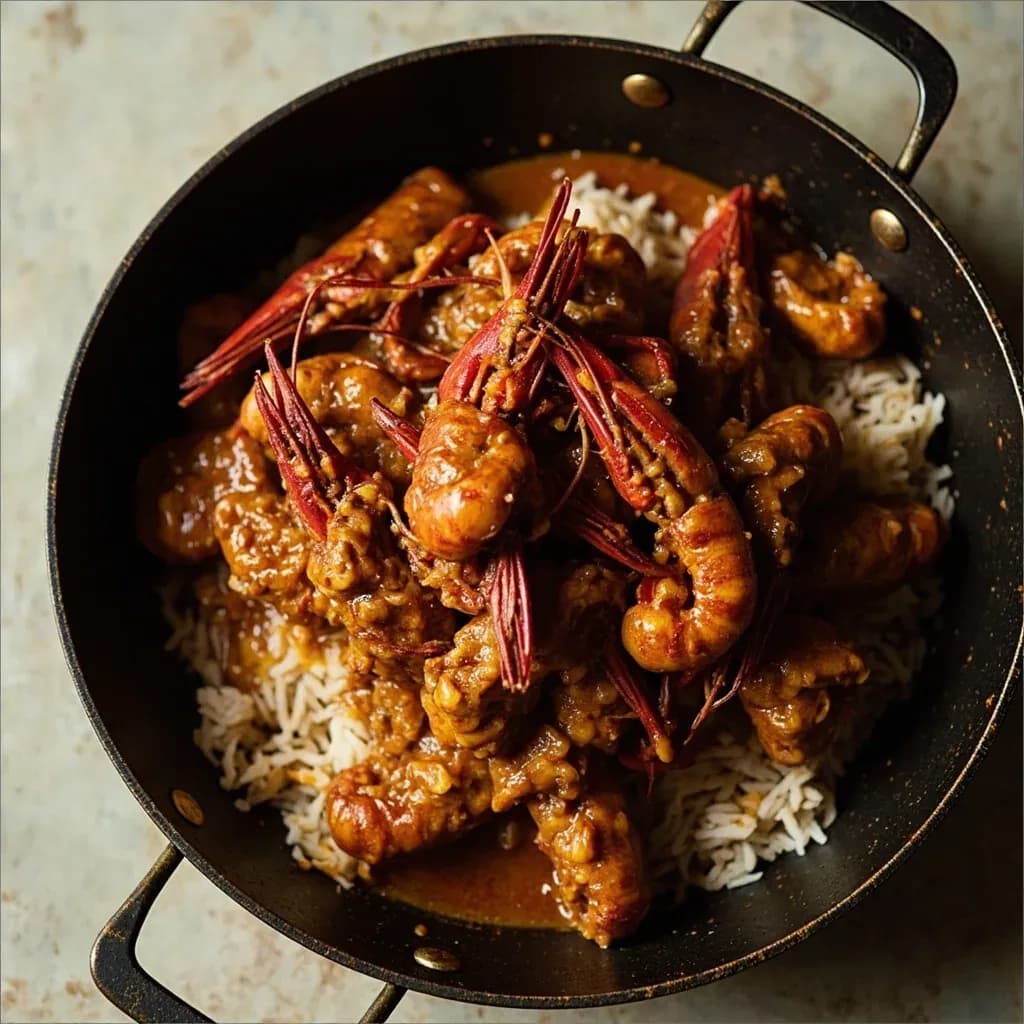
Etouffee, French for smothered, cooks meat or shellfish gently in a thick, roux-based sauce of aromatics and a little liquid, usually with the lid on. The closed, low simmer traps moisture so the food braises in its own juices and the holy trinity of onion, celery, and bell pepper. It is a cornerstone of Cajun and Creole cooking, classically served over rice.
Étouffée — literally "smothered" in French — is the technique of cooking food in a shallow bath of seasoned liquid under a tight lid, low and slow, until the food is tender and the liquid has reduced into a glossy, concentrated sauce. Unlike a braise, which uses enough liquid to partially submerge the food and often finishes uncovered for a deeper reduction, étouffée keeps the liquid barely reaching the food and relies on the closed lid to trap steam. That trapped moisture is what gently cooks delicate proteins like crawfish and shrimp without toughening them, while simultaneously basting the aromatics underneath.
What makes the technique worth learning is the one-pot economy: the protein seasons the sauce as it cooks, and the sauce braises the protein. There is no separate gravy step, no second pan, and almost nothing wasted. The flavor of the finished dish is built in layers — a fond from searing, a soft bed of aromatics, sometimes a blond or peanut-butter roux, and a stock or wine that reduces into something much bigger than its starting volume. The cook's main job is restraint: shallow liquid, low heat, a tight lid, and patience.
The same underlying method wears different names depending on where you stand. In Louisiana it is étouffée, almost always served over rice and built on the holy trinity of onion, celery, and bell pepper. Across the broader American South the same approach is called smothering, and you'll see it applied to pork chops, chicken, steak, and vegetables served with grits, potatoes, or cornbread. In classical French cuisine it shows up as à l'étouffée — rabbit, quail, or veal cooked gently with mirepoix and an herb bundle, sitting in the same family as fricassée and shallow braising.
- Difficulty
- Medium
Types & varieties
The iconic Cajun version from the Breaux Bridge tradition; Louisiana crawfish tails in a butter-and-roux sauce with the holy trinity, served over rice.
Coastal Cajun variant using shrimp; cooks fast and is the everyday substitute when crawfish are out of season.
Less common; uses lump or claw crabmeat added off heat so the texture stays intact.
Creole-leaning and Southern home-style; bone-in thighs or a cut-up bird simmered with onion, celery, and bell pepper.
Southern U.S. classic — bone-in chops cooked with onions, sometimes bell pepper, in a thin pan gravy.
Cube steak or top round braised with onions and a flour-thickened pan gravy.
Lowcountry and Creole vegetable étouffée using okra, tomatoes, or sturdy greens cooked down to a spoonable side.
Classical application to rabbit, quail, or veal with mirepoix, white wine, and a bouquet garni.
How to do it
- 1
Choose the protein and cut
Pick a cut that benefits from gentle moist heat: bone-in chicken thighs, pork shoulder chops, chuck cubes, whole quail, or, for Cajun étouffée, peeled crawfish tails or shrimp. Pat dry and season with salt and, optionally, cayenne, paprika, and black pepper.
- 2
Make the base — aromatics and (optional) roux
In a heavy Dutch oven over medium-low heat, sweat diced onion, celery, and bell pepper in butter or oil until soft and translucent, 8–10 minutes. For a richer étouffée, start with a medium roux: melt equal parts butter and flour and stir over medium heat until peanut-butter colored, then add the trinity and stir to coat.
- 3
Build depth
Add minced garlic, thyme, and a bay leaf; cook 30–60 seconds until fragrant. Optional at this stage: a spoonful of tomato paste, a splash of Worcestershire or hot sauce, a pour of dry white wine or sherry — let any alcohol cook off before moving on.
- 4
Add the liquid
Pour in warm stock (seafood, chicken, or veal) just to barely cover the food or come about halfway up. For crawfish or shrimp étouffée, a light shellfish stock is traditional. The volume should look like too little — it will reduce.
- 5
Sear and add the protein
For meats, sear them first in a hot pan to develop fond, then nestle them into the aromatic base. For shellfish, add them raw and let them poach in the sauce; they will release their own liquor.
- 6
Cover and smother
Bring to a bare simmer, cover with a tight lid, and drop the heat to low. The pot should barely tick — a bubble every few seconds, not a rolling boil. Cook 30–45 minutes for chicken thighs or pork chops, 45–60 minutes for tougher cuts, 5–10 minutes for shrimp, 8–12 minutes for crawfish.
- 7
Adjust and reduce the sauce
Uncover, lift out the protein, and simmer the liquid until it coats the back of a spoon. Skim excess fat. Taste for salt, acid (a squeeze of lemon or splash of vinegar brightens shellfish étouffée), and heat.
- 8
Finish and serve
Return the protein to the sauce to warm through. Off the heat, swirl in a tablespoon of cold butter for gloss. Ladle over steamed white rice for étouffée, or alongside grits, mashed potatoes, or crusty bread for smothered meats. Garnish with chopped green onion and flat-leaf parsley.
Étouffée vs. Smothering vs. Braising
These three techniques get tangled in conversation, but they sit on a spectrum of liquid depth, lid time, and finishing style. A braise uses enough liquid to come roughly halfway up the food, often finishes uncovered to reduce a deeper, stew-like sauce, and is built for tough cuts over a long cook. Étouffée uses less liquid — the food sits on or just barely in the aromatics and steams under a tight lid — and finishes in a tighter, glossier sauce in a fraction of the time. Smothering is essentially the Southern English-language name for étouffée, but in practice it leans on a flour-thickened pan gravy built from pan drippings rather than a long-cooked roux, and the protein is typically served over grits, mashed potatoes, or rice. Same physics, different vocabulary and finishing fat.
Building the Aromatic Foundation
The flavor of every étouffée and smothered dish rests on its aromatic base, and how you build it determines everything that follows.
- In Louisiana, the base is the holy trinity — onion, celery, and green bell pepper in roughly equal parts — sweated slowly in butter until soft and translucent, 8–10 minutes. Garlic and thyme go in just before the liquid so they don't scorch.
- In classical French cooking, the base is a mirepoix (onion, carrot, celery) cooked in butter with a bouquet garni; leek sometimes joins for white meats and rabbit.
- For Southern smothered meats, the base is often just a heavy hand of sliced onions, sometimes with bell pepper, cooked in the rendered fat or oil until jammy and sweet.
- Whichever base you use, cook the vegetables slowly to draw out their sweetness. Cajun and French versions stop at a translucent sweat; Southern smothered dishes often push further to soft, lightly caramelized, jammy onions.
Common uses
Tips & pitfalls
- Use a heavy Dutch oven or braiser with a tight lid — the lid is doing half the work by trapping steam.
- Sear the protein first; the fond on the pot bottom is the foundation of the finished sauce.
- Keep the liquid shallow. If the pot is boiling hard, you've added too much liquid or the heat is too high.
- For Cajun étouffée, build a medium-brown (peanut-butter-colored) roux before adding the holy trinity — it is the flavor backbone.
- Add delicate seafood in the last 5–10 minutes only; it finishes in the residual heat and stays tender.
- Skim surface fat before reducing, then swirl in cold butter off heat for a glossy finish (monter au beurre).
- Season in layers — salt the protein, season the aromatics as they sweat, taste the sauce before the final simmer.
- Rest the dish off heat for a few minutes before serving so the sauce tightens and the protein relaxes.
Good to know
- Origin
- French technique (étouffer = "to smother"); refined in Louisiana Cajun and Creole cooking
- Heat method
- Moist heat, low and slow, almost always covered
- Liquid level
- Shallow — barely reaches or partially covers the food; never fully submerged
- Core ratio
- Roughly 1 cup liquid to 1–1.5 lb protein or vegetables
- Typical vessel
- Heavy Dutch oven or wide braiser with a tight lid
- Cooking time
- 5–10 minutes for delicate seafood up to 2–3 hours for tough cuts or whole poultry
- Sauce result
- Liquid reduces into a glossy, concentrated pan sauce, often finished with butter
- Signature aromatics
- Onion, celery, bell pepper (the "holy trinity"), garlic, and thyme in Cajun/Creole versions
Also called
smothering · etouffee · Smothered Cooking
Related

Boil
Cook in vigorously bubbling liquid at full rolling heat

Simmer
Hold liquid at a gentle shimmer for tender, unhurried cooking

Poach
Cook gently in barely-trembling liquid for silky, tender results

Steam
Cook in rising vapor to keep color, nutrients, and shape intact

Blanch
Plunge briefly in boiling water, then shock cold to lock color

Braise
Sear, then cook slow in a little liquid until fall-apart tender

Stew
Simmer bite-sized pieces fully submerged into a rich, unified pot

Sous-Vide
Seal and cook in precise warm water for edge-to-edge doneness