Prep & Assembly
Building a Bouquet Garni
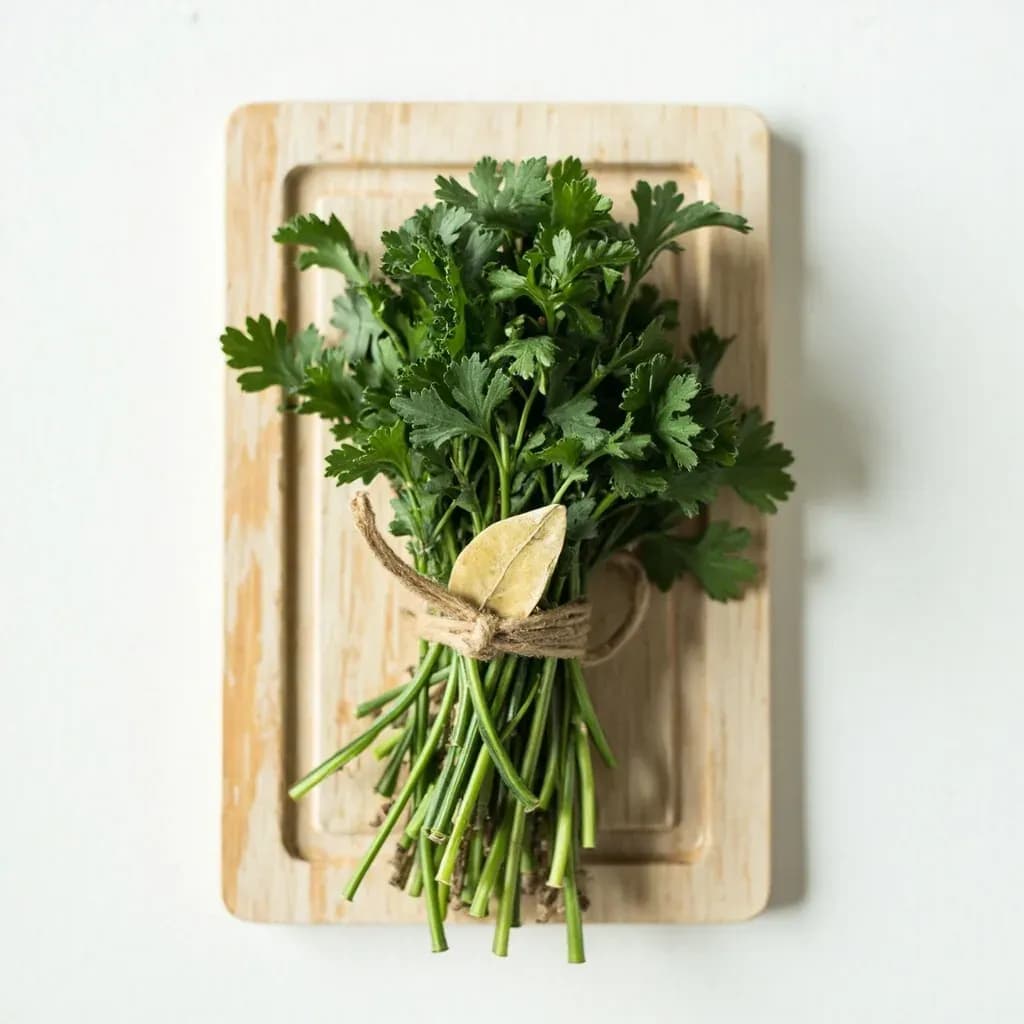
Tying herbs into a bundle to flavor stocks and stews, then lift out cleanly when done.
A bouquet garni bundles aromatic herbs like thyme, parsley stems, and bay leaf, often tied with string or wrapped in leek, to season simmering liquids. Its close cousin, the sachet d'epices, encloses herbs and spices in cheesecloth. The bundle infuses stocks, soups, and braises with flavor and is removed whole before serving. Keeping the herbs contained means no loose leaves to strain out later.
A bouquet garni is the classical French answer to a problem every cook faces: how to infuse a long-simmering liquid with herbal flavor without leaving loose bay-leaf shards, thyme leaflets, or grit floating through the finished dish. The bundle — typically bay leaf, fresh thyme, and flat-leaf parsley stems tied into a single parcel — goes into the pot at the start of cooking and gets lifted out whole before service. What you get is layered, even seasoning with none of the cleanup headache of fishing through a finished consommé with a spoon.
The defining virtue of the bouquet garni is behavior over time. The herbs release their essential oils gradually as heat coaxes them out, then the bundle is simply retrieved by its trailing twine. This makes it ideal for stocks that bubble for hours and for delicate court bouillons that need only twenty minutes of contact. Because the parsley stems, thyme sprigs, and bay leaves are physically contained, the cook can control exactly how much herbal character enters the pot — add another bundle for a bigger batch, pull it early for a lighter hand.
The technique rewards small habits: bruised thyme, herbs that have been rinsed and patted dry, untreated cotton twine, and a tail long enough to grab without breaking the simmer. Once you've built a few, the bundle becomes a reflex — dropped into any braise, soup, or bean pot the way salt goes into pasta water.
- Difficulty
- Easy
Types & varieties
Bay leaf, thyme, and parsley stems — the standard workhorse for stocks, braises, and soups.
Adds rosemary and savory, occasionally orange peel or fennel fronds; common in southern French cooking.
Herbs and whole spices (peppercorns, cloves, allspice, coriander) tied in a cheesecloth pouch; preferred for clear consommés and court bouillon.
Bundle is sheathed in blanched leek greens instead of twine; keeps herbs contained through long bean cooks.
Same idea as leek-wrapped; used when celery is already in the dish and the leaves would otherwise go to waste.
Parsley, thyme, and bay plus cracked peppercorns and sometimes a slice of lemon — built for poaching fish and seafood.
How to do it
- 1
Select the herbs
Gather 1–2 fresh bay leaves, 4–6 sprigs of fresh thyme, and a generous handful of flat-leaf parsley stems (8–10). Rinse briefly and pat dry. Skip any herb that is yellowed, blackened, or past its prime; a stale bay leaf will drag a whole pot down with it.
- 2
Bruise the thyme
Lay the thyme sprigs on the cutting board and press the flat of a knife against them with a firm tap of your palm. This cracks the stems and leaf surfaces so the essential oils escape more readily during simmering.
- 3
Layer the bundle
Lay the parsley stems parallel as a base, all pointing the same direction. Set the bay leaves on top of the parsley, then arrange the thyme sprigs across the parsley crosswise. Layering this way prevents the stiff bay leaf edges from poking out through gaps in the twine.
- 4
Tie with cotton twine
Wrap untreated cotton kitchen twine around the herbs three or four times and knot securely. Leave a tail of 6–8 inches — long enough to drape over the edge of the pot or to grab with tongs without breaking the simmer. Trim any excessively long herb ends.
- 5
Choose an enclosure for the job
Use the tied bundle as-is for stocks, braises, and bean pots. For consommés, aspics, or any liquid that must come out crystal clear, wrap the same herbs in a double layer of cheesecloth and tie into a tight pouch (a sachet d'épices); tuck in whole peppercorns, cloves, or allspice at this stage. For very long bean cooks, sheath the bundle in a washed, blanched leek green and tie both ends.
- 6
Add at the right moment
Drop the bouquet into cold or warm liquid at the start of a stock, braise, or bean pot so its flavors build slowly. For delicate sauces, court bouillon, and fish dishes, add it only in the last 20–30 minutes of cooking — longer contact turns the herbal notes grassy and overpowering.
- 7
Simmer and monitor
Cook as the recipe directs, keeping the bundle fully submerged. If herbs start to escape — bay leaves are the usual escapees — tighten the twine or wrap a second loop. The bundle should look intact, not unraveling.
- 8
Remove before serving
Lift the bundle out by the trailing twine, or fish it out with a slotted spoon. Press it gently against the inside of the pot to drip out absorbed liquid without squeezing grit from the herb interiors into the finished dish. Discard the used bundle — it has given all it has.
Regional and practical variations
Regional French kitchens adjust the herb ratio to suit local ingredients and the cook's hand. Provençal cooks almost always add a short sprig of rosemary and a few leaves of savory; Normandy kitchens tend to omit both. The unifying rule is that bay, thyme, and parsley form the backbone, while everything else is a regional accent. A second practical axis is enclosure. Tied bundles suit stocks, braises, and bean pots where small fragments won't matter. Cheesecloth sachets are mandatory for consommés and aspics where clarity is non-negotiable, and they also allow whole spices — peppercorns, cloves, allspice, coriander seed — to ride along without escaping into the liquid. Leek-green and celery-leaf sheaths are kitchen-garden improvisations that turn trim into structure: the bundle stays intact even after hours of simmering, and the outer leaf adds its own mild allium or celery flavor.
How herbs behave in long cooking
The three core herbs do not release flavor at the same rate, and a thoughtful builder uses that to advantage. Parsley stems contribute a clean, grassy note early and recede as the simmer lengthens; they round out the first hour of a stock. Thyme holds its middle position, giving steady herbal warmth throughout a long simmer. Bay leaf is the slow player — its volatile oils emerge over hours and anchor the finish. Resinous herbs like rosemary, sage, and savory behave differently: their essential oils intensify rather than dissipate, so a sprig added at the start of a three-hour braise can taste sharp and medicinal by the end. The standard remedy is to add resinous herbs in the final twenty or thirty minutes, or to use a single short sprig so the dose stays modest. Bruising the thyme against a knife blade before bundling accelerates its release and evens out the infusion.
Common uses
Tips & pitfalls
- Use parsley stems rather than leaves alone; the stems carry as much or more flavor and cost nothing — a built-in kitchen economy.
- Always tie with untreated cotton kitchen twine. Synthetic string can melt at simmer temperatures, shed fibers into the liquid, or off-gas an unpleasant chemical note.
- Go easy on rosemary, sage, and other resinous herbs. Their essential oils intensify over long cooking, and a single sprig added at the start of a three-hour braise can end up tasting sharp and medicinal.
- Leave a long twine tail (6–8 inches) trailing over the rim or hooked on a pot handle so you can pull the bundle without breaking the simmer or fishing with a spoon.
- For consommés and other crystal-clear liquids, skip the open bundle and use a cheesecloth sachet — loose thyme leaflets will cloud an otherwise pristine broth.
- Add the bouquet at the start of stocks, braises, and bean pots; add it only in the final 20–30 minutes for delicate sauces, court bouillon, and fish dishes, where extended infusion turns the flavor grassy.
- Discard bay leaves older than a year. They lose their volatile oils and start tasting flat, dusty, or faintly musty — and one stale leaf can drag down an entire pot.
- Pre-build several bundles and freeze them flat in a labeled zip bag. They drop straight into any simmering pot from the freezer and save a minute of prep on busy nights.
Good to know
- French name
- Bouquet garni (literally "garnished bouquet")
- Origin
- Classical French cuisine
- Core components
- Bay leaf, fresh thyme, flat-leaf parsley (typically stems)
- Standard bundle
- 1–2 bay leaves, 4–6 thyme sprigs, 8–10 parsley stems
- Coverage
- One bundle flavors roughly 2–4 quarts of liquid
- Tie material
- Untreated cotton kitchen twine (never synthetic)
- Always removed
- Yes — lifted out before serving; not eaten
- Close cousin
- Sachet d'épices — same herbs enclosed in cheesecloth, often with whole spices
Also called
Making a Sachet d'Epices · Sachet d'Epices
Related

Whisk
Beat ingredients smooth and aerated with a looping wire motion

Sift
Pass dry ingredients through mesh to aerate and remove lumps

Strain
Pour through mesh to separate solids from liquid for a smooth result

Filter
Pass liquid through fine material to clarify out the smallest particles

Rice
Press cooked potatoes through small holes for fluffy, lump-free texture

Mash
Crush soft cooked food into a rustic, creamy purée

Grind
Crush food into a coarse to fine texture, from spices to meat

Grate
Shred food into fine bits against a sharp-toothed surface