Heat & Fire
Frying
Cooking food in hot fat, from a light coat to a full skillet, for crispness and flavor.
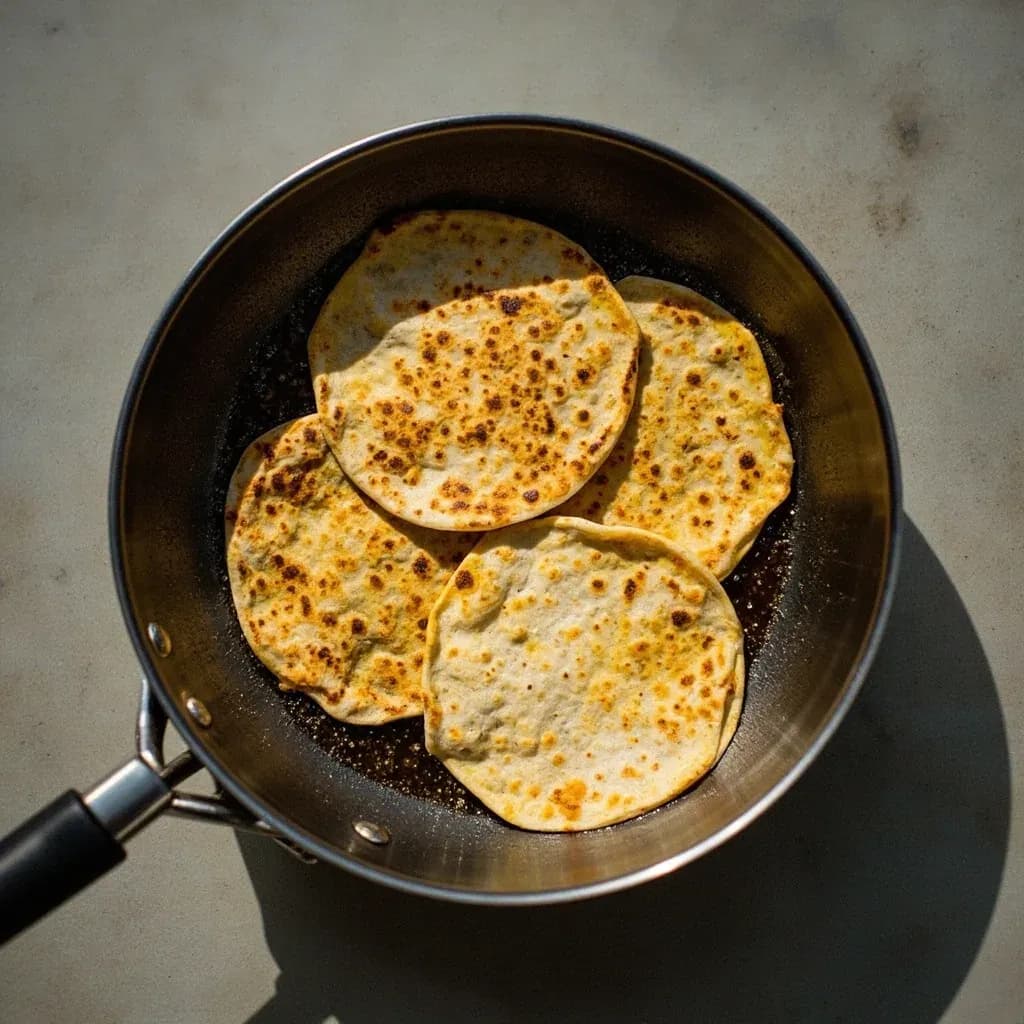
Frying is the general technique of cooking food in hot fat, spanning everything from quickly crisping tortillas to frying up rice and beans. The fat conducts intense heat that browns surfaces and develops flavor through the Maillard reaction. Choosing the right amount of fat and heat level determines whether food crisps, sears, or simply softens.
Frying is the technique of cooking food in hot fat — from a paper-thin film that barely coats a skillet to a deep bath in which the food floats freely. Despite the range, the underlying physics is the same: heat from the oil rapidly drives surface water out of the food, then drives the Maillard reaction between amino acids and reducing sugars, along with sugar caramelization, to build a crisp, flavorful crust. That crust does double duty, slowing further moisture loss from the interior and producing the contrast of crunchy outside and tender within that defines nearly every fried dish. The single variable that determines success or failure is oil temperature relative to the food's water content.
What separates good frying from greasy frying is almost entirely a matter of keeping the oil hot enough — usually 325 to 375 °F (165 to 190 °C) for most work — and not overloading the pan. Oil that is too cool lets water linger on the food's surface, which both steams instead of sears and gives the food time to absorb fat; oil that is too hot scorches the crust before the interior cooks. A reliable clip-on or deep-fry thermometer and small, patient batches fix the great majority of home frying problems, and the rest are usually about choosing the right oil for the temperature and the flavor you want.
The named variants of frying — pan-frying, sautéing, stir-frying, deep-frying, confit, and the rest — are not different techniques so much as different equipment and cut sizes applied to the same principle. Treating them as distinct skills, with their own pan, oil depth, and target temperature, is what lets a single cook move confidently from a buttered egg to a kettle of doughnuts.
- Difficulty
- Easy
Types & varieties
Food cooked in a shallow layer of fat, typically ⅛ to ½ inch deep, in a skillet; used for cutlets, eggs, pancakes, and fillets.
Food fully submerged in hot oil in a deep pot or fryer; used for doughnuts, French fries, tempura, and breaded chicken.
Small or thin pieces tossed or stirred in a thin film of fat over medium-high to high heat in a wide pan.
Chinese and broader East Asian technique using a wok, very high heat, a small amount of oil, and constant motion; food is typically cut small for fast cooking.
Slow-cooked submerged in fat at low temperature (around 180–200 °F / 82–93 °C), traditionally as a preservation method for duck, garlic, and pork.
Brief immersion in very hot oil to set a coating, finish a previous cooking step, or crisp the surface before a second fry.
Two-stage deep fry, common for French fries and Korean-style chicken: a first fry at lower temperature to cook through, a second at higher temperature to crisp.
Cooking in a hot pan with no added fat, relying on the food's own renderings (bacon, chorizo, minced cumin or coriander seed).
How to do it
- 1
Select the fat
Match oil to task: neutral, high-smoke-point oil (peanut, canola, sunflower, rice bran, or refined olive) for deep frying and high-heat pan work; butter, ghee, or extra-virgin olive oil for shallow work where flavor matters. Confirm the smoke point is at least 25–50 °F above your target cooking temperature.
- 2
Heat to the correct temperature
Pour oil to the required depth (about 1 inch for shallow frying, enough to fully submerge food plus clearance). Heat slowly and attach a thermometer to the side of the pan, the bulb in the oil but not touching the bottom. Common targets: 325 °F for potatoes and dense vegetables, 350 °F for breaded chicken and fish, 375 °F for doughnuts and thin batters.
- 3
Prepare the food
Cut to even thickness so pieces cook at the same rate. Pat completely dry with towels — surface moisture is the chief cause of splattering and of greasy results. Season lightly, dredge in seasoned flour, dip in egg wash, and coat in breadcrumbs or batter only just before frying, so coatings stay dry and adhere well.
- 4
Add food carefully
Lower food away from you using tongs, a slotted spoon, or a fry basket so oil does not splash toward you. Add pieces one at a time and in small batches — never more than a single layer that covers the pan surface, and never more than one-third full in a deep pot.
- 5
Monitor and turn
Adjust heat to hold the target temperature; expect a 10–25 °F drop when food first goes in, and wait for it to recover. Turn food only when the underside is deeply golden and releases easily; constant turning prevents proper crust formation. For deep frying, gently agitate or turn pieces midway through the cook.
- 6
Finish and drain
Remove food when the interior reaches a safe temperature (165 °F for poultry, 145 °F for fish, 160 °F for ground-meat or breaded items) and the crust is the desired color. Lift out and let oil drip back into the pot, then transfer to a wire rack set over a sheet pan so air circulates and the crust stays crisp.
- 7
Season and serve immediately
Salt or finish with a flavored salt as soon as the food comes out of the oil, while the surface is still hot and slightly oily — salt adheres best at this moment. Serve within a few minutes for maximum crispness.
The science in plain terms
When food enters hot oil, three things happen in quick succession. First, the surface water vaporizes — you can hear and see it as bubbling. While that water is boiling off, the food's surface cannot climb above 212 °F, so the crust cannot form. Once the surface dries out, temperatures there rise rapidly past 300 °F and the Maillard reaction between amino acids and reducing sugars, along with sugar caramelization, builds the brown, flavorful crust. Inside the crust, the food is essentially being steamed in its own moisture, which is why a properly fried chicken breast can emerge juicy even though the exterior is dry and crisp. Oil absorption is mostly a surface phenomenon: a thin, well-browned crust actually repels further oil, while a pale, slow-cooked surface is spongy and soaks it up.
Choosing oil by smoke point and flavor
Smoke point is the temperature at which an oil breaks down and gives off acrid smoke and off-flavors. It is not a single number but a range that falls as the oil is used, contaminated with food bits, or heated repeatedly. Match the oil to the job rather than reaching for the highest smoke point you can find: neutral, high-smoke-point oils such as peanut, canola, sunflower, and rice bran for deep frying and high-heat pan work; butter, ghee, or extra-virgin olive oil for shallow frying where flavor is the point.
How much oil is enough
For pan-frying and sautéing, the oil should be enough to coat the pan and pool slightly under the food — about 1 to 2 tablespoons in a 10-inch skillet for sauté, ⅛ to ½ inch for shallow frying. For deep frying, use enough to submerge the food with at least 2 inches of clearance to the rim of the pot, and never fill the pot more than one-third full to leave room for bubbling and for the food's own displacement. A Dutch oven or heavy stockpot is the usual home vessel; a narrow saucepan leaves no margin for safe boiling.
Common uses
Tips & pitfalls
- Pat food completely dry before frying — surface water drops oil temperature and causes splattering and greasy results.
- Use a thermometer; guesswork is the most common cause of failed fried food. Aim for the right band for the food, not the maximum heat your oil can take.
- Do not crowd the pan. Adding too much food at once drops oil temperature below the boiling point of water, so the food steams in oil instead of frying — the most common home-frying mistake.
- Salt only after frying when possible; salt on wet or raw surfaces pulls out moisture and inhibits browning.
- Choose oil by smoke point and flavor: neutral high-smoke-point oils (peanut, canola, sunflower, rice bran) for deep frying; butter, ghee, or olive oil for shallow work where flavor matters.
- Maintain oil temperature between batches; let it recover for 30–60 seconds before adding the next portion, and adjust the burner to hold the band.
- Drain finished food on a wire rack set over a sheet pan, not on paper towels — steam trapped underneath softens the crust.
- Reuse frying oil only when it is still clear and light-colored and not smoking below its normal temperature; discard if foamy, dark, or viscous.
- Test oil with a small piece of bread or a pinch of flour: it should sizzle immediately and turn golden within 30–45 seconds at correct temperature.
- Adhere batters and breadings just before frying so they do not absorb moisture from the food and slough off in the oil.
Good to know
- Definition
- Cooking food in hot fat or oil, ranging from a thin film that just coats the pan to a deep bath in which food is fully submerged.
- Primary mechanism
- Rapid surface dehydration, Maillard browning, and caramelization, which together produce a crisp crust and concentrate flavor.
- Temperature range
- Typical cooking oil 325–375 °F (165–190 °C); most vegetable oils reach usable temperature around 350 °F.
- Smoke point relevance
- Frying oil should have a smoke point well above the target cooking temperature; peanut, refined sunflower, canola, and refined olive oil are common choices, with rice bran another high-heat option.
- Origin
- One of the oldest documented cooking methods; deep-frying in olive oil is recorded in ancient Mediterranean and Middle Eastern cooking, with later refinement across European and East Asian cuisines.
- Oil absorption
- Properly fried food absorbs only a thin surface layer (a few percent of weight); oil that is too cool causes heavy absorption.
- Time per item
- Thin-cut vegetables 1–3 minutes; breaded cutlets 4–6 minutes; thick chicken pieces 8–12 minutes; doughnuts 2–4 minutes per side.
- Safety
- Never add water or wet food to hot oil; have a lid or metal sheet pan nearby to smother flare-ups; never leave hot oil unattended.
- Reusing oil
- Strain through fine mesh or cheesecloth once cool, store in a sealed jar, and reuse 2–4 times if still clear, light, and not smoking below its normal temperature.
Also called
Frying Tortillas
Dishes that rely on it
Related

Sear
Blast the surface hot for a deep-browned, savory crust

Sauté
Cook quickly in a little fat over lively heat, tossing as you go

Stir-Fry
Toss bite-sized pieces over roaring heat for fast, smoky cooking

Pan-Fry
Crisp food in a shallow layer of hot fat, turning once or twice

Deep-Fry
Submerge in hot oil for an all-over crackling crust

Roast
Cook uncovered in dry oven heat for browned edges and tender centers

Bake
Cook with steady, surrounding oven heat — the soul of bread and pastry

Broil
Hit food from directly above with fierce overhead heat