Heat & Fire
Shallow-Frying
Frying food in oil reaching partway up its sides for a crisp crust on two faces.
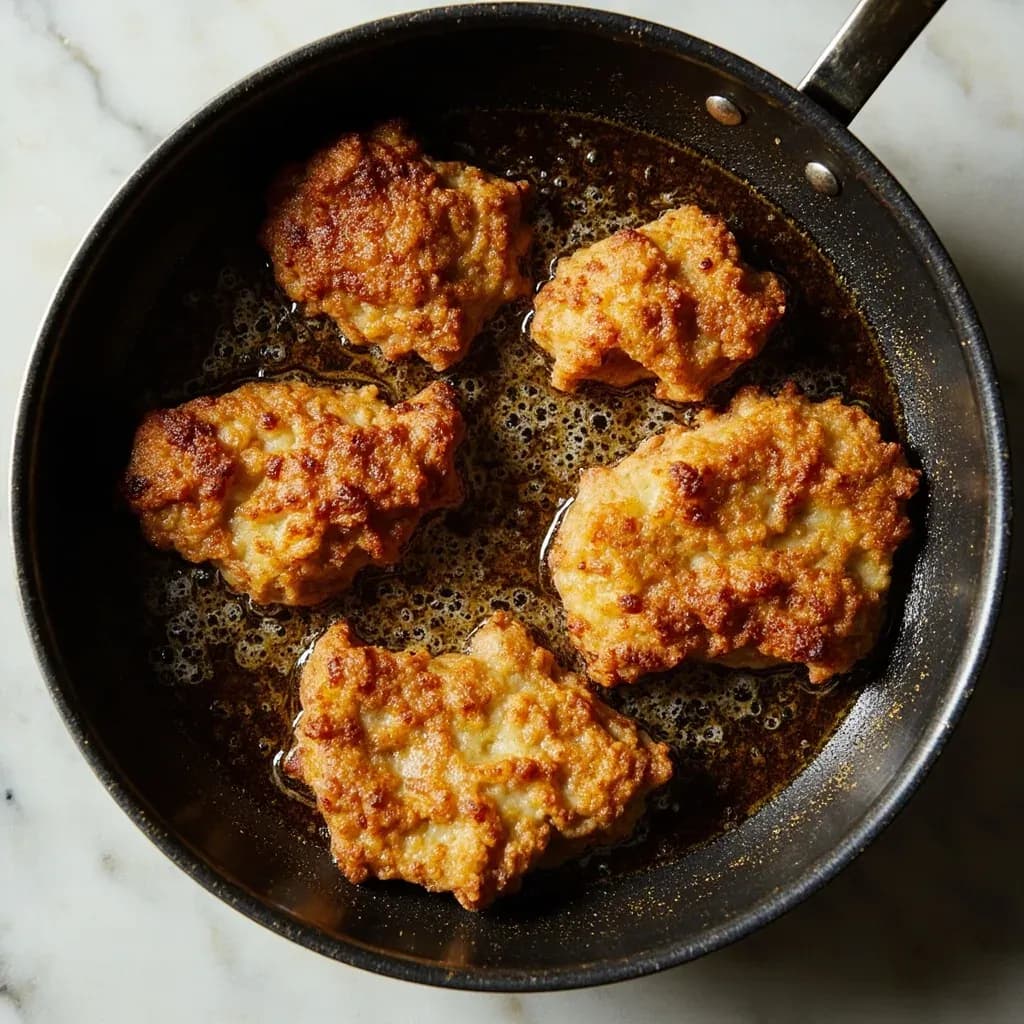
Shallow-frying uses enough oil to come partway up the food so it crisps on the bottom, then is flipped to crisp the other side. It sits between pan-frying and deep-frying, suiting cutlets, fritters, and breaded items too thick to submerge economically. The exposed top stays uncrisped until flipped, giving control over each side's color.
Shallow-frying is the workhorse method for turning a flat piece of food — a pounded cutlet, a fish fillet, a potato cake — into something with a uniformly golden, audibly crisp crust and a tender, just-cooked interior. It is defined by geometry: a measured pool of hot fat that climbs partway up the sides of the food rather than submerging it. That halfway-up relationship is the key. Enough oil to conduct heat into the food and crisp the coating through contact, but not so much that the food floats, cools the oil, and cooks without ever touching the pan. The crust is the goal, and it is built by the Maillard reaction and rapid surface dehydration, both of which need temperatures well above boiling.
What separates shallow-frying from its closest cousins is intent and equipment. Sautéing uses a film of fat and tosses the food; deep-frying fully submerges it; shallow-frying leaves the food alone, lets one side set into a crust, then flips it once. A heavy pan matters more than almost any other variable, because a thick slab of metal keeps the oil from plunging in temperature when cold food hits it. Done right, the food absorbs only 8–12% of its weight in oil; done with oil that is too cool or a pan that is too crowded, that figure can double and the result is greasy rather than crisp.
Shallow-frying is also the foundation beneath dozens of national classics — cotoletta, Wiener schnitzel, tonkatsu, milanesa, latkes, pakoras, quesadillas, gyoza — and the sear that opens almost any braise or stew. The skills it teaches (temperature control, breading discipline, restraint with the spatula) transfer to nearly every other hot-pan technique a cook will ever use.
- Difficulty
- Easy
Types & varieties
Often used as a synonym for shallow-frying; sometimes refers to a slightly drier method with oil only coating the pan.
Minimal fat, high heat, food is tossed or moved; browning rather than crusting is the goal.
Wok-based variant: very small amount of oil, constant motion, extreme heat, very fast cooking.
A brief shallow-fry to develop a browned crust on a piece that will be finished by roasting or braising.
Food is dipped in wet batter (tempura, pakora) before shallow-frying; oil is held slightly lower so the coating sets before the inside overcooks.
Food is breaded with dry crumbs (schnitzel, tonkatsu, milanesa) before shallow-frying; the most iconic shallow-fried format.
How to do it
- 1
Set up the station
Arrange three shallow trays or plates: seasoned flour (with salt and pepper), beaten egg mixed with a splash of water or milk, and fine dry breadcrumbs or panko. Place a wire rack over a sheet tray nearby for draining.
- 2
Prepare the food
Pound cutlets to an even thickness of about 1–1.5 cm, score the edges to prevent curling, and pat completely dry with paper towels. Season lightly with salt just before breading.
- 3
Bread the food
Coat each piece in flour, shake off the excess, dip fully in egg, then press firmly into breadcrumbs so an even, cohesive layer forms. Rest the breaded pieces on a rack for 5–10 minutes so the coating sets.
- 4
Heat the pan and oil
Add oil to a depth of about 1 cm (roughly ½ in) in a heavy skillet and heat over medium to medium-high until it shimmers and reaches 170–180 °C. Test with a breadcrumb — it should sizzle and turn golden within about 10 seconds.
- 5
Lay the food in carefully
Gently lower each piece away from you to avoid splashing. Lay it flat in a single layer with at least 2 cm between pieces. Do not move it once placed.
- 6
Fry the first side
Cook undisturbed for 2–4 minutes, until the underside is deep golden and the edges look set. Lower the heat if the crust is darkening too quickly.
- 7
Flip and finish the second side
Turn once with a wide spatula, supporting the food so the crust does not tear. Fry another 2–4 minutes until the second side is equally golden and the interior reaches a safe temperature (74 °C for poultry, 63 °C for pork and veal).
- 8
Drain and rest
Lift onto the wire rack, tilt briefly to let excess oil run back into the pan, then rest 2–3 minutes so juices redistribute and the crust re-crisps.
- 9
Check and serve
Confirm doneness with an instant-read thermometer for anything thicker than 1.5 cm. Salt while hot and serve immediately for maximum crust contrast.
The three-stage breading
Most classic shallow-fried dishes — schnitzel, cotoletta, tonkatsu, milanesa, katsu curry — share the same Central European breading system, refined in Viennese and northern Italian kitchens and now global. The sequence is flour, egg, crumbs, and each stage has a job.
- Flour: dries the surface and gives the egg something wet to cling to. Season it lightly with salt and pepper.
- Egg: thinned with a splash of water or milk for a dippable consistency. It bridges the dry flour and the dry crumbs.
- Breadcrumbs: fine, dry, and pressed on firmly so they form a cohesive sheet. Panko gives a shatteringly crisp, textured crust; fine dried crumbs give a smoother, more uniform one.
- Rest 5–10 minutes after breading so the crumbs hydrate slightly and bond to the food; skip this and the coating often falls off in the oil.
Choosing the fat
The fat you choose is doing two jobs at once: conducting heat into the food and contributing flavor. The trade-off is almost always between smoke point and taste.
- Refined neutral oils (sunflower, canola/rapeseed, peanut, grapeseed) handle the highest temperatures cleanly and let the food's flavor lead.
- Clarified butter and ghee add a nutty, dairy-rich note; use them for schnitzel, eggs, and paneed dishes at moderate heat (around 170 °C).
- Extra-virgin olive oil is flavorful but smokes around 190 °C, so save it for low-temperature Mediterranean pan-fries (a thin eggplant slice, a piece of halloumi).
- Lard and rendered bacon fat give exceptional crust and flavor for potato dishes, latkes, and rösti, though they are best saved for moderate heats.
Draining and resting
What happens in the ten seconds after the food leaves the oil matters as much as what happened in the pan. The crust is still releasing steam, and where that steam goes decides whether it stays crisp.
- Drain on a wire rack set over a sheet tray; air circulates all around the piece and the underside does not soften.
- Avoid paper towels or a flat plate — trapped steam condenses under the food and turns the bottom of the crust leathery.
- Let the piece rest 2–3 minutes so the juices redistribute and the crust re-crisps from its own residual heat.
- Salt at this stage, not before frying; salt pulls moisture from the coating and will steam it from within.
Common uses
Tips & pitfalls
- Preheat the oil fully before adding food — test with a small breadcrumb; it should sizzle and turn golden in 8–12 seconds.
- Pat food dry before breading; surface moisture causes oil to splatter and prevents a crisp crust from forming.
- Salt breaded items after frying, not before — salt draws moisture out of the coating and steams the crust from within.
- Do not overcrowd the pan; leave at least 2 cm between pieces so steam can escape and the oil recovers temperature between additions.
- Allow the oil to return to temperature between batches — a heavy pan shortens this recovery and keeps the crust consistent.
- Flip only once with a wide metal spatula, supporting the food so the crust stays intact.
- Drain on a wire rack over a tray rather than on flat paper towels — trapped steam softens the underside.
- Finish thick or stuffed cuts in a 180 °C oven to reach a safe internal temperature without burning the crust.
- Common mistakes: oil too cool (greasy, pale food), oil too hot (scorched crust, raw interior), flipping too early (crust tears off), and seasoning too far ahead (soggy breading).
Good to know
- Definition
- Cooking food in a thin layer of preheated fat in an open pan, with oil typically reaching halfway up the sides of the food — less than deep-frying, more than sautéing.
- Oil depth
- Roughly 0.5–2 cm (¼–¾ in), enough to come partway up the food but not submerge it.
- Oil temperature
- Usually 170–180 °C / 340–355 °F; lower (around 160 °C) for wet batters, higher (180–190 °C) for thin breaded cutlets and patties.
- Smoke point requirement
- Use a refined oil with a smoke point of at least 200 °C — refined sunflower, canola/rapeseed, peanut, grapeseed, or clarified butter/ghee.
- Pan material
- Stainless, cast iron, carbon steel, or hard-anodized aluminum hold heat best; thin pans create hot spots and uneven browning.
- Time per side
- Typically 2–4 minutes per side for thin cutlets under 1.5 cm thick; thicker pieces may need finishing in the oven.
- Fat absorption
- Properly fried breaded cutlets absorb 8–12% of their weight in oil; poor temperature control can push this above 20%.
- Relation to other methods
- Distinct from deep-frying (fully submerged), sautéing (very little fat, food tossed), and stir-frying (wok, extreme heat, constant motion).
Also called
Shallow-Fry · Goreng Cetek
Dishes that rely on it
Related

Sear
Blast the surface hot for a deep-browned, savory crust

Sauté
Cook quickly in a little fat over lively heat, tossing as you go

Stir-Fry
Toss bite-sized pieces over roaring heat for fast, smoky cooking

Pan-Fry
Crisp food in a shallow layer of hot fat, turning once or twice

Deep-Fry
Submerge in hot oil for an all-over crackling crust

Roast
Cook uncovered in dry oven heat for browned edges and tender centers

Bake
Cook with steady, surrounding oven heat — the soul of bread and pastry

Broil
Hit food from directly above with fierce overhead heat