Heat & Fire
Frying Aromatics (Tempering / Bloom in Oil)
Sizzling garlic, ginger, spices, or paste in hot oil to bloom their flavor into the fat.
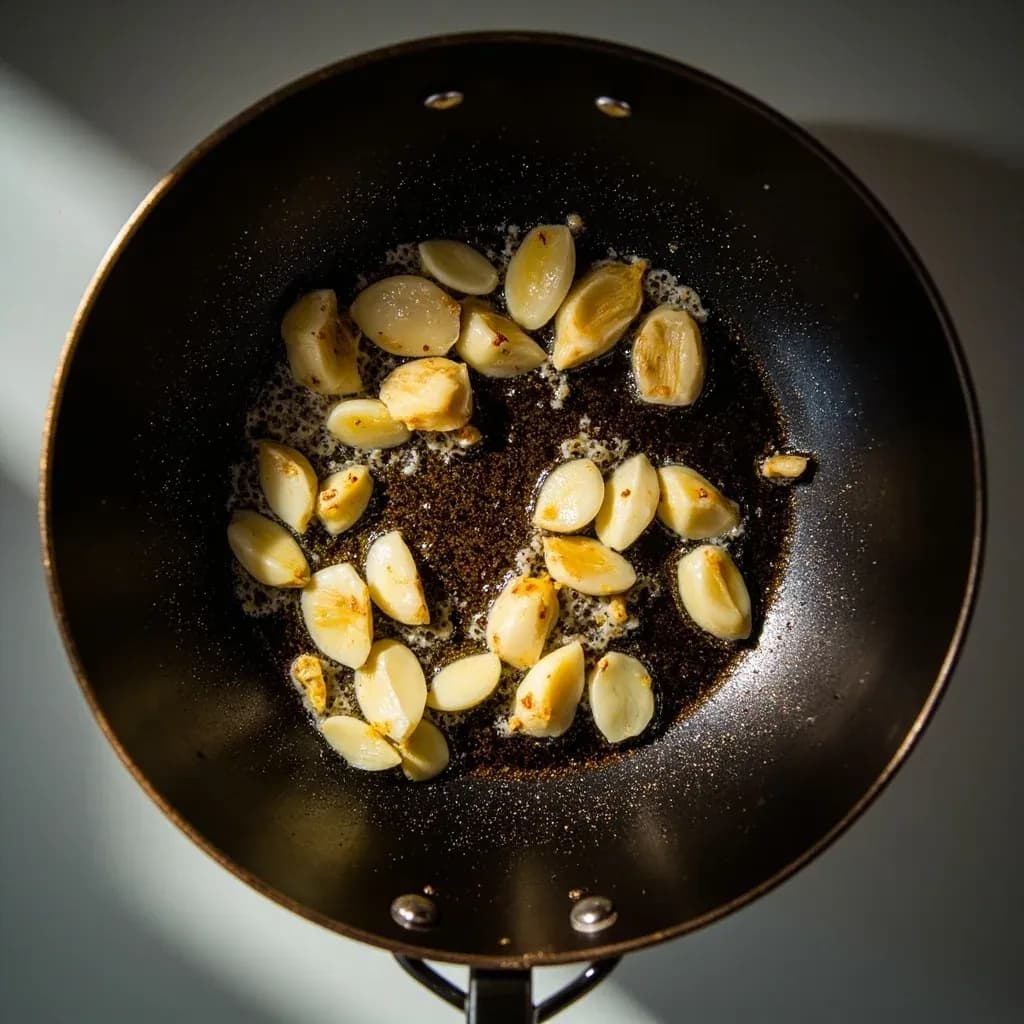
Frying aromatics sizzles garlic, ginger, scallions, spices, or chili paste in hot oil so their fat-soluble flavor compounds dissolve into the oil, perfuming the whole dish. Known as bao xiang in Chinese cooking and tadka or tempering elsewhere, it is the fragrant opening or finishing step of countless stir-fries, curries, and dals. The oil must be hot enough to bloom the aromatics quickly but not so hot that it scorches garlic into bitterness.
Frying aromatics — variously called tempering, tadka, blooming, or 爆香 (bào xiāng) — is the brief, deliberate cooking of spices, alliums, or paste in hot fat to release their flavor into the oil before that oil becomes either the foundation or the finishing flourish of a dish. The chemistry is straightforward but powerful: many of the most evocative compounds in spices (turmerones in turmeric, eugenol in cloves, cinnamaldehyde in cinnamon, allyl sulfides in garlic and onion, capsaicinoids in chilies) are fat-soluble. Hot fat dissolves and carries them in a way that water-based cooking cannot, and the oil then deposits that flavor on every grain of rice, every lentil, every piece of meat that follows. The technique is also the most fragile thing a cook does at the stove: once those compounds emerge, they keep cooking, and a few extra seconds turns them acrid and bitter.
Because timing is measured in seconds, not minutes, frying aromatics is best treated as a sequence of additions in descending order of density and resilience: hard whole seeds first, dried leaves and chilies next, ground spices and fresh alliums last — often added off the heat entirely. The fat, the temperature, and the size of the pan matter as much as the spice list. Ghee, mustard oil, coconut oil, peanut oil, and neutral vegetable oil all behave differently, and choosing among them is half of what gives each regional cuisine its tempering signature. The other half is the spice combination: panch phoron in Bengal, mustard-and-curry-leaf in Tamil Nadu, garlic-ginger-chili in Cantonese and broader Chinese stir-fries, achiote-onion-bell pepper in Puerto Rican and Dominican sofrito.
What makes the technique universal is that it solves the same problem everywhere: how to make a dish taste like the place it comes from, fast. A finishing tempering poured over dal, khichdi, or rasam revives a long-simmered dish with bright, toasty, almost smoky aroma; a base tempering at the start of a stir-fry or curry sets the aromatic stage for everything that follows. In both cases the cook is doing the same job — unlocking flavor with fat — and the regional names are simply the accents on a shared sentence.
- Difficulty
- Medium
Types & varieties
Whole spices (cumin, mustard, fennel, nigella, fenugreek, curry leaves, dried chilies, hing) bloomed in ghee or oil; the classic finishing move for dal, kadhi, khichdi, sabzi, and raitas.
Mustard seeds popped first, then urad dal, curry leaves, dried chilies, and asafoetida; the signature finish for sambar, rasam, kootu, and poriyal.
Mustard and cumin seeds with asafoetida and curry leaves bloomed in oil; foundational for shaak and dal preparations.
Five-seed mix of cumin, fennel, nigella, fenugreek, and black mustard bloomed in mustard oil heated to its smoke point — the bedrock of Bengali flavor.
Garlic, ginger, scallion whites, and dried chilies briefly fried in hot oil as the first step of stir-fries, braises, and soups.
Wet curry paste fried in coconut cream until the oil splits and 'cracks,' concentrating flavor before the main liquid is added.
Clarified butter slowly infused with cardamom, cinnamon, cloves, cumin, fenugreek, and korerima — the spiced fat that cooks virtually all Ethiopian dishes.
Onion, garlic, peppers, cilantro, and achiote bloomed in olive oil or annatto oil as the base for rice, beans, and stews.
Mirepoix, garlic, herbs, and bouquet garni gently cooked in butter or oil as the foundation for sauces, soups, and braises.
Onion, celery, and bell pepper sweated in oil or butter as the base for gumbo, étouffée, and jambalaya.
Garlic and chili in olive oil, or rosemary and thyme in warm oil, used as a finishing condiment for bread, pasta, and pizza.
How to do it
- 1
Choose the fat for the cuisine
Match the fat to the dish. Ghee or neutral oil for North Indian tadka; coconut oil for South Indian and most Sri Lankan temperings; mustard oil (heated to its smoke point, then cooled slightly) for Bengali kasha; peanut or grapeseed oil for Chinese bào xiāng; olive oil for Mediterranean and Latin sofrito; sesame oil stirred in off-heat at the end. Use 2–4 tablespoons per batch in a small pan — a tempering in a small hot pan behaves far better than the same spices in a wide cold one.
- 2
Heat the fat to the right temperature
Bring the fat to 150–180 °C / 300–350 °F for whole spices, 120–150 °C / 250–300 °F for ground spices and fresh alliums. Visual cues: the oil shimmers, ripples, or just begins to send up the first wisp of smoke. Test with a single mustard or cumin seed — it should sizzle and crackle within 1–2 seconds. Too cool and the aromatics stew and absorb grease without releasing flavor; too hot and they scorch before they bloom.
- 3
Add whole hard seeds first
Drop in cumin, black mustard, nigella, fennel, fenugreek, or coriander seeds. Wait for mustard seeds to pop across the surface, for cumin to deepen a shade, and for fenugreek to turn reddish-brown — usually 20–60 seconds. These dense seeds need a head start because oil has to penetrate the husk to extract their flavor.
- 4
Add dried leaves, chilies, and whole sticks
Toss in curry leaves, dried red chilies, bay leaves, cinnamon sticks, green cardamom pods, star anise, or cloves. They bloom in 5–15 seconds. Curry leaves should spatter and crisp at the edges; dried chilies should darken a touch. Have the next ingredients ready — the window is closing.
- 5
Bloom ground spices, often off the heat
Sprinkle in ground turmeric, cumin, coriander, paprika, Kashmiri chili, or sambar powder. Bloom for 5–10 seconds, or pull the pan off the burner and stir. Ground spices scorch almost instantly. The oil should turn richly colored and smell toasty, not sharp or ashy.
- 6
Add minced garlic, ginger, or shallot
Stir in finely chopped or grated garlic, ginger, shallot, or scallion whites. Cook 15–40 seconds until fragrant and just turning golden at the edges. Stop the moment the raw smell disappears; over-browned garlic turns bitter fast and will dominate everything that follows.
- 7
Use the tempering
Either pour the sizzling fat and aromatics straight onto a finished dish and cover for 1–2 minutes to trap the steam, or proceed immediately with the rest of the recipe — add onions, vegetables, meat, or liquid to the infused fat as a base. Always pour the fat too, not just the solids; the infused oil is where most of the flavor lives.
- 8
Troubleshoot and recover
If the spices smell acrid, sharp, or ashy, dump the tempering and start over in a clean pan — burnt spices cannot be rescued. If the flavor seems flat, the oil was probably too cool; bloom the next batch hotter and shorter. If a finishing tempering threatens to overcook on the way to the table, slide the pan off the burner; residual heat will finish the bloom while you walk it over.
The Science in Plain Cook's Terms
Spices carry their flavor in two places: inside the cells as volatile oils (terpenes, aldehydes, phenols) and on the surface as pigments and sulfur compounds. Heat ruptures the cell walls and vaporizes the volatile oils; the surrounding fat catches those vapors and suspends them in a stable, even distribution. This is why a tempering can flavor an entire pot of dal with a teaspoon of bloomed cumin, and why a finishing drizzle of sizzling ghee over rice smells more intense than the same spices cooked into the rice itself. The catch is that these same compounds oxidize and polymerize quickly once released — which is the chemistry of burning. The window between 'bloomed' and 'burnt' is narrow, often only 5 to 15 seconds, and it narrows further as the particle size shrinks. Whole seeds can sit in hot oil for almost a minute; a fine powder of the same spice will scorch in five.
- Fat-soluble compounds: turmerones (turmeric), curcumin pigment, eugenol (cloves), cinnamaldehyde (cinnamon), allyl sulfides (garlic, onion), capsaicinoids (chili), thymol (ajwain, thyme).
- Water-soluble compounds: many of the bright top notes in cardamom, coriander leaf, and citrus zest — these do not benefit from oil blooming and are better added later.
- Whole spices release slowly because oil has to penetrate the husk; grinding multiplies surface area and accelerates both extraction and burning.
- Mustard oil is heated to its smoke point to drive off allyl isothiocyanate, the harsh compound that gives raw mustard oil its bite.
The Two Tempering Modes: Base vs. Finish
A base tempering is the first thing that goes into the pan, and its infused fat becomes the medium in which onions, vegetables, meat, or rice are cooked. A finishing tempering is poured sizzling over a fully cooked dish at the last moment, often covered to trap the steam. Both rely on the same chemistry, but they are timed differently. A base tempering has more leeway: once the onions go in, the pan cools, the spices stop cooking, and the flavor is locked in. A finishing tempering has almost no leeway at all — the spices bloom in the ghee and immediately begin to darken, so the cook is racing the clock to get the pan from burner to table in seconds. Indian dals, rasam, and khichdi are the classic finishing-tempering targets; the same tempering poured over the dish at the start would cook out long before the lentils softened.
Common uses
Tips & pitfalls
- Mise en place is non-negotiable: have every aromatic measured, chopped, and within arm's reach before the oil goes on. Once spices hit hot fat, you have seconds, not minutes.
- Test oil readiness with one mustard seed or cumin seed. If it sizzles and crackles within 1–2 seconds, the oil is ready. If it sits silently, wait; if it smokes instantly, cool the pan.
- Add ingredients in descending order of density and resilience: hard whole seeds first, dried leaves and chilies next, ground spices and fresh alliums last. Skipping the order is the most common way temperings turn bitter.
- For ground spices and curry leaves, pull the pan off the burner before adding them. Residual heat blooms them in 5–10 seconds without scorching — this single change eliminates most burnt-tadka disasters.
- If a tempering burns, discard it and start over. There is no saving scorched spices; their acrid compounds will leach into anything they touch and ruin the dish.
- Listen for the sustained sizzle when frying curry leaves — a few seconds too few and they stay grassy, a few seconds too many and they turn bitter.
- Heat mustard oil to its smoke point before tempering to drive off the harsh raw bite, then let it cool 10–15 seconds so the spices don't scorch on contact.
- Always pour both the infused fat and the solids onto the finished dish. The oil is carrying most of the flavor; leaving it in the pan is leaving flavor behind.
Good to know
- Also known as
- Tempering, tadka/chaunk/tarka (Hindi), phodni (Marathi), vaghaar (Gujarati), thalippu/poppu (South Indian), 爆香 bào xiāng (Chinese), faire revenir (French), sofrito/recaito (Latin American/Mediterranean), bloom
- Core principle
- Hot fat extracts fat-soluble flavor and aroma compounds (terpenes, pigments, sulfur compounds, capsaicinoids) from spices and alliums, then carries that flavor into the dish
- Oil temperature
- 150–180 °C / 300–350 °F for whole spices; 120–150 °C / 250–300 °F for ground spices, garlic, ginger, and curry leaves, which scorch in seconds
- Time per batch
- Whole hard seeds 20–60 seconds; dried leaves and chilies 5–15 seconds; ground spices 5–10 seconds; minced garlic/ginger 15–40 seconds
- Fats used
- Ghee, mustard oil, coconut oil, peanut oil, neutral vegetable oil, olive oil, sesame oil (stirred in off-heat at the end)
- Difficulty
- Conceptually simple, timing-sensitive — burnt spices cannot be rescued and will make the entire dish taste acrid
- Equipment
- Small heavy pan or tempering ladle (Indian tadka pan), wok, small saucepan, or a ladle held directly over a flame
- Two modes of use
- Base tempering at the start of cooking, or finishing tempering poured sizzling over the dish just before serving
Also called
Tempering · Tadka · Blooming Spices · Bao Xiang · 爆香
Dishes that rely on it
Related

Sear
Blast the surface hot for a deep-browned, savory crust

Sauté
Cook quickly in a little fat over lively heat, tossing as you go

Stir-Fry
Toss bite-sized pieces over roaring heat for fast, smoky cooking

Pan-Fry
Crisp food in a shallow layer of hot fat, turning once or twice

Deep-Fry
Submerge in hot oil for an all-over crackling crust

Roast
Cook uncovered in dry oven heat for browned edges and tender centers

Bake
Cook with steady, surrounding oven heat — the soul of bread and pastry

Broil
Hit food from directly above with fierce overhead heat